

Dear Friends,
Below are 33 thoughts on the Democrats potentially forcing a government shutdown to combat excesses of the Trump administration.
The Lay of the Appropriations Land
The annual appropriations for fiscal year 2025 (FY25) will expire at the end of the month. If appropriations bills for FY26 (or a continuing resolution (CR) providing temporary funding) are not enacted into law by then, there will be a lapse in appropriations and a government shutdown.
Annual appropriations bills are subject to a filibuster in the Senate, requiring 60 votes to end debate in the face of minority opposition. Consequently, the politics of appropriations are inherently bipartisan; you always end up with a deal, and no one gets exactly what they want.1 Brinksmanship, bluffing, and public messaging are routine features at the top level. True bipartisanship also appears around specific programs and projects at the lower levels.
This year, the politics have been complicated by the aggressive attacks by the Trump administration on congressional spending authority. Under the terms of the Impoundment Control Act, the president and Republicans in Congress rescinded $9B of FY25 money on a party-line vote. The administration has also (IMO, illegally) refused to spend or otherwise withheld other appropriations enacted into law, claimed the authority to conduct so-called pocket-rescissions, and promoted a (IMO, nonsense) theory of presidential constitutional impoundment authority.
Coming soon to a Capitol building near you? Whatever you think of these administration moves as substantive policy or constitutional law, they have blown up the negotiating process in Congress. How can you have a bipartisan negotiation over spending if the executive has no intention of executing the deal in good-faith?
Democrats are also concerned about general lawlessness in the Trump administration. Donald Trump didn’t invent the increasing presidential encroachment on spending authority, but he has taken it to 11 in ways that former presidents of both parties never would have dreamed. And it’s not just on spending; Trump appears to be pushing every possible boundary of norms and law across the executive branch. At DOJ. With personnel. Personally profiting off the office. Putting troops in American cities and threatening “war” on them. It’s pretty obvious that he believes there are no legitimate statutory restraints on presidential power.
Consequently, a number of prominent liberals are advocating for the Senate Democrats to force a government shutdown as a strategic move against the administration’s encroachments on the spending power and, to a lesser extent, Trump’s general lawlessness. Ezra Klein makes the case here. Josh Marshall here. Brian Beutler here. Lots of Democrats are itching to do something and shutting down the government is certainly something they can do.
It’s also a terrible idea. It’s bad policy. It’s worse politics. And it won’t work.
Shutdowns are Bad Policy
Now, government shutdowns do not affect all government services. Under the terms of the Anti-Deficiency Act, certain government activities can continue in the absence of funding. For example, the military and federal law enforcement activities continue to operate. IRS continues to collect tax revenue. And programs with mandatory spending in law, such as social security and Medicare, are largely unaffected.
But a whole lot of programs that you might consider essential do stop operating. FDA inspections have been delayed in past shutdowns. EPA inspections have stopped. NIH grants don’t go out. SNAP and TANF benefits may halt.
And many government activities—including safety and security programs—are strained. Federal employees who resent having to work while missing paychecks have refused to show up for work, leading to long lines at TSA and a shortage of air-traffic controllers. Less concerning but no less annoying to the public are the closing of national parks facilities around the country and tourist attractions in DC.
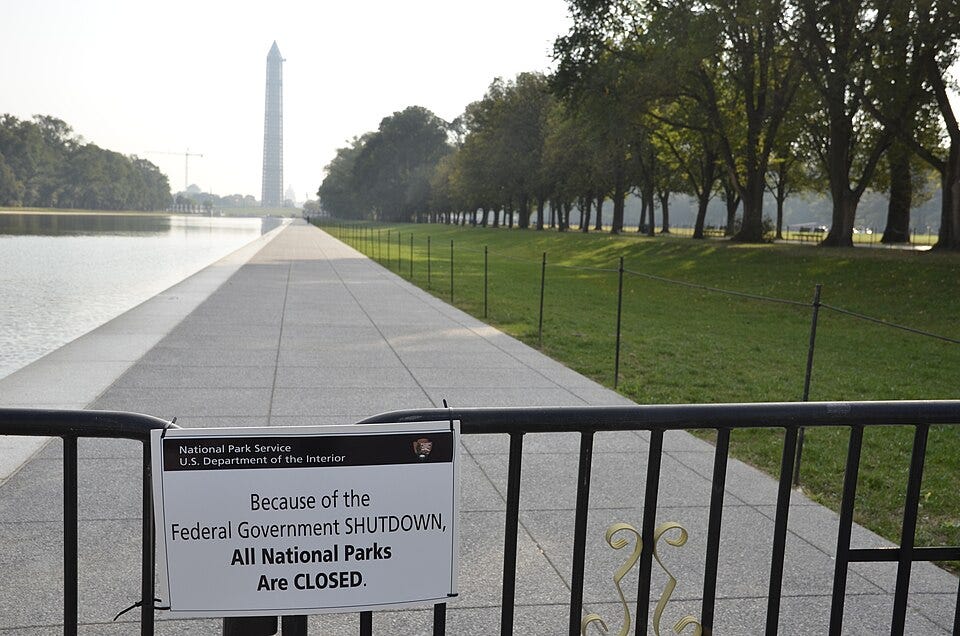
Not a great way to endear yourself to swing voters Shutdowns also put agencies in limbo. Without current year funding numbers, agencies cannot budget or plan properly. New program starts are not allowed. Employee salaries—whether they are working or furloughed—are delayed. Contractors don’t get paid, at all. And all of this is most acutely felt at the worst possible place, the Department of Defense, where uniformed soldiers work while missing paychecks and a massive number of programs are thrown into chaos. Even a CR is terrible for DoD; a shutdown is all that and more.
Strategic Shutdowns Are Bad Politics
It’s tempting for parties to play hardball and try to use a government shutdown to force action on specific policy issues. The theory is that the shutdown will either cause enough pain for the other party that it will come back to the bargaining table ready to offer concessions, or that public opinion will turn against the other party and those shutting down the government will reap future electoral benefits.
The problem is that it has basically never worked. The party trying to leverage the shutdown doesn’t get the other side to the bargaining table; instead, the other side simply demands an unconditional reopening of the government while pointing out all the ways the shutdown is hurting defense, federal workers, and people trying to go to Yellowstone. Public opinion turns against those trying to leverage the shutdown, and they eventually cut a face-saving deal. As Jonathan Bernstein—who’s not totally anti-shutdown—said today, shutdowns are “utterly useless as negotiating tactics.”
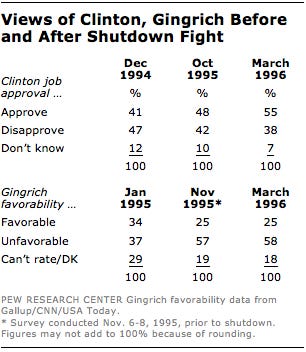
There have been four more-than-a-day shutdown showdowns in the modern era. The party trying to leverage the shutdown always loses the public opinion battle. True for the Gingrich Republicans in 1995. True for the Ted Cruz Obamacare opponents in 2013. True for the Trump border-wall shutdown in 2019. And true for the Senate Democrats in 2018 (they folded in two days over a weekend, arguably not an actual, technical shutdown).
I see some people saying there are no lasting political impacts of shutdowns, and that you may lose public opinion for a bit, but you don’t pay an electoral price. I’m very skeptical. It’s hard, of course, to isolate the variables, but in my view, for example, the 1995 Gingrich shutdown basically destroyed the Republican brand, neutered Gingrich as a national leader, and launched the Clinton turnaround from the 1994 drubbing.

Gingrich never really recovered from 1995 The bottom line is you really can’t find a party that caused a strategic shutdown and came out politically better off on the other side of it. One retort to this is that what you can do is avoid being blamed for the shutdown. Every party seems to think they can win the public opinion battle. But as far as I can tell, no one has ever achieved it. And this year, it would be overwhelmingly obvious who wanted and caused the shutdown, because the only people arguing for it are a faction of Democrats.
Filibuster shutdowns are the dumbest of them all. It’s one thing to cause a strategic shutdown when you control the entire legislative branch and are fighting with the president. That has some small-d democratic merit. There’s even a weak but real case for it when you control one chamber of Congress. But using the filibuster to force a shutdown opposed by the House, Senate, and president is more folly than strategy, and will be viewed by the public as such. You won’t avoid the blame.
A Dem shutdown now would be especially disastrous
As described above, a strategic shutdown will not improve your bargaining position on the substantive policies in the bills. It just doesn’t work. There’s simply no way that the end result of a shutdown is going to be the president signing a bill in defeat, which severely limits his forward going ability to encroach on the spending power and/or cleans-up the lawless excesses of the administration. I would literally bet my house on it.
Consequently, advocates for a shutdown tend to rely on the ability to create a crisis moment that focuses public attention and shifts future politics in favor of those shutting down the government. This is basically the Klein argument: if you create a spectacle and get everyone paying attention, you can inform the public and make your case. The administration will then be faced with an awful choice: relent on their excesses or get punished badly in the next election. It’s not an obviously wrong theory, per se.
The reason it’s wrong is practical: it won’t work. The Democrats will obviously own the shutdown, public opinion will marginally move against them, their coalition and enthusiasm for the shutdown will wane, and they’ll cut the same or marginally worse deal than what they would have cut had they not caused the shutdown. Not only no policy gain, but also no political/electoral gain.
Or, maybe they will dig in and stay unified! That still won’t achieve their objectives. When push truly comes to shove, Senate majorities simply rewrite the rules of minority obstruction. At some breakpoint, the Republicans will use the shutdown to nuke the filibuster in the Senate and pass a set of party-line appropriations that give the Democrats nothing. Will that happen? It’s not likely—the Republicans will be much more in the mood to just force the Democrats to vote over and over again on opening the government as the public pressure to cave ramps up. But will it happen before Trump gives in and cuts a deal that limits his authority to Democrats liking? For sure.2
(Right now, it looks like the big ask for the Democrats in the negotiations is going to be the extension of Obamacare subsidies that are set to expire. For many liberals, that’s small beer in the face of the perceived stakes. And they worry that Trump will renege on it, or or any number of other deals they cut. But this oversells the amount of executive tinkering with spending by a lot, especially relative to a party-line bill written by Republicans. And honestly, the president refusing to spend widely popular healthcare money would be a better electoral gift to Democrats than anything they could gin up in a shutdown.)
Even worse, a shutdown might rehabilitate Trump and the GOP. Whatever else you might hear, he’s wildly unpopular. He’s underwater on almost every major issue. And the spending power fight has divided his party, with major appropriations leaders and other Senators breaking with him on pocket rescissions and funding cuts. All of that would be reversed in a shutdown. Trump—holding the presidential advantages of media and coordination—will parade around talking about the disastrous “Schumer Shutdown.” He’ll use his marginal discretion—as Obama did—to close high-visibility popular government operations, like national parks. The GOP will universally back him. And the issue will divide the Democrats, with centrists in both chambers objecting to the gambit.
A very important rule of party politics is that you should do things that unite your coalition and divide the opposition, and avoid things that do the opposite. The classic historical example is the civil war. Slavery tended to unify the South and divide the north. But secession tended to unify the North and divide the South. Once the terms of debate shifted from slavery to secession, the North immediately gained an advantage. Shifting the debate from Trump’s power grabs to a Democratic shutdown flips the party politics in favor of the GOP.
The politics of “do something” is not great
Hiding behind all of this is the politics of “do something.” Klein is more or less specific about it in his piece: we are in an emergency, Trump is an authoritarian consolidating power, Schumer and the Democrats didn’t shut down the government in March for strategic reasons (Trump would honor the spending bargains, or the courts would stop trump, or the markets would stop trump, etc.) , and none of that has been true. Trump undermined the deal and no one stopped him. So unless you have a better plan, a government shutdown is the default option this time around.
It’s true in politics that “something tends to beat nothing.” If I show up at the PTA meeting with a detailed plan to accomplish a goal, and you don’t like it but you have no alternative to achieve the goal, I usually win by default.3
The problem here is that doing nothing is almost certainly better electoral politics than a strategic shutdown. Remember, shutdowns don’t work. You don’t get your policy and you don’t improve your public standing. On the margin, it goes the other direction. The risk-reward ratio is really bad, not because it’s a huge risk, but because there’s basically zero reward.
This is especially true when you don’t have a plan. Klein, for his part, recognizes that for this to work, the Democrats have to have a strong messaging game that explains the stakes, the reasons for the shutdown, and the goals.
But of course no one has yet figured out what the magic explainer sauce is to win a shutdown. That’s sort of the point. There’s a very real meme quality to this whole strategy. First, shutdown government. Second, explain why to America. Third: ????. Fourth: win elections! The first “solution” everyone reaches for in politics is “we need to fix our messaging.” And that’s because it’s easier than admitting your policies need to be adjusted. Sometimes it’s true! But usually it’s just an avoidance tactic.
What “doing something” does do is satisfy the liberal wing of the party that is itching for a high-profile fight with Trump. And that’s understandable. For the wing of the party that believes Trump is a clear and present danger to the Republic, there’s nothing left to do but take drastic, risky action. A shutdown is the bare minimum; I suspect many on the left are ready to escalate to things like a general strike or other forms of direct action. By shutting down the government, Dem leaders can signal that they are not “treating Trump like normal politics.”
That’s not inherently a problem, but it is when it divides your party and turns off independents. Even if you fully believe all of this about Trump and the administration, it’s a huge problem that a non-trivial portion of Democrats do not believe it, and a huge portion of independent and swing voters definitely do not believe it. What you are actually creating is a bitter internal dispute between Democrats that will probably alienate centrists and independents who are currently skeptical of Trump but don’t see him as the existential threat that the left does.
An underlying problem here is that the liberal wing of the Democratic party doesn’t really want to go the other plausible route to electoral success: make party policy concessions toward the center that would help position the party to capture the Senate in the 2026 election. Run Senate candidates that could win in various swing states and produce more Joe Manchin or Krysten Sinema or Jared Golden type politicians in the Senate. And abandon the loser liberal issues that anchor down their chances. For many on the left, that’s no better than Republicans holding those seats. I think that’s a strategic mistake and bad reasoning, but it’s definitely a real factor.
So instead, they are advocating for a gambit to unify a coalition around the idea that Trump is unfit for office and a serious threat to the nation in a variety of ways. And trying to sell that by committing themselves to drastic action in the form of a shutdown, to elevate attention and then move public opinion. That might satisfy coalitional interests within the party, but it’s not much of a policy or electoral strategy.4
That’s quite a parlay, and one that I see little to no chance of working. The Democrats are well-positioned to win the House in 2026 and perhaps even make serious gains in the Senate. Thermostatic public opinion is real in America, and the public almost always punishes the president’s party in the midterms. Trump is incredibly unpopular and his party remains divided over a number of his major policies. It can be hard in politics to do nothing, but if the Democrats strategically shut down the government, they will likely hurt themselves on the margin electorally, for no real potential upside.
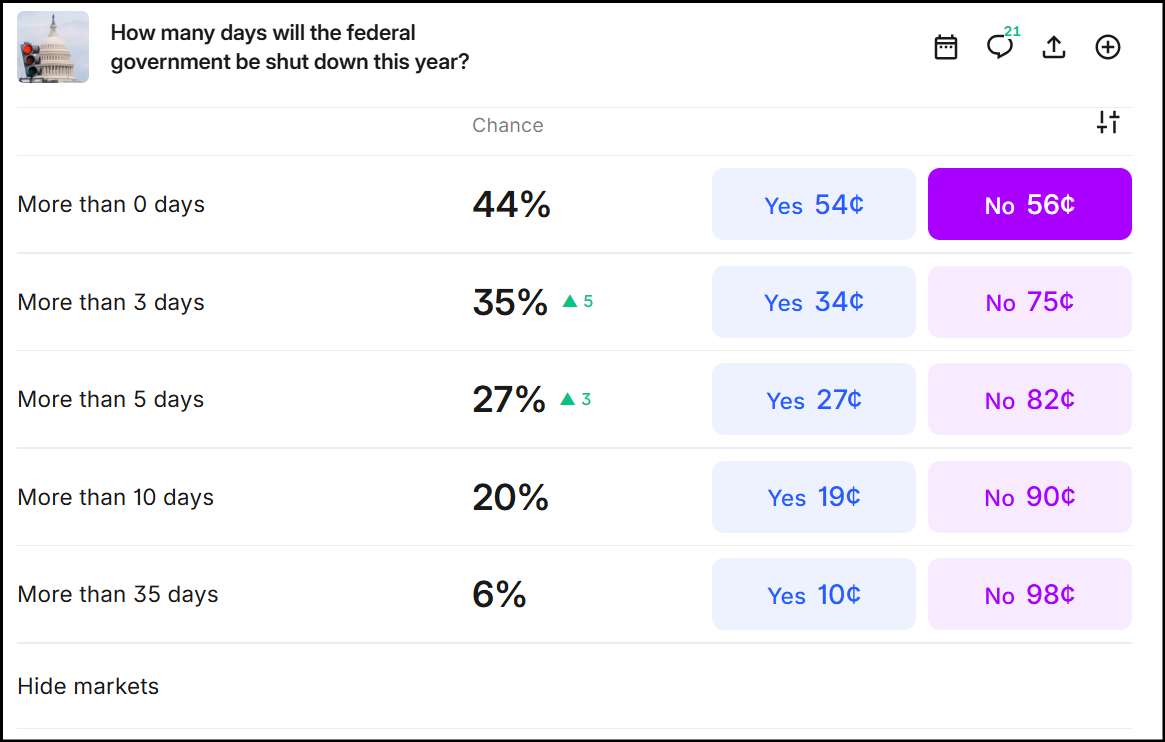
So what will happen? All of this has been a prescriptive account. As a forecasting matter, my instinct is that we won’t have a shutdown. The Senate Dems will cut a deal on the appropriations, Trump will continue various gambits to impound or otherwise shirk statutory spending in FY26, and Schumer and, to a lesser degree, Jeffries will take a lot of heat for that from their left. But I’m far from certain. Kalshi currently has any lapse in appropriations this year at 44% . I’m a seller at that price, but not by much. Put me at 2-1 (33%) or 5-2 (28%) against.
Cheers,
Matt
Especially the partisan House majority, which is often jammed by the bipartisan deal struck in the Senate.
Arguably, this might be a good outcome for Democrats in the long-run, if you think the filibuster burdens them more than the Republicans. But if the Democrats want to end the filibuster while the GOP is in control of the Senate, they can do that at any point, simply by declaring they are no longer going to filibuster anything and will formally abolish it whenever they get back in power.
This is why you should always surprise people with detailed, thought-out plans when you arrive for a group decision-making meeting. You’ll usually win. If you bring a spreadsheet or a slide deck, even better.
This is not to deny that coalition maintenance is important, it definitely is.
Yeah, Dems should not exercise any of the dwindling power they have until all of their power has evaporated. Then, they can email press releases into the void to their hearts' content.
At the very least, if they're going to do nothing, they should not extend Obamacare subsidies, either. It's bad policy and will hurt people, but Republicans chose to do it and should pay the price. Republicans have stabbed Democratic administrations in the back on economic policy time and time again to their great benefit (2010 being the most notable example.).
The Republicans won the 2014 elections handily after the 2013 shutdown. The American electorate has a very short memory.
It’s also arguably even worse politics for the Dems to not shutdown. Approval ratings for the Dem leadership fell enormously after March. If they don’t trigger a shutdown, the base will revolt against the establishment and the party will have a civil war. I personally think that could be a good thing in the long term but if you’re a congressional Dem interested in self-preservation, you would probably want to avoid a primary challenge.