

Earlier this week, I did a walk-through of the Congressional Record for a single day in the House. We covered the call to order, morning-hour debate, recesses, the prayer-journal-pledge, one-minute speeches, suspensions of the rules, voting, the yeas and nays, postponement, official communications to the House, record votes, special order speeches, and adjournment.
A lot of those things are going to happen again on this second walk-through, and when they do we will breeze by them with just a link to the other post. The focus here will be on normal-ish stuff that didn’t happen on the first walk-through.
If you have not read the part I post, I recommend doing so before reading this one.
Walking Through A Second Day in the House
Let’s start. It’s the morning of February 12, 2026.1 You crack open yesterday’s congressional record from Wednesday, February 11th and turn to the proceedings of the House. We can walk through it, letter by letter.
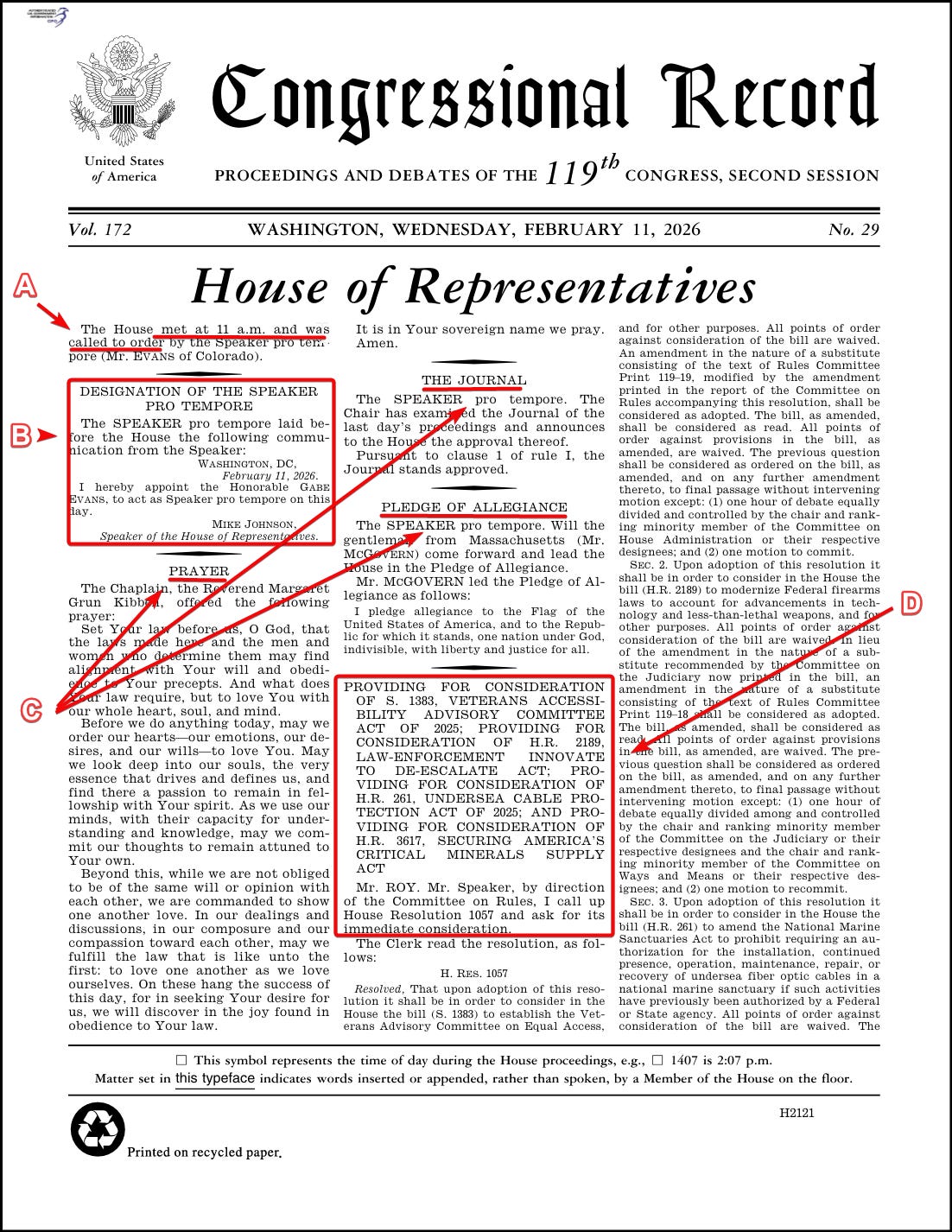
A. The House met at 11 a.m. and was called to order. Wait, why did the House meet at 11 a.m. instead of noon? And where’s the morning-hour debate? Well, the resolutions providing for the hour of meeting of the House adopted the first day of Congress and then again on the first day of the second session of Congress (H.Res.6 and H.Res.976, respectively), state that unless otherwise ordered the House will meet at noon on Wednesdays.
Likewise, the order adopted by unanimous consent from January 3, 2025 that sets up the morning-hour debate states that "when the House convenes pursuant to an order other than H.Res.6 (and superseded by H.Res.976) , the House shall convene for the purpose of conducting morning-hour debate only as prescribed by such order.”
As it turns out, the House adopted an order by unanimous consent the night before, adjusting the meeting time for today to 11 a.m. That supersedes the resolution providing for the normal meeting time and triggers the alternative provision in the morning-hour order. Since no morning-hour debate was provided for in order specific to today, no morning hour debate occurred.
B. The Speaker Pro Tempore was designated. This was covered in part I. Rep. Evans is in the chair to start the day.
C. The Regular Order in the House begins. This was covered in part I. Under Rule XIV of the House, we start with the prayer, the reading and approval of the journal, and the pledge of allegiance to the flag. As usual, no one objects to dispensing with the reading of the journal.
D. A Special Order of Business Interrupts Regular Order. Absent any privileged business or unanimous consent requests, the House would now continue with its order of business under Rule XIV. As discussed in part I, that almost never happens. Here, we see Rep. Roy from the Committee on Rules call up H.Res. 1057 and ask for its immediate consideration. The resolution qualifies as privileged business that may interrupt the normal order under Rule XIII, Clause 5 because it is a special order of business reported by the Committee on Rules.
A special orders of business—typically just called a “rule” on the Hill—is the primary device by which the majority party controls the agenda on the floor for legislation that does not have the bipartisan support necessary for a 2/3 majority to pass it by suspension of the rules. Since the regular order of business provided in Rule XIV does not allow for the timely consideration of whatever the majority happens to want to do, they must seek to alter the regular order of business. And they typically accomplish that by adopting a resolution from the Rules Committee that temporarily alters the regular order and makes it in order to bring up the legislation they want to consider.2
Of course, in order to do that, you have to actually pass the resolution adjusting the regular order.
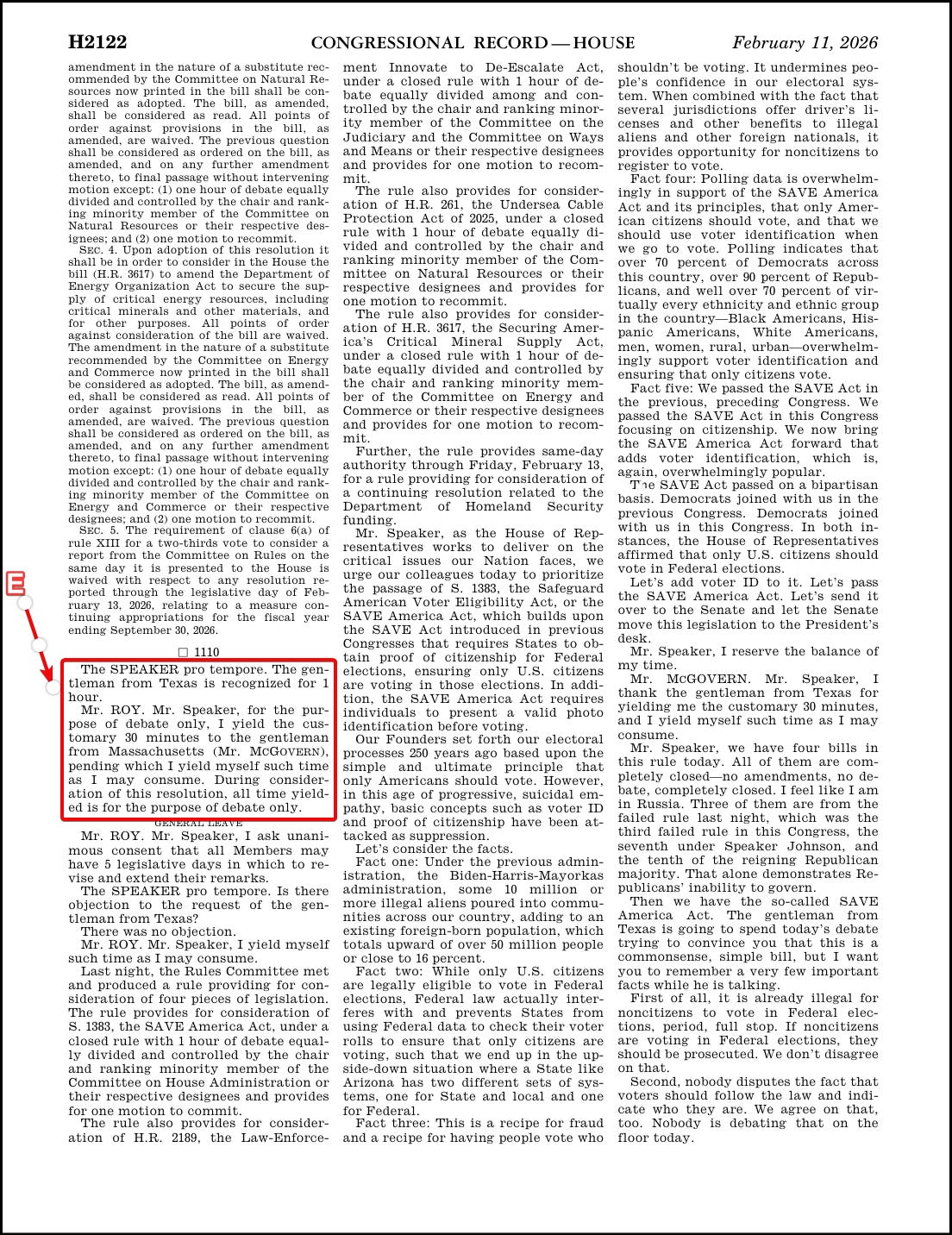
E: Consideration of the special order of business begins. Under House rules, privileged resolutions brought up in the House providing for a special order of business are considered under the hour rule, with the first hour controlled by the Member who called up the resolution. Here we see Mr. Roy yield half of his hour to the minority, for the purpose of debate only. The is not required, but longstanding custom in the House. In effect, each side will control 30 minutes of debate on the resolution, but the minority manager of the time can only use it for debate, and may not make any motions when he has the floor.
What exactly is in the privileged resolution they are debating? H.Res.1057, if adopted, would do five things:
make in order and set the terms of consideration for S.1383;
make in order and set the terms of consideration for H.R.2189;
make in order and set the terms of consideration for H.R.261;
make in order and set the terms of consideration for H.R.3617; and
adjust clause 6(a) of Rule XIII from February 13th to September 30th so that resolutions for special orders of business from the Rules Committee related to continuing resolutions for appropriations can be considered the same day as they are reported from the committee without a 2/3 vote. Under current rules, such resolutions would have to wait a day for consideration absent a supermajority.
So, again, the point of adopting this special order of business is to make in order the consideration of bills the majority would like to take up today, but cannot under the regular order of business. And also set the terms of consideration for them. Here’s the text of how the rule structures consideration for H.R.3617 (emphasis mine):
Sec. 4. Upon adoption of this resolution it shall be in order to consider in the House the bill (H.R. 3617) to amend the Department of Energy Organization Act to secure the supply of critical energy resources, including critical minerals and other materials, and for other purposes. All points of order against consideration of the bill are waived. The amendment in the nature of a substitute recommended by the Committee on Energy and Commerce now printed in the bill shall be considered as adopted. The bill, as amended, shall be considered as read. All points of order against provisions in the bill, as amended, are waived. The previous question shall be considered as ordered on the bill, as amended, and on any further amendment thereto, to final passage without intervening motion except: (1) one hour of debate equally divided and controlled by the chair and ranking minority member of the Committee on Energy and Commerce or their respective designees; and (2) one motion to recommit.
Four things the rule does worth noting: (1) makes it in order to consider the bill; waives all points of order someone might try to bring against the bill or its consideration; (3) orders the previous question—more on this soon—to preclude any amendments to the bill prior to a final vote; and (4) allows for an hour of debate.
But none of that can happen until a majority in the House agrees to the special order of business. And so the debate on the resolution from the Committee on Rules begins, with half of the time controlled by Rep Roy for the majority, and half of the time controlled by Rep. McGovern (ranking Member of the Rules Committee) for the minority.
When all time for debate had been yielded back, Mr. Roy was still in control of the floor under the hour rule:
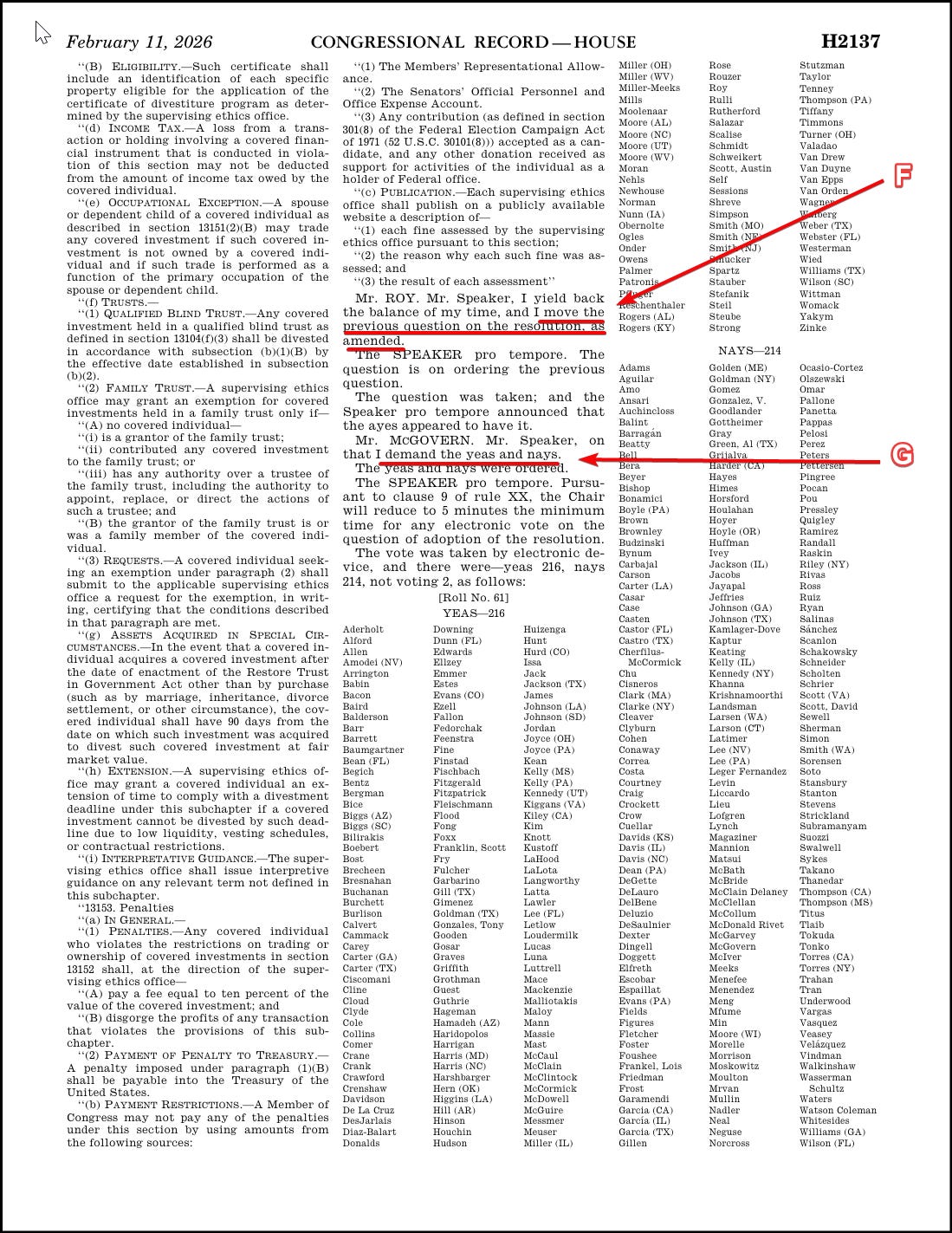
F. A motion is made for the previous question. At the end of debate, Rep. Roy moves the previous question. A successful motion for the previous question ends debate, bars the offering of further amendments, and brings the House to an immediate vote on the underlying resolution. It is a primary tool used by a majority in the House to quickly work its will and bring about final decisions; the lack of a motion for the previous question in the Senate is what enables filibusters.
If the motion for the previous question is defeated, it would allow a Member in opposition to control a second hour of debate, during which they could offer an amendment to the underlying resolution. This essentially never happens in the House; the majority leadership leans extremely hard on their Members to never vote against the previous question on a rule resolution. If a majority did defeat the previous question, they would essentially have hijacked the floor and could set the agenda themselves.
In this case, the previous question wins on the voice vote.
G. The yeas and and nays are demanded and ordered. Rep. McGovern demands a record vote and 1/5 of the Members present agree. This was covered in part I. An electronic vote is taken, and the previous question is ordered, 216-214.
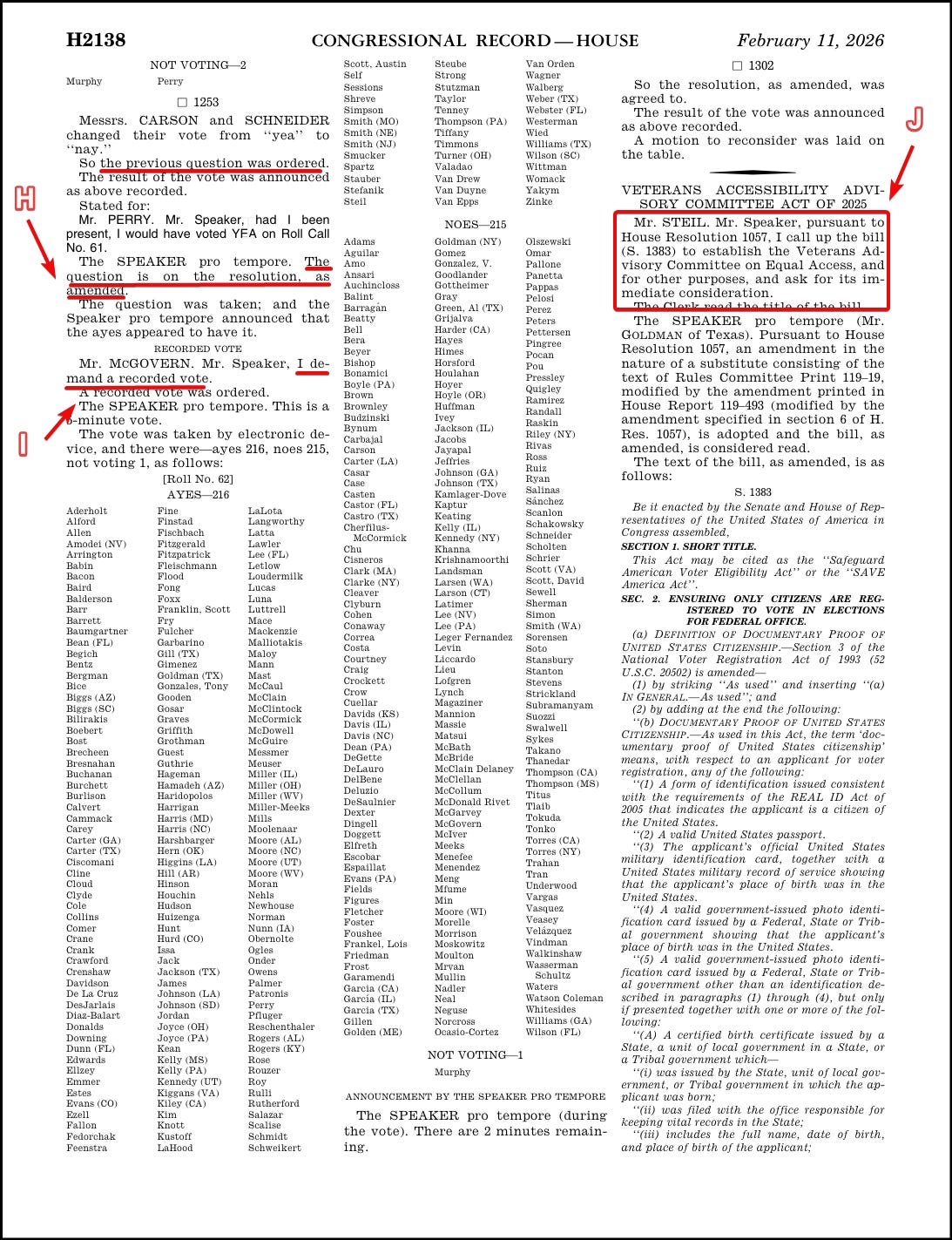
H. The resolution for a special order of business is voted on. With the previous question ordered, no more debate is in order, and the chair puts the question on adoptions of the resolution. By voice vote, the resolution is agreed to.
I. The yeas and and nays are demanded and ordered. Rep. McGovern demands a record vote and 1/5 of the Members present agree. This was covered in part I.
An electronic vote is taken, and the resolution is agreed to, 216-215. It is not common for special orders of business to be rejected; traditionally, the majority party sticks together, as leaders negotiate the agenda with the party in caucus, and the backbenchers accept the results of the negotiations on the floor. But in the 118th and 119th Congresses, with their narrow majorities and factional disputes among the GOP majority, this procedural coalition has fallen apart. Lots of special rules have failed, including a slightly different version of this one, just the day before. And if you can’t pass the rule, you can’t interrupt the regular order with what you actually want to do.
J. S.1383 is called up pursuant to the just-passed rule. Having been made in order by the resolution for a special order of business, Rep. Steil calls up S.1383 pursuant to the rule. As the rule allows for one hour of debate, equally divided and controlled by the chair and ranking member of the Committee on House Administration (it is normal for debate time to be controlled by the leaders of the committee of jurisdiction), the debate proceeds.
After the hour of debate, pursuant to the rule, action continues on S.1383.
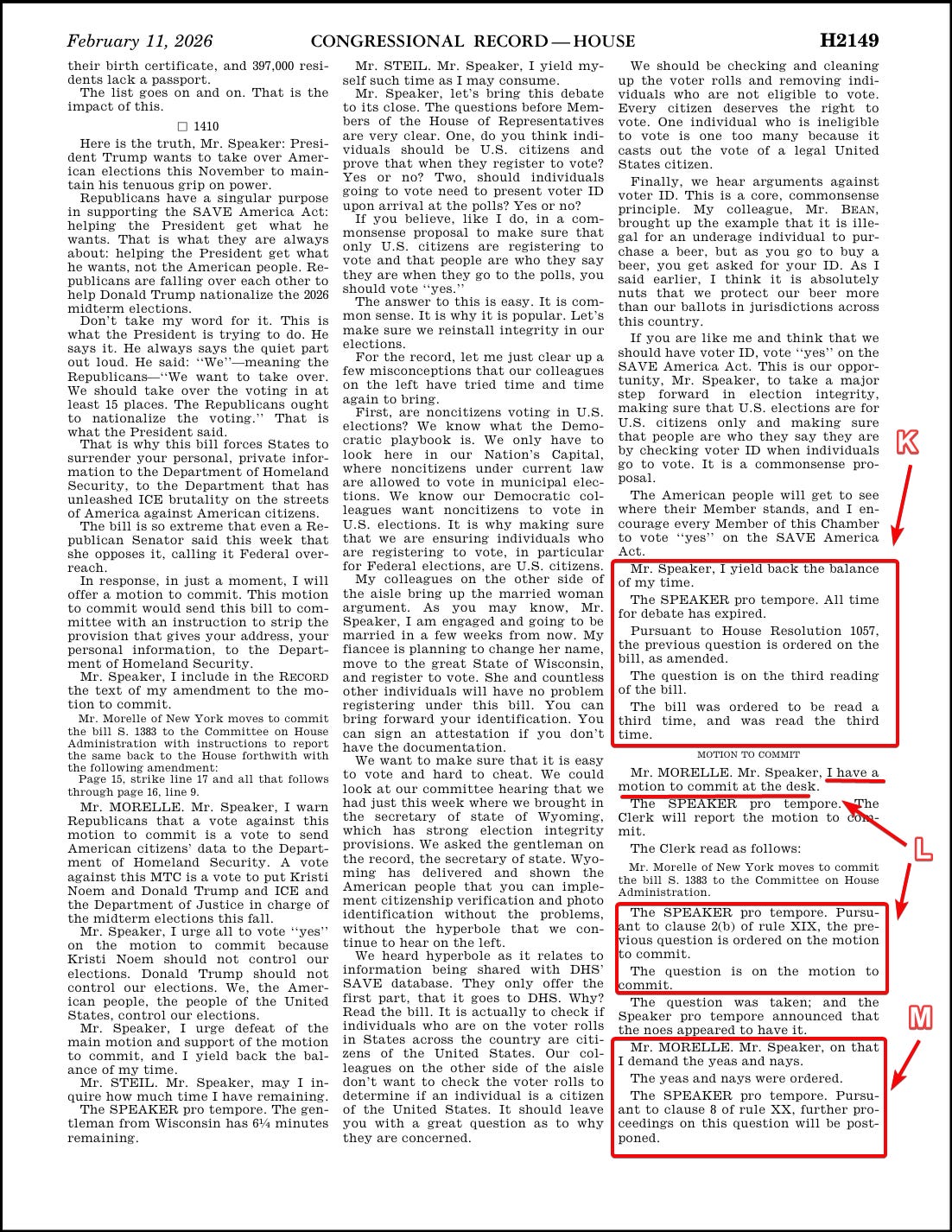
K. Debate ends and consideration of S.1383 continues. Rep. Steil yields back his remaining time for debate, and the chair announces all time for debate has expired. Following the special order as adopted in H.Res.1057, the previous question on the bill is considered order, and a largely pro forma vote is taken on the third reading of the bill.
L. Rep. Morelle makes a motion to commit. Under the rule as adopted in H.Res.1057, no motions are allowed after debate and before a vote on final passage, except one motion to commit. This is an opportunity for the minority to have the bill sent back to committee. Why would the majority allow this motion to be in a special order of business? Because under House Rule XIII, clause 6(c), a special order of business reported from the Rules Committee may not preclude the minority from making a motion to recommit.
This is a traditional prerogative of the minority. It virtually always fails on a party line vote. Prior to the 117th Congress, the motion to commit (or recommit as the case may be) had somewhat more teeth, as the rule allowed for 10 minutes of debate on the motion and the minority could offer instructions with the motion that essentially turned it into an amendment, which guaranteed that they would always get a vote on at least one amendment to the bill.
Since the 117th, however, the rules have allowed neither debate nor instructions, meaning all the minority can do is talk during general debate about what they would change in the bill if the motion to (re)commit were successful. This has essentially foreclosed the possibility of the minority amending bills via the motion, or putting majority Members to tough votes.
M. The yeas and nays are demanded on the motion to commit and the vote is postponed. After the voice vote on the motion to commit, Rep. Morelle demands the yeas and nays, and the chair postpones further consideration under clause 8 of Rule XX, in order to create a vote stack later in the day. This was covered in part I.
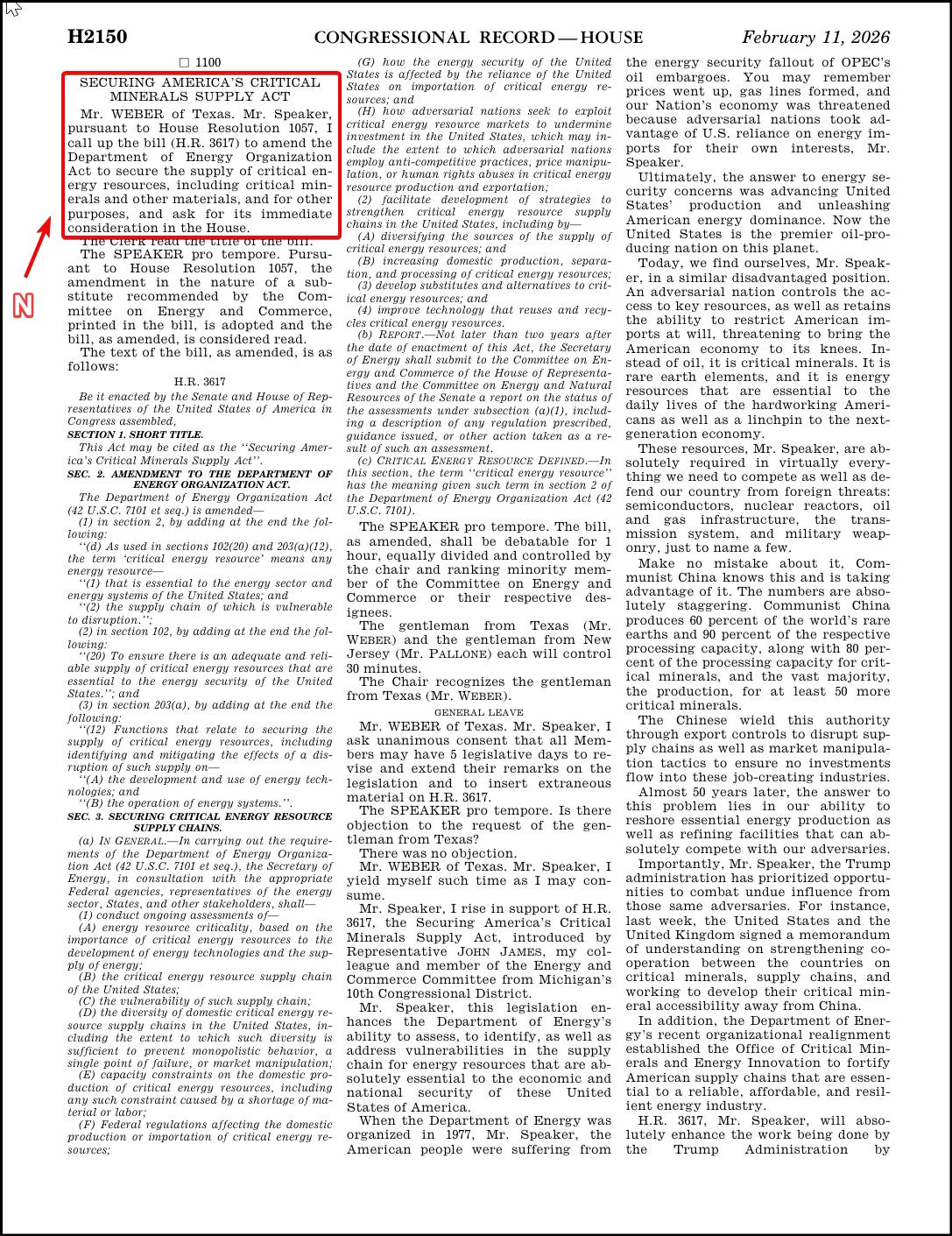
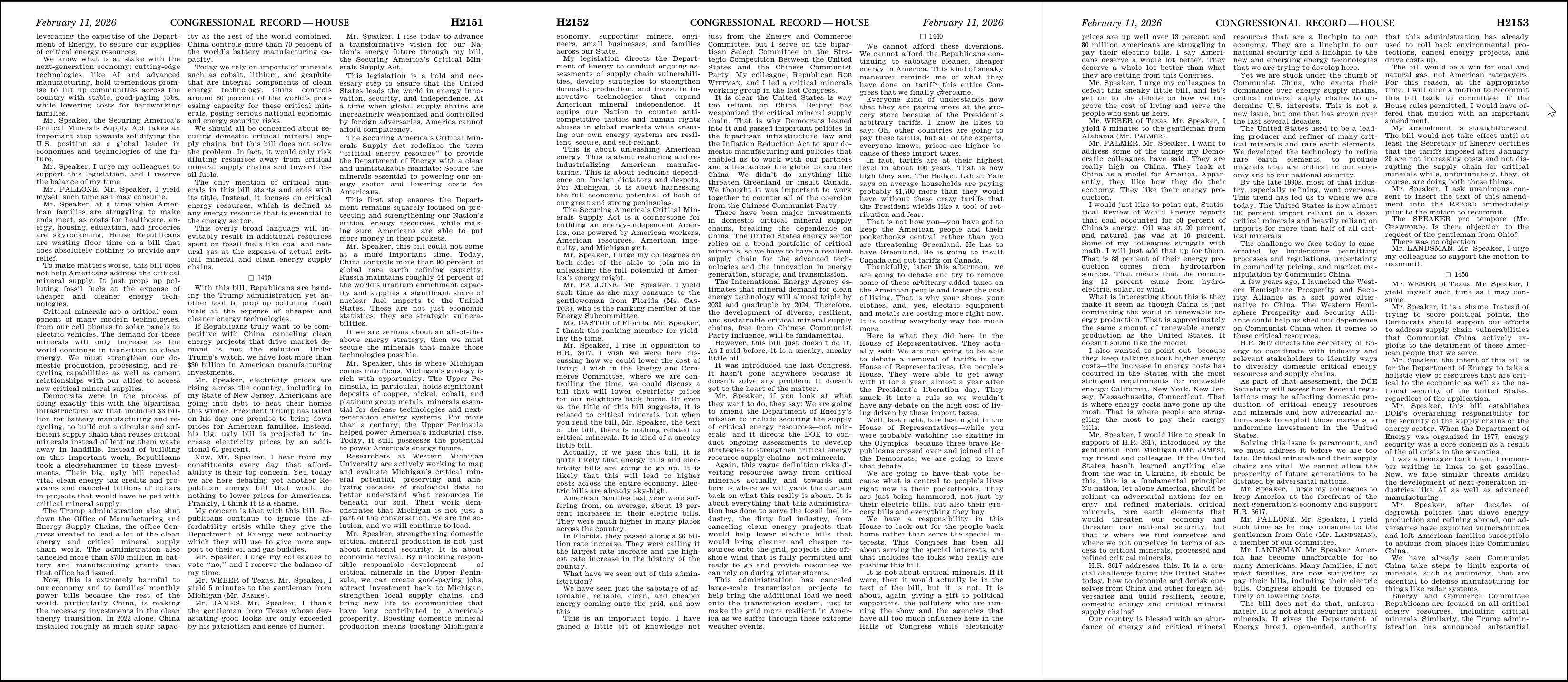
N. Consideration of H.R.3617. After the postponement of consideration of S.1383, Rep. Weber calls up H.R.3617, pursuant to the rule. The rule provides for virtually identical terms of consideration as it did for S.1383, so we need not go through it here. There is an hour of general debate, a motion to recommit, a demand for the yeas and nays on the motion, and a postponement of further consideration:
After the postponement of consideration of H.R.3617, you might expect the House to consider the other two bills that were made in order by the rule. But instead, some other privilege business interrupts:
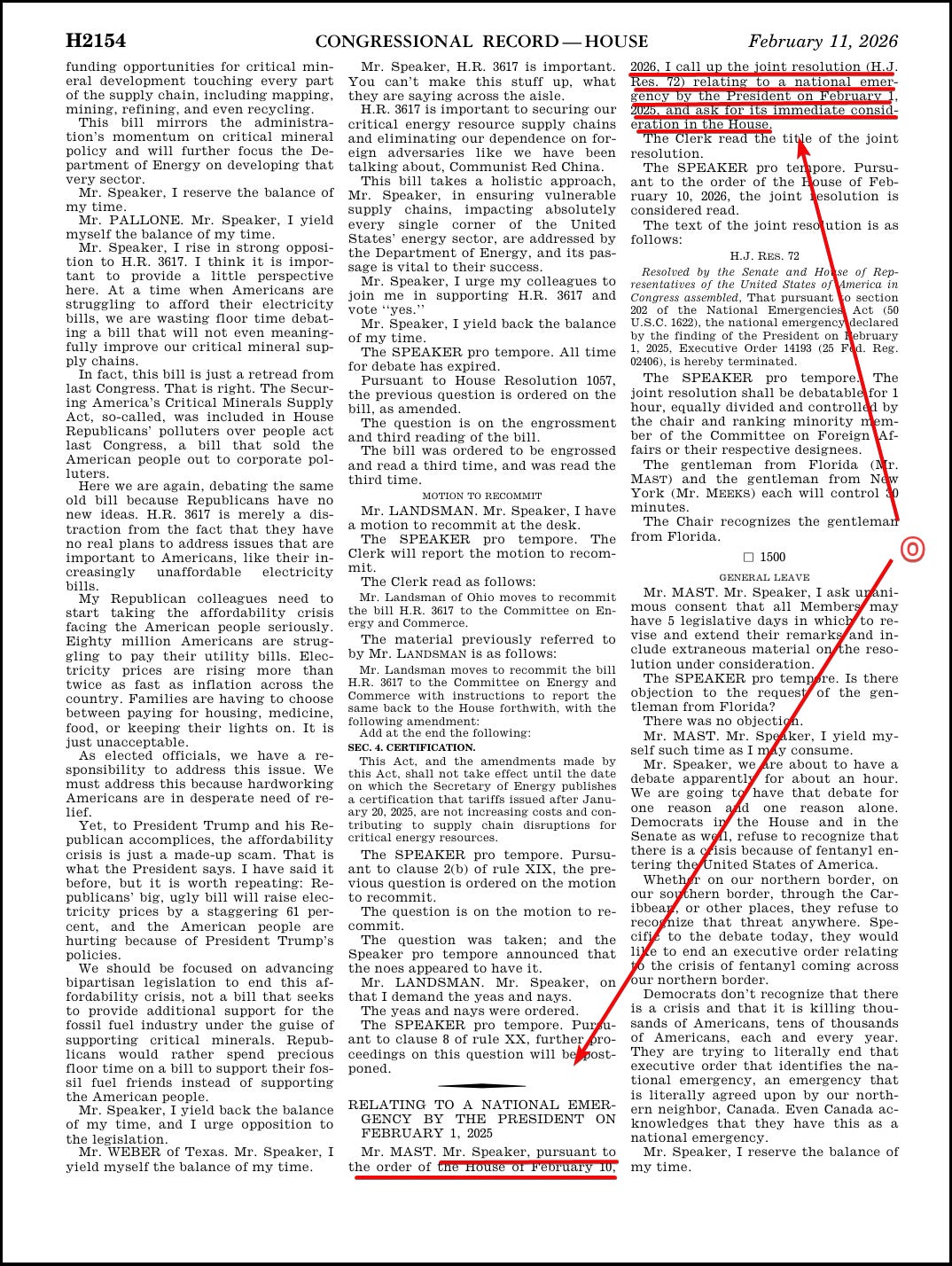
O. Calling up H.J.Res.72, to terminate a national emergency. Rep. Mast is recognized and calls up H.J.Res.72 pursuant to an order of the previous day (February 10). What is going on here?
This is an effort to end the tariffs put in place last year by President Trump. Under the National Emergency Act—which is the authority by which Trump put in place certain tariffs—there are a set of statutory rulemaking procedures by which Members of Congress can quickly force a vote on legislation to overturn presidentially-declared emergencies. For most of the 119th Congress, the House majority has prevented these votes from taking place by passing special rules that essentially prevented the consideration of such legislation for a certain period of time.
That period of time, however, expired earlier this month. And when the House attempted to extend the period of time when you could not bring up such legislation by placing it in a special rule for the consideration of other legislation, it was defeated. That was the rule that did not pass on the previous day, February 10th. It was a major defeat for the GOP leadership, and for the White House.
After the rule failed and the House refused to prevent the consideration of legislation to terminate the national emergency, Rep. Mast made a unanimous consent request to structure consideration of the legislation (had he not, other Members would have had the ability to call it up on their own). The unanimous consent request provided that: (1) the resolution be in order to consider at any time; (2) there be an hour of debate, equally divided and controlled; and (3) no other motions be allowed en route to a final passage vote. Essentially, it was a unanimous consent request to create a special order of business.
And so consideration of H.J.Res72 followed a similar pattern to consideration of the previous two bills today, except there was no motion to recommit, since the unanimous consent request is not under the same limitations as a resolution reported from the rules committee.
In fact, we can zoom ahead through consideration of H.J.Res72 and one of the other bills provided for in the special order of business (H.R. 261) since they all followed the now-familiar pattern of debate, vote, and postponement.
After consideration and postponement of H.R.261, three messages were received from the President:
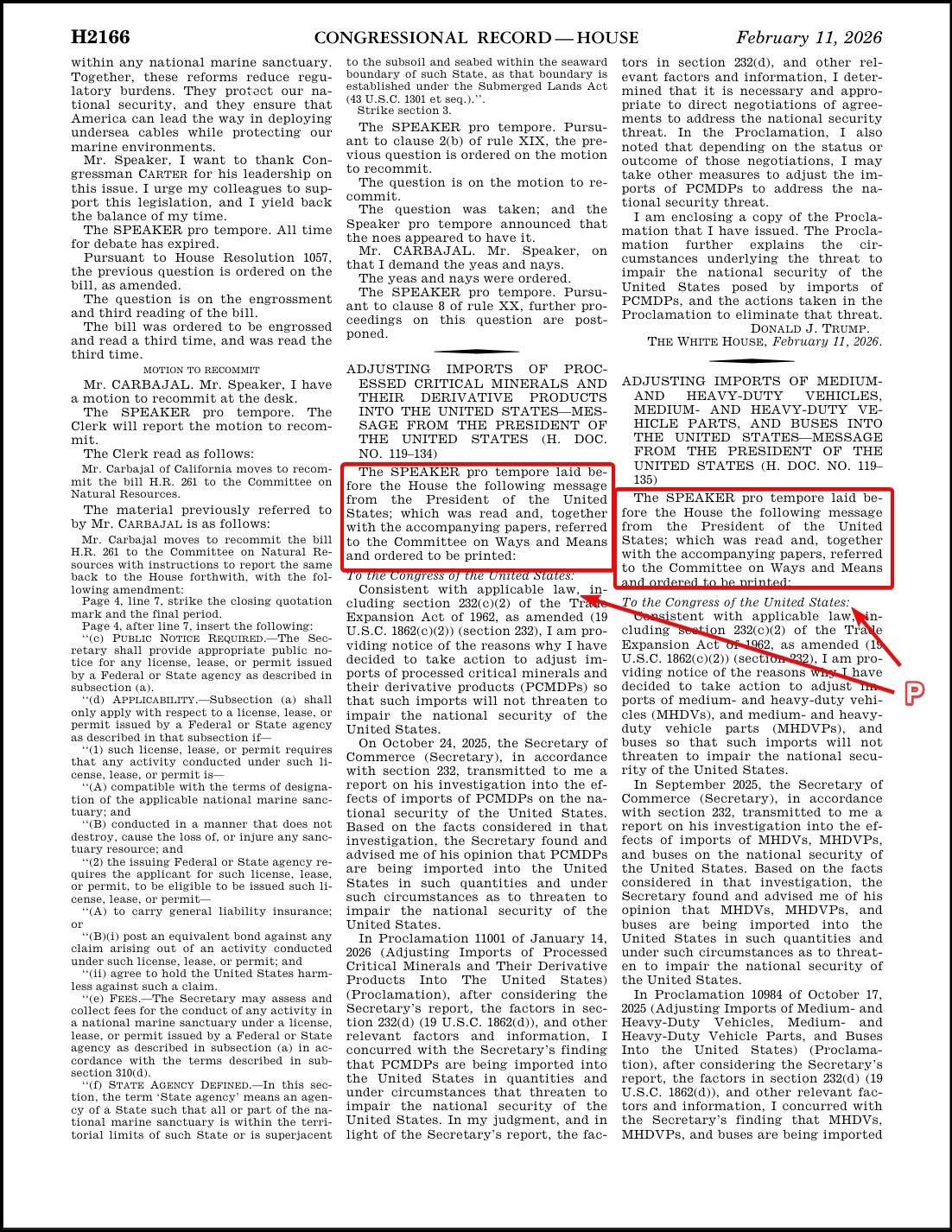
P. Messages from the President. The Chair laid before the House communications from the president, fulfilling statutory obligations to notify Congress when he makes adjustments to tariffs under the Trade Expansion Act of 1962.
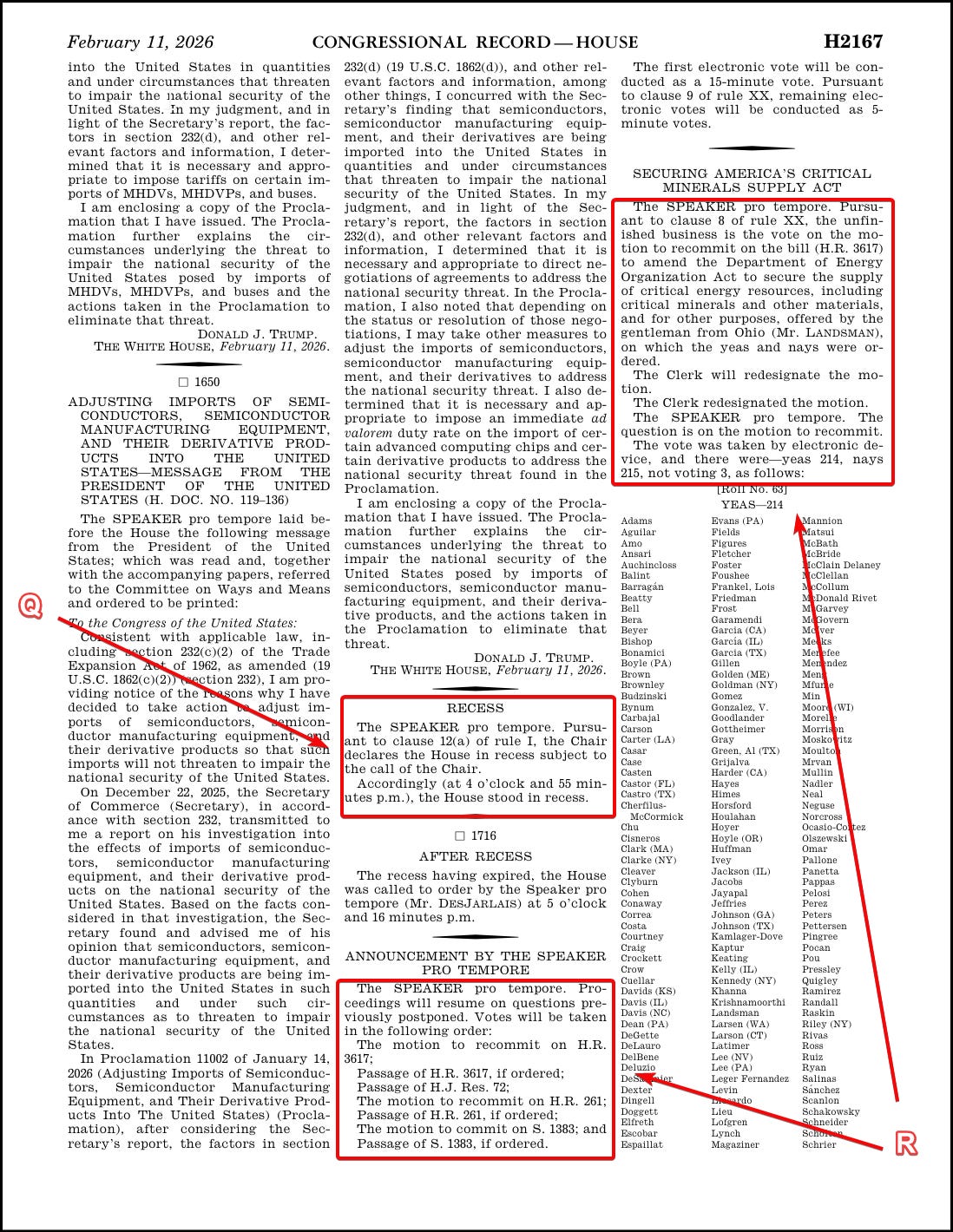
Q. Recess at the call of the chair. After receiving the messages from the president, the chair calls a recess at 4 p.m. under the Rule I, clause 12(a) authority. This was covered in part I.
R. Vote Stack. At 5:16 p.m. the House is called to order and the recess expires. The chair announces that proceedings will resume on the questions previously postponed, and announces the order votes will be taken. Recall that up to seven votes may happen:
the motion to commit on S.1383 and, if it is defeated, final passage of S.1383;
the motion to recommit on H.R.3617 and, if it is defeated, final passage of H.R.3617; and
the motion to recommit on H.R.261 and, if it is defeated, final passage of H.R.261; and
final passage of H.J.Res.72, which does not have a pending motion to recommit.
We discussed the convenience of the stack in the previous post. Note the first vote is 15-minute vote, but the chair announces the 6 subsequent votes will be 5-minute votes.
All of the motions to (re)commit fail, and all of final passage votes succeed.
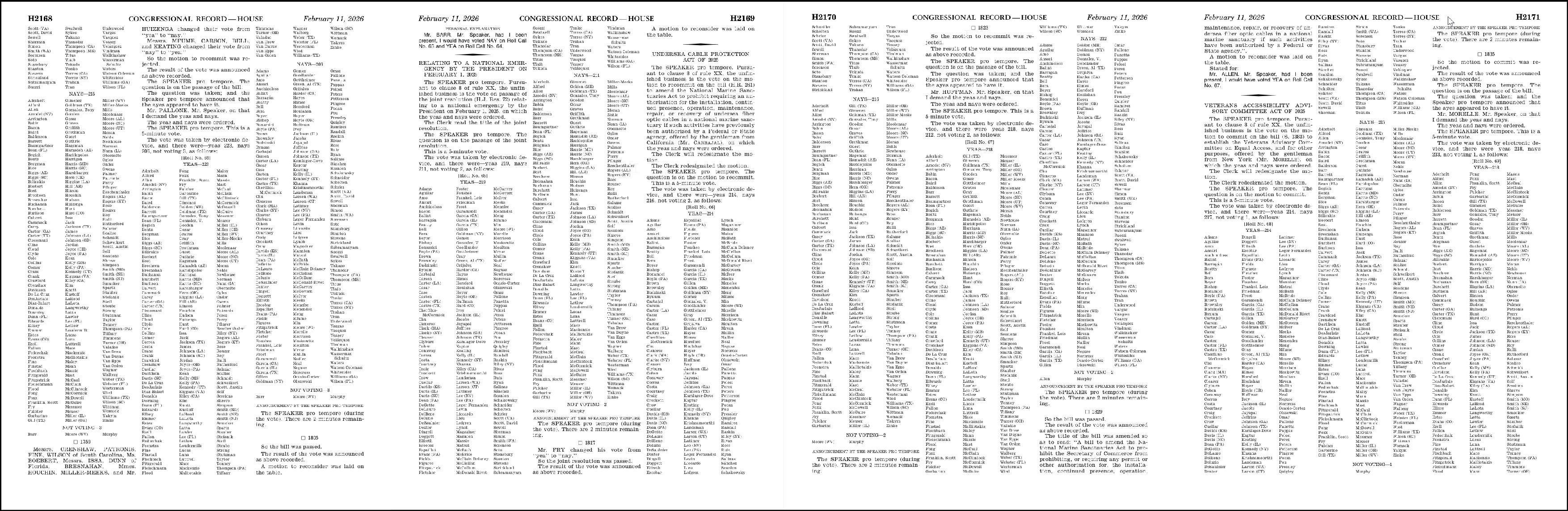
You may wonder what happened to the other bill (H.R. 2189) made in order by the special order of business? They chose not to bring it up. The provisions of the special rule make it in order at any time, and so they can choose to wait and call it up on another day. In fact, it was brought up the next day, on February 12th.
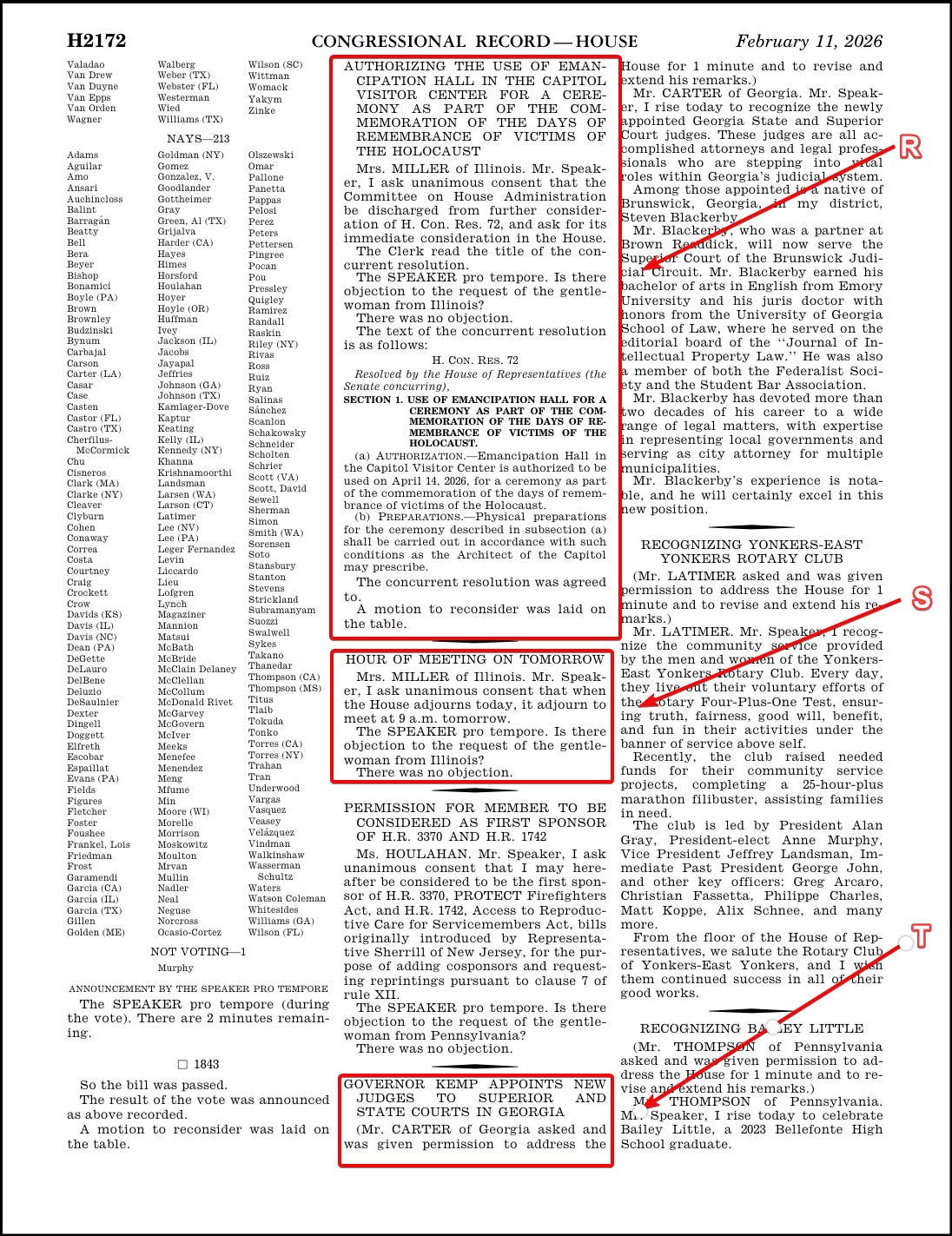
R. Unanimous consent to discharge a resolution and consideration of it. After the vote stack, the House will return to the regular order of business, barring interruption. But there’s always an interruption. Here, Rep. Miller asks unanimous consent to discharge a resolution (H.Con.Res.72) from committee and consider it. It is granted. The resolution is non-controversial—it provides for the use of emancipation Hall for a commemoration—and it is agreed to by voice vote. Almost no one is in the House chamber, most Members having left after the vote stack.
S. Fixing the time of meeting tomorrow. Rep. Miller asks unanimous consent that the House meet at 9 a.m. the following day (instead of noon). There is no objection and thus it is ordered. Note this will also preclude the morning-hour debates.
T. The Speaker begins to entertain one-minute speeches and special order speeches. Legislative business apparently over the night, the chair begins to entertain one-minute speeches, and then special order speeches. These were covered in part I.
After special order speeches are done, it’s time to adjourn:
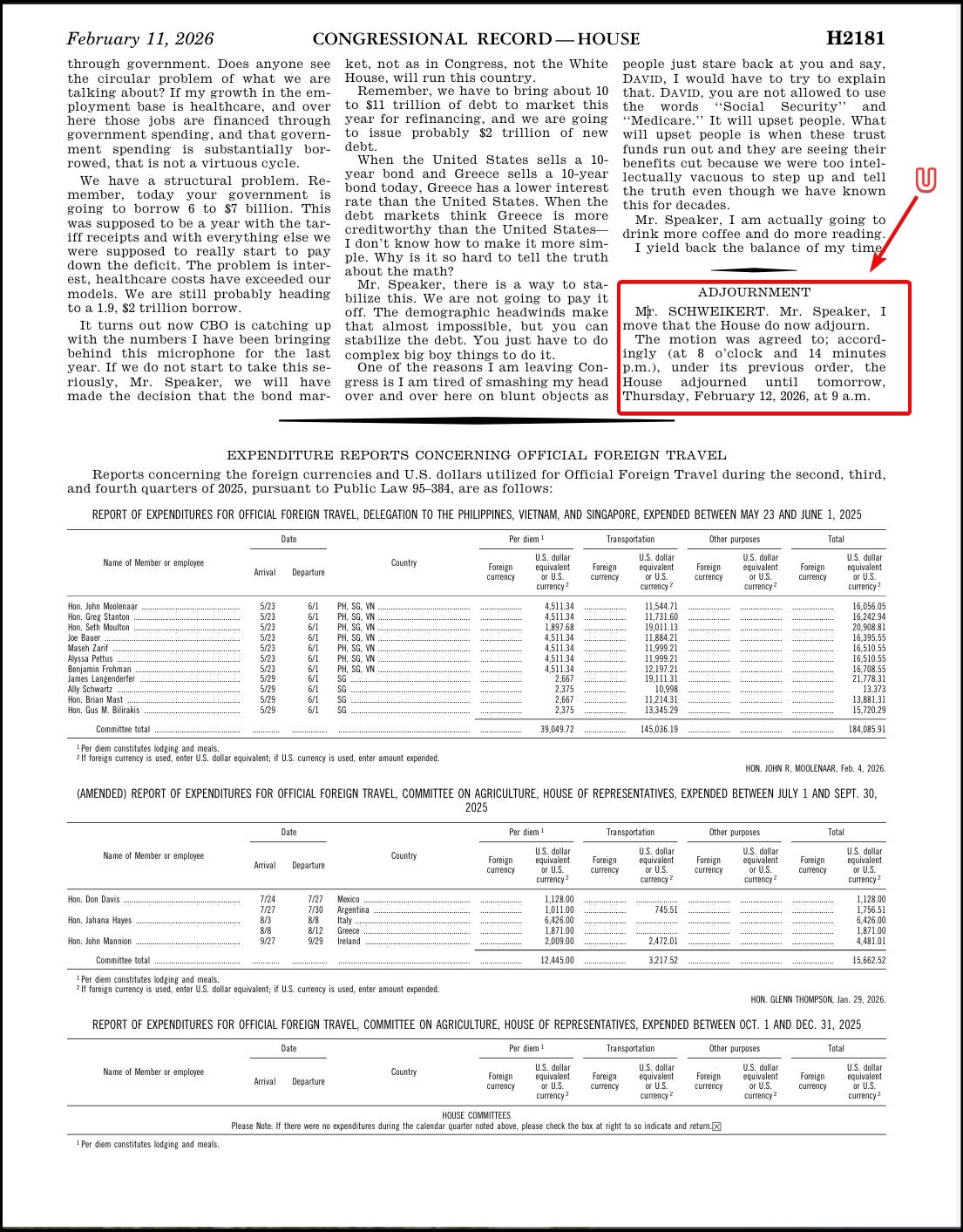
U. The House adjourns for the evening. At the end of his special order speech, Rep. Schweikert moves that the House adjourn. A voice vote is taken and the adjournment is agreed to at 8:14 p.m. Under the previous order created by unanimous consent, the House will come back at 9:00 a.m. the following day, and there will be no morning-hour debate.
Wrap Up
I always recommend people who are interested in what is going on in the House do these sorts of walk-throughs. But once you get the feel for the House floor by going through the congressional record like this a few times, it’s much easier to use the daily digest, which includes everything we saw here, but cuts out all of the actual debate.
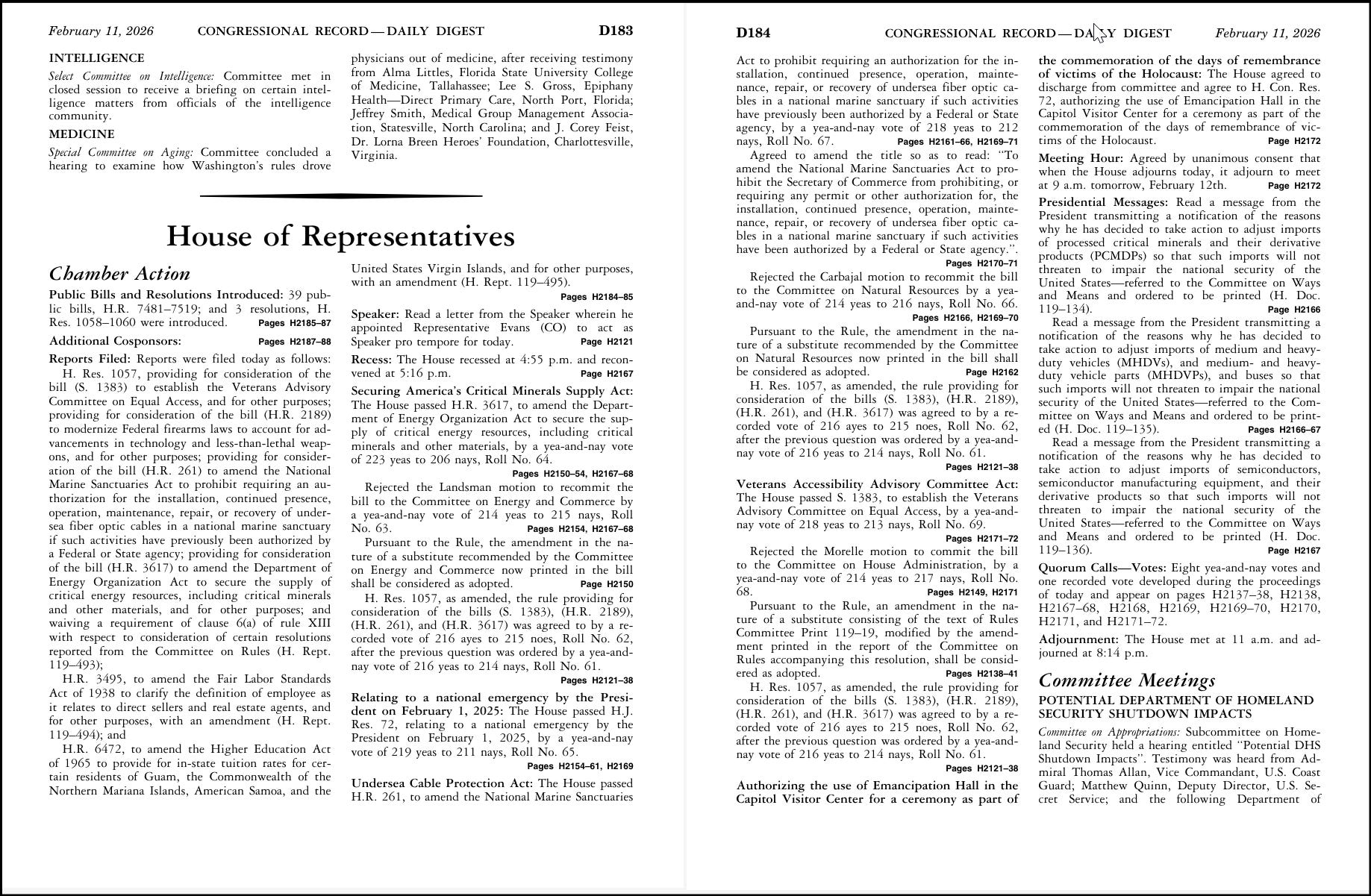
Careful readers will not that we skipped a day in the House here between the two walk-throughs. This is because February 11 included some unusual legislative action on the House floor, and the idea here was to walk through normal days.
It may occur to you that the ability to report special orders of business makes the Committee on Rules in the House particularly powerful. And indeed, that is the case. Since 1963, the committee has been dominated by the Speaker, who has exclusive right to appoint the majority Members of the committee, which has a 9-4 majority/minority breakdown. At the outset of the 118th Congress, however, a faction of Republicans (the so-called House Freedom Caucus) declined to vote for Rep. McCarthy for Speaker unless he ceded them 3 seats on the Rule Committee. That has continued in the 119th Congress under Speaker Johnson, creating an uneasy coalition on the committee.