

The 57th annual World Series of Poker kicks off in Vegas today, a seven-week series of 100 poker tournaments that will attract hundreds of thousands of players and a total prize pool likely in excess of $400 million, culminating in the $10,000 buy-in Main Event in July. In addition, hundreds of other tournaments will take place throughout Vegas, piggybacking off the WSOP and making for a far greater density of poker tournaments than any other time or place in the world.
I’m not going to make it out to the WSOP this year—I tried to make room for a week in June, but couldn’t pull it off. Still, the opening of the World Series generates an excitement among poker players even from a distance. I’m a poker romantic at heart, and a strong believer in the social capital produced by card games; poker is a game, but it’s also a path to friendship. I think I’ve made at least one new friend through card games every year since 1991. It’s also one of the easiest ways to start hanging out with your neighbors. Just do it.
My friend Nate Meyvis likes to say there are three truly great American inventions: baseball, jazz, and poker. Have fun and play well to all my friends heading to Vegas, wish I could be there with you. -M
Here are 12 updated thoughts about poker, America’s greatest gambling invention:1
#1. Poker is a great game, but it’s not really a card game.
I wrote about this a few years ago. Poker is better described as a gambling game played with cards. Real card games—like Bridge or Hearts or Oh Hell or Gin or even Go Fish—tend to (1) revolve around the play of the cards as the key to the game; and (2) make sense as non-gambling endeavors. There’s no need to set the stakes of a random game of Hearts at your kitchen table, because the game itself is fun. And indeed, the vast majority of card games are played recreational, for points and wins, not money.
The only decisions in poker involve how many additional chips to wager. You aren’t gambling on how good you are at the card game, because the gambling is intrinsic to what you are doing: every decision in poker is itself a decision on how much to gamble. And everyone knows poker is the stupidest possible game if you don’t play for money.
#2. Poker is an extremely good gambling game.
Personally, I think gambling on real card games is a heck of a lot of fun. But a lot of the theoretically best card games to gamble on—like Bridge—don’t work that well in practice, because the skill-to-luck ratio is bent too far toward skill. The better players win too quickly. It’s not like chess or golf, where outclassed players are almost immediately overmatched and demand a handicap. But it’s not not like that.2
Poker has an almost ideal balance between skill and luck. It offers significant opportunities for skilled players to outplay weaker players, but on any individual hand, luck—in the form of the deal of the cards—dominates skill. Even over the course of 10 or 20 or 50 or 100 hands, it’s totally normal for an inferior player to be ahead of a highly-skilled player. Plus, each individual hand is very short. Consequently, weaker players can have regular winning sessions even though skilled players will get the money in the long run.3
#3. Gambling has boomed in America, but poker still stands out.
There’s been an absolute explosion of legal gambling in the United States in the last 40 years, and in particular a massive rise in sports betting since 2018, when the Supreme Court struck down the federal ban. Throw in prediction markets—which allow betting on basically anything—and it feels like society is now awash in proposition wagers. It’s hard to get away from it, and public opinion has begun to turn against this expansion of legal gambling, which an increasing number of Americans see as bad for society.
“Gambling” is an umbrella word for an incredibly wide variety of activities: four friends betting $25 each on their Saturday afternoon golf match; playing blackjack at a casino for $25 a hand; putting $25 into an online betting market on the outcome of the Virginia gubernatorial election; buying a $25 lottery scratch-off ticket; playing poker for $25 at your kitchen table with your family; betting your buddy $25 on the outcome of the Army-Navy football game; entering a $25 Scrabble tournament that has cash prizes; simultaneously playing five $5 online poker tournaments; and dropping $25 into a Vegas slot machine.
Each of these things involves gambling $25. But they aren’t even remotely the same activities, nor do they have the same consequences for society. In my view, slot machines are very bad, and the trend in the gambling world, especially sports betting, is making a lot of things look more and more like slot machines. There has never been more opportunity to gamble in America, but there has also never been more opportunity to make -EV wagers.
But poker remains the only public gambling game in which (a) you aren’t playing against the house; and (b) there’s a legitimate chance you can win. The allure of sports betting is that, like poker, you aren’t playing against the house and can theoretically win. But when you bet sports, you have to be sharper than the combined knowledge of the entire global market in order to be +EV. And even if you somehow are, they will usually just stop letting you play.
In poker, you just have to be sharper than the 8 other people at your table. That’s much more doable. And that hasn’t changed in 150 years.
#4. No-Limit Hold’em is the most popular poker game, but it’s not great for a casual home game with friends.
Since the poker boom in the early 2000s, No-Limit Hold’em (NLHE) has become the dominant form of the game, in public card rooms, on the internet, and on TV. For many people, NLHE is poker. But it’s actually a terrible game to play in your basement with friends. It forces people to risk a lot of money on individual decisions, meaning you can lose a whole bunch 5 minutes after you start playing. Among the poker variants, it has one of the worst skill-luck ratios, with skilled players winning somewhat more often than is ideal. And, frankly, the proper strategy is actually pretty boring: you really need to fold a lot more than people want to on Thursday night at the kitchen table.
Prior to the poker boom, home games were dominated by what’s known as limit poker, usually variants of Seven Card Stud. These games have strict caps on what can bet at any given time, and the difference in play from NLHE is striking. Whereas NLHE games create tense moments of high-pressure and eerie silence that can easily ruin and/or end someone’s night, limit poker home games generally feature lots of boisterous laughter, few moments of intense pressure, and little or no drama of someone having to quit because they lost all their money in 12 minutes. If you want to start a game with your neighbors—and I highly recommend it—you should really play limit poker.4
#5. No-Limit Hold’em is the perfect tournament poker game.
Tournament poker has become increasingly popular in the past 25 years. It’s a simple concept: instead of playing a never-ending string of hands for cash until people don’t want to play anymore, have everyone (say 10 people) pay a fixed amount of money (say $25) for a fixed value of poker chips (say 3000), and then play until one person has all the chips, awarding fixed prizes for the people who last the longest (say, the top 3).
No-Limit Hold’em absolutely shines in this format. First, participants’ downside risk is capped and known, since you can never lose more money than the entry fee. Second, what a lot of recreational players love about NLHE—they ability to bet all the chips, particularly on a bluff—becomes a lot less scary when it’s not actual cash being wagered. And finally, tournament poker has much higher variance than cash poker, which pulls the skill-luck ratio of NLHE much closer to an ideal spot.
In fact, if you are going to play NLHE with your friends and neighbors in your basement, I highly recommend playing tournaments instead of cash game. Everyone loves them, everyone is comfortable with the stakes, and everyone enjoys trying to make big bluffs without the pressure of it being real cash. The best setup for a home game is a NLHE tournament, and then a limit poker cash side game that populates as people bust out of the tournament.
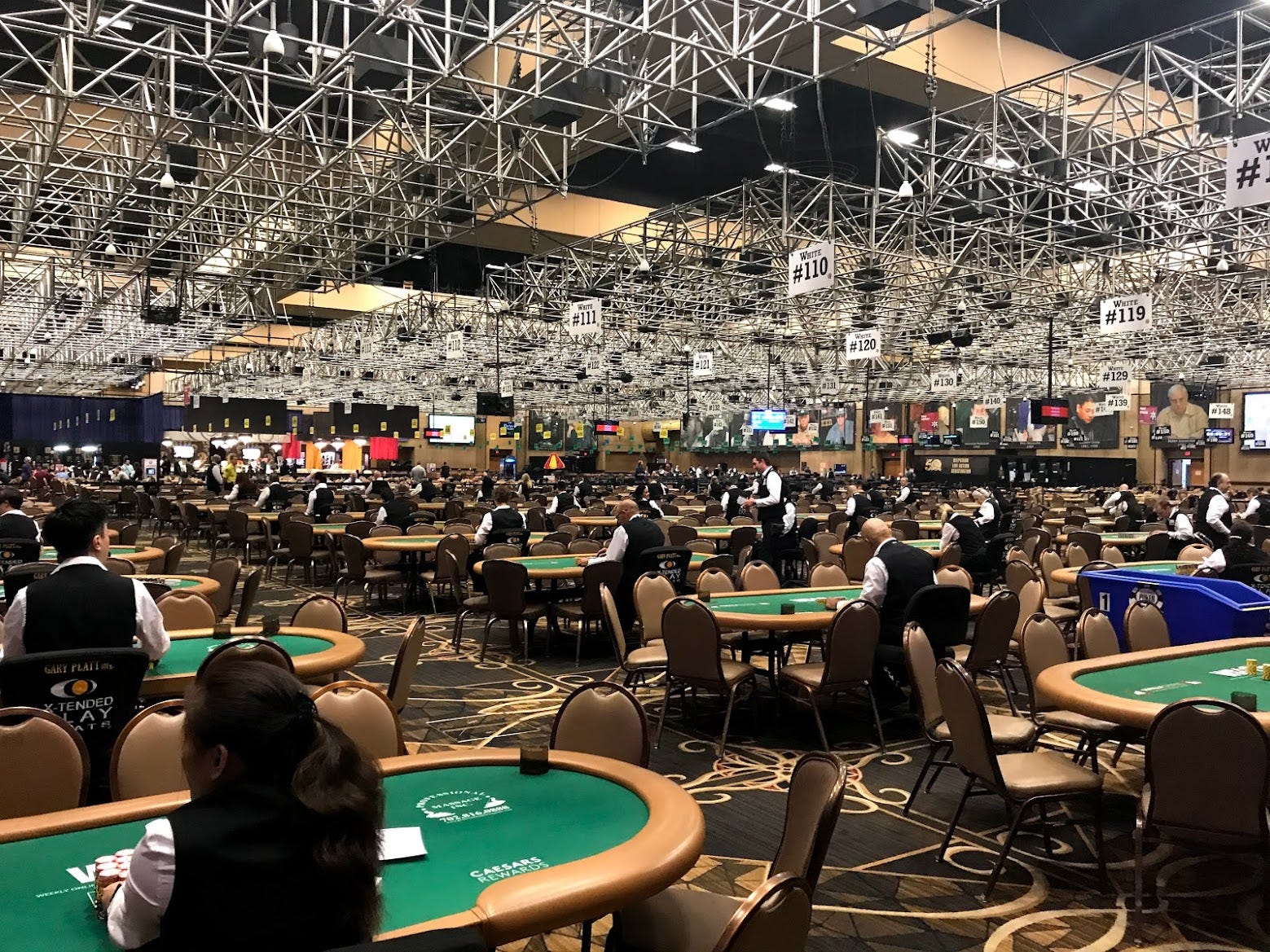
#6. Public poker tournaments are tough to beat, because of the rake.
How tough is the competition at the World Series of Poker?
It’s a good question. Some of the tournaments—like Event #55, the Super High-Roller that costs $250,000 to enter (yes, $250k!)—are filled almost exclusively with the very best professional players in the world. Other tournaments—like the $400 Colossus or the various low-buy-in Daily Deep Stacks—more closely resemble the skill of a serious-ish neighborhood basement game, with some not particularly good amateurs and other pretty decent (for amateurs) amateurs.
But in another sense, the WSOP is brutally difficult compared to a neighborhood tournament. Even if the players had the exact same skill level as your home game tournament, the WSOP would be a much tougher spot to make money. And that’s because of the rake.
Unlike a home game, all the money that goes into the tournament in a casino does not come out. Since you are not playing against the house in a poker tournament at a casino, the casino needs some way to cover the cost of running the tournament and make some profit. So the casinos charge a fee—usually called the rake—for playing in the tournament. This money does not go into the prize pool to pay the winners. Instead, it goes directly to the casino. In most poker tournaments, the rake is somewhere between 10% and 20% of the entry fee.
This makes public tournament poker negative-sum. The rake turns marginally +EV poker players into marginal losing players. It also greatly reduces the profits for the winning players that remain. The casino is, by far, the biggest winner in the tournament series.
None of this means casino poker is unbeatable. But it does mean it is much tougher to beat than home game poker, even if you are playing against players of identical skill level. The skill edge required to beat the players alone doesn’t cut it, you need to be able to beat them by enough to also cover the rake.
#7. Don’t bother teaching poker to kids.
Poker is an excellent game to pick up as a teenager, but I recommend against teaching it to kids. If you want your kids to enjoy card games, teach them the real card games, the Whist variants: Pitch, Euchre, Oh Hell, Spades, Hearts, Catch The Ten, and so forth. Or get them playing Authors. Or the speed games just Spit or James Bond. Those are the game that kids love.
Poker just doesn’t work with kids. It makes no sense without wagering something of value. The skill-luck ratio means you get terrible feedback on whether you are making good plays or bad plays, so it’s hard for kids to improve. They hate folding, which means strategically there should be very little bluffing in their games, but bluffing is half the fun of poker for kids. And they get bored of it very fast. You can try playing tournaments with them—that’s a lot better—but it still isn’t great. Just play real card games with them.
#8. Poker strategy has basically been rewritten in the last 25 years.
People debate exactly where to draw the line, but it’s probably true to say that a typical player in one of the many $2-$5 NLHE game at your local casino right now might be better at poker than most of the best players in the world circa 2002. Same thing, perhaps more so, for tournament players. Things really have changed that much. Much of the widely-believed wisdom about the game from the 1990s and before has turned out to be wrong, and we shouldn’t be all that surprised about it: a generation ago people were still trying to work out the basic probabilities of the game.
The poker boom of the early 2000s brought in a wave of young players who began to systematically study the game, aided both by computers and the ability to share information on the internet. And the ability to play millions of hands on the internet with a full record of the results, which allowed for the building of massive databases that could answer empirical questions—like “how much more profitable is AA than JT over the long run in NLHE?” and “am I making or losing money over the long term when I have a flush draw?”—and allow people to iteratively refine strategies.
In recent years, computers have been successfully programmed to play most poker games better than humans, as well as to play in a game-theory optimal (GTO) manner, essentially making them impossible to beat. Studying these so-called solvers has helped human players improve their strategies, although no one is capable of memorizing the GTO solution, nor would you really want to. Most players play so far from optimal that you can win more money from them by trying to exploit their strategies rather than play a perfect unbeatable one yourself. Even if you knew the perfect strategy, maximizing your winnings is a still a question of estimating how your opponents are deviating from that strategy.

#9. America no longer dominates poker; in fact, it’s sort of the opposite now.
Poker is probably one of the quintessential American cultural inventions, along with baseball and jazz. And for decades upon decades, America was the home of the best poker players in the world, by far. Even through the early years of the poker boom, Americans were the dominant players, and very young Americans were the tip of the spear on the development of cutting edge strategy.
That all changed in 2011, when the federal government shut down the major online poker operators—Pokerstars, Full Tilt Poker, and a few others—that were operating in the United States in a legal grey area. Online poker didn’t go entirely away in the United States—some pseudo-legal sites remained available—but with the big players out of the market, things dried up fast. Consequently, online poker became a foreign game, and in the modern era the best players and cutting-edge strategy has always been developed online. Online poker has slowly returned to the U.S., state by state, but we no longer dominate the volume of play.
As a result, an American accent is now something high-level players hope to hear from their opponents at major tournaments, as it’s often a sign of someone who isn’t up-to-speed on cutting-edge strategy and who hasn’t been playing millions of hands a month professionally online. Scandinavians, Germans, Russians, and increasingly Brazilians are dominating poker. But it has truly become a global game, and while America may still be the center of the poker universe, Americans are no longer the overwhelmingly central figures in the game.
#10. Poker continues to be shaped by public policy.
The historical development of poker in America is essentially a history of its legality. For most of the 20th century, it was not publicly legal anywhere except Las Vegas and parts of California; most poker was private home games. In the early 90s, Indian reservations won the federal right to open casinos and poker was also legalized in Atlantic City. The game began to grow.
But the development of gray-market internet poker in the late 90s fundamentally changed things, and led directly the boom in poker’s popularity in the early 2000s. This boom was stemmed by the UIGEA in 2007 and stronger federal enforcement in 2011, but the legalization and proliferation of non-Indian casinos throughout the country by that point put public poker within a comfortable drive of hundreds of millions of Americans. By 2010, the game had gone public.
Oddly, the explosion of online sports betting and casino gaming hasn’t brought back online poker to its high point of the boom days. Federal laws continue to hamper efforts at national expansion by the major online poker operators, and state by state legalization has been slow. Recent changes to tax laws have also called into question the profitability of professional poker going forward.
Poker culture has also developed in relation to this shift. Once upon a time, poker was sort of edgy, the type of thing you didn’t necessarily advertise to people you were involved with. By 2005, it had gone completely mainstream, something you might casually talk about with your kid’s teacher. Another change was that poker culture went from being driven by home game culture to being driven by elite player culture. If you asked someone about poker in 1997, they would invariably have told you about their neighborhood game. Now? They would probably tell you about something they saw on TV. In my view, this has had some drawbacks.
#11. If you enjoy poker, pull the trigger and go to Vegas for the WSOP sometime.
If you’ve never played poker outside of casual neighborhood games, but you enjoy those games, I highly recommend trying out some public card room poker. There are now casinos virtually everywhere in the United States, and lots of them have poker rooms. My suggestion is to try public tournaments rather than cash games, for many of the reasons listed earlier: tournaments have fixed, known downside risk; NLHE is more fun in a tournament format; and tournaments themselves are just a heck of a lot of fun.
That said, I think everyone who enjoys poker should take a trip to Vegas and check out the WSOP sometime. There’s nothing quite like it. It really is a rush just to walk into a room with an endless sea of 200 poker tables and hear the chips clacking from every direction. And it’s something else entirely to play in a tournament in a room that size, knowing that millions of dollars of prize money are going to someone sitting at one of the tables, maybe you. There’s a hedonism in Vegas that is inescapable, but at the WSOP it tends to be tinged with a spirit of exuberant optimism and amateur hope, which makes for a remarkable atmosphere.
Nate Silver wrote an excellent piece this week on how a recreational player should prepare for the WSOP. But step zero is convincing yourself that you belong out there at the WSOP, and I’m telling you, you do. Between the WSOP and the other events going on in Vegas, there are thousands of poker tournaments in town over the next few months, many of them costing just a few hundred bucks to enter. Even just a weekend trip to play a few $250 daily events will be a memorable experience.
#12. If you like poker, here’s some non-strategy things to read.
There’s been a lot of garbage written about poker. But if you want to get into the swing of the WSOP from afar, here are some great pieces of writing I recommend. First, Nate Meyvis’ trip report from the 2011 WSOP Main Event, which is simply the best recap of a poker tournament run I’ve ever read. Second, go get a copy of The Biggest Game in Town, which was written in 1981 but still sets the scene for nosebleed-level gambling at the WSOP better than anything. My favorite piece of poker writing will probably always be Shut Up and Deal, a thinly-disguised memoir novel by Jesse May about his time playing professional poker in Atlantic City and Foxwoods in the early 90s.
This is an update to a post that originally ran in 2024. The main updates are the sections on the gambling boom (#3), the rake (#6), and public policy (#10).
Oh Hell is a fabulous game to gamble on, with a skill-luck ratio in a pretty good sweet spot.
This also makes it hard for players to assess if they are inferior, which is sort of crucial in any gambling endeavor. In fact, the beauty of a game like Limit Seven Card Stud is that it can be extremely hard to tell if someone has you outclassed or if they are just getting lucky. You can play with someone for hours upon hours and not really be sure.
You can play Limit Hold’em, but the classic games are usually the variants of Seven Card Stud: regular Stud, Stud High-Low, and then all the wild card variations: Chicago, Follow the Queen, Low Hole Wild, and so forth. In public poker, a mini-boom has taken place among more exotic mixed games: Badugi, Baduecey, Triple Draw, and Drawmaha.
To Poker’s transformation, it’s really a beautiful thing to study in relation to the felt impact of AI, because I *was* good to eight-table Paradise/Party/etc in college and bring in prolly $5k a semester on very small blinds - living like a king for a college student! - but I *am not at all* good enough to represent a range of hands against an opponent’s likely range of hands and vary the representation in a GTO-adjacent way. Yet I know people who not only are, but can do so easily. It’s besutiful to watch and reminds me very much of the ‘oh, duh’ moment in AIs solving Erdos conjectures or whatever: you can definitely see the shadows of what is operating, but the light is withheld even though you know it’s there.