

A Note to Readers: many of the arguments presented here were fundamentally shaped by writing by, and discussions with, my friend Josh Chafetz. In particular, Josh has written an absolutely fantastic forthcoming law review article on Chadha, the legislative veto, and the Trump presidency, entitled “The Chadha Presidency.” It provides extended analysis of the issues, a wonderful history of the legislative veto and the aftermath of Chadha, and an important account of the Trump presidency. I leaned on it a lot for this piece, and I highly recommend you read it
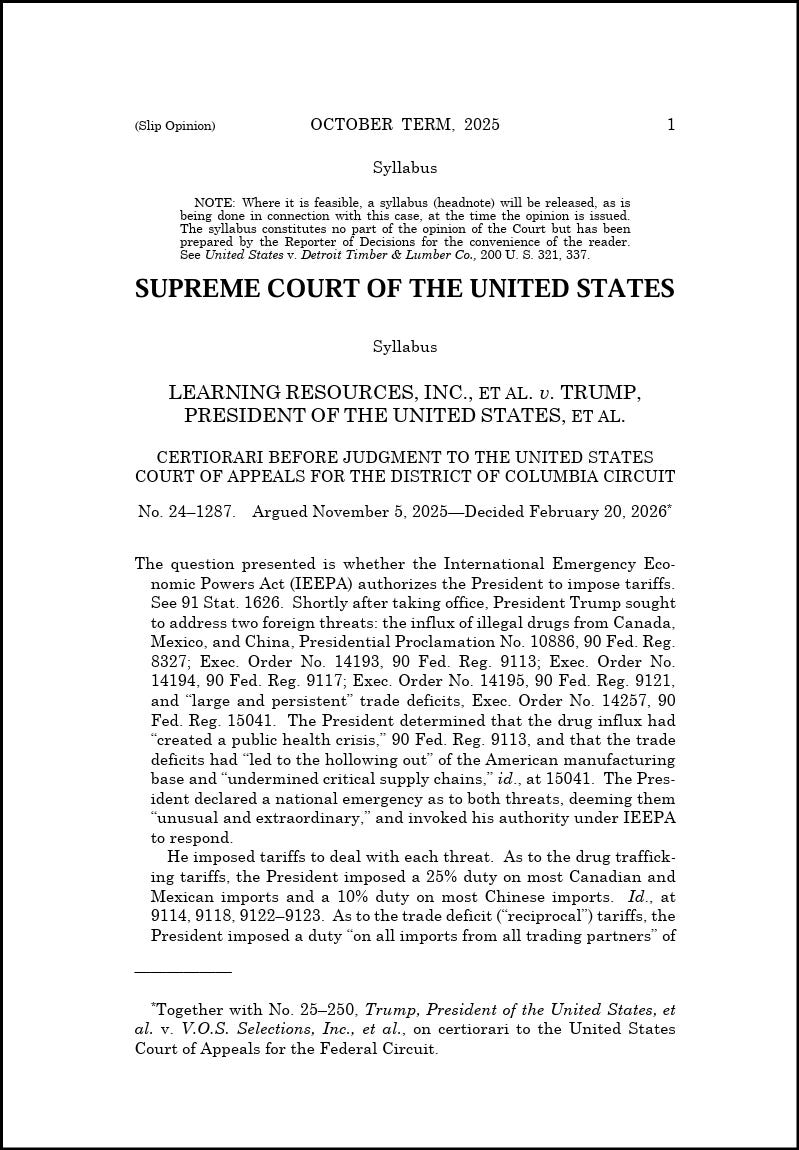
In case you just woke up from a coma, last week the Supreme Court struck down President Trump’s worldwide tariffs, 6-3, in a long-awaited decision.
In one sense, Learning Resources vs. Trump is a very straightforward case. Everyone involved, including the administration, agreed that the president does not have any inherent constitutional authority to impose tariffs, which are wholly within Congress’ exclusive power to tax. The only way, therefore, that the president could impose a tariff would be if Congress had, by law, delegated him that authority.
And thus the only question the justices needed to answer was just that: did Congress delegate to the president the authority to tariff when it enacted the International Emergency Economic Powers Act (IEEPA)1 in 1977?
Too simple to not be complicated
Congress did not. That’s the answer from Chief Justice Roberts’ majority opinion in Learning Resources v. Trump. Here’s the Chief:
The President asserts the extraordinary power to unilaterally impose tariffs of unlimited amount, duration, and scope. In light of the breadth, history, and constitutional context of that asserted authority, he must identify clear congressional authorization to exercise it.
IEEPA’s grant of authority … falls short. IEEPA contains no reference to tariffs or duties. The Government points to no statute in which Congress used the word “regulate” to authorize taxation. And until now no President has read IEEPA to confer such power.
Given how straightforward Roberts’ ultimate conclusion is, you would be forgiven if you were surprised that the nine justices wrote seven different opinions that ran a total of 170 pages. As it turns out, nobody really agrees all that much about how to think about vague delegations of congressional authority.
Three of the conservative justices (Chief Justice Roberts, Neil Gorsuch, and Amy Coney Barrett) believe that the Major Questions Doctrine (MQD) applies here—raising the bar for executive claims of delegated congressional authority when the president is trying to do something of “economic and political significance.” In such cases, rather than giving the executive branch the benefit of the doubt in close calls, there needs to be “clear congressional authorization.” They decided IEEPA falls short of that, and ruled against Trump on these grounds.
The three liberal justices (Sonia Sotomayor, Elena Kagan, and Ketanji Brown Jackson) believe that a plain reading of the IEEPA statute using the normal judicial tools of textual analysis (and, for Brown Jackson, the legislative history) show that Congress did not delegate tariff authority to the president. They joined the majority holding, but reject the logic of the Major Questions Doctrine. For them, the bar doesn’t even need to be raised. The tariffs fall on normal analysis of delegated authority.
Three of the conservative justices (Brett Kavanaugh, Samuel Alito, and Clarence Thomas) believe the opposite: that the IEEPA statute does provide a clear congressional authorization for the tariffs, but also argued that this case should not be held to the Major Questions Doctrine standard, because it deals with foreign affairs. They dissented.
To make it even more confusing, everyone decided they needed to have their say. Chief Justice Roberts wrote the majority opinion. Justice Barrett wrote a solo concurrence outlining her general thinking about the MQD. Justice Kagan wrote a concurrence (joined by the liberals) arguing you don’t need the MQD at all in this case. Justice Brown Jackson wrote separately that you should really look at the legislative history of IEEPA. Justice Kavanaugh wrote the principal dissent, which was joined by Alito and Thomas. Thomas wrote a separate, bizarre dissent in which he opined extensively on separation of powers.
And Justice Gorsuch wrote a long solo concurrence in which he spoke elegantly about Congress and its role in our system, but also took the time to explain to the rest of the justices why they were all a bunch of rank hypocrites. He chided the liberals for accepting absurdly vague statutes as congressional authorizations during COVID and on student loans when Biden was president, and then he lambasted the conservative dissenters for rejecting such statutes when the issue was expansive EPA authority.
But, for me, the most galling feature of the opinions is what goes completely unsaid in all of them. The Court is grappling at length to understand what Congress meant when it enacted IEEPA, but Congress never actually enacted—and probably never would enact—this version of IEEPA.
The Court did.
Congressional delegation, ratcheting-up, and the legislative veto
In order to make good public policy, Congress has to delegate authority to the executive branch. In some sense, that’s what we mean by governance. Congress can authorize things and provide money for them, but Congress is simply not going to figure out how to create a COVID vaccine and the best way to distribute it to 300 million people. That’s an executive function.
And it’s also what Hamilton was getting at when he talked about “energy in the executive.” Good governance needs good executive leadership. Congress has neither the expertise nor the capacity to respond to problems in real-time. All it can do is outline the mission and provide the resources.
The quality of governance ultimately rests on executive problem-solving and decision-making. Congress (or any legislative body, even a PTA) can write all the good law it wants, but without smart executive decision-making in execution, the end product will be garbage.
And whenever Congress delegates authority to the executive branch, it faces a basic principal-agent problem: how do you ensure that the authority will be used by the executive branch in ways that conform to congressional intent?
This should be a familiar problem to anyone who has ever delegated authority to someone or received delegated-authority from someone. It’s not different than any parent-child or manager-employee relationship.
Executive branch officials—like any child or employee—often have their own ideas about not only how to do things, but what the mission itself should be. And they can be very clever about using delegated power in creative ways that weren’t intended, even to the point of absurdity.
It’s basically impossible to write a law that preemptively addresses every possible executive aggrandizement; language just can’t be that precise, and when you do make it absurdly precise you tend to handcuff the very executive discretion that underlies good government. And that’s before we consider bad-faith on the part of executives.
Congress has lots of standard tools for dealing with this, which again should be familiar to anyone in a family or workplace relationship. None of this is rocket science. It’s just like dealing with a teenager when you give them money to go buy a birthday present for their aunt. You do oversight by checking up what they bought and how much they spent. You impose penalties for improper use, like if they spent it on themselves instead. You threaten reduced resources or removal of future delegated authority.
And, ultimately, if nothing else works, you put new conditions on the delegated authority or actually withdrawal it all together. Same with Congress. It’s really not different.
Congress, however, faces a distinctive ratcheting-up problem. Unlike the parent-child relationship, Congress faces an asymmetry in its ability to delegate power and to subsequently withdraw it. Congress can provide the executive branch with delegated authority by majority vote in the House and Senate, but in order to withdraw that authority, it needs either the consent of the president (highly unlikely), or a 2/3 supermajority of each chamber in order to override his veto.
This has resulted, over time, in an accumulation of executive branch power; all the president needs is 1/3 of one chamber in order to block congressional attempts to reduce delegated authority.
Now, there are ways for Congress to deal with this. Most notably, they can set authorities to expire (or sunset, as it is typically called), so that inaction withdraws the authority. That eliminates the ratcheting-up problem while retaining Congress’ authority to extend the delegated authority by majoritarian vote if they so choose.
In fact, this is the subtle reason that the “power of the purse” is so powerful; it’s not just that Congress controls the money, it’s that the money runs out. Because they naturally sunset, annual appropriations automatically favor Congress. The executive branch must come begging for more, and inaction leaves them with nothing.2
Beginning in the 1930s, Congress increasingly dealt with the delegation problem via another strategy: the legislative veto. Congress would provide authority to the president or other executive-branch officials, but reserve the right to overturn any individual use of the authority, via passage of a concurrent resolution in the House and Senate. This was an elegant solution to both the basic dilemma of delegation and the ratcheting-up problem; the executive branch could be given significant authority to problem-solve, but a bare majority in Congress could overturn specific uses of it.
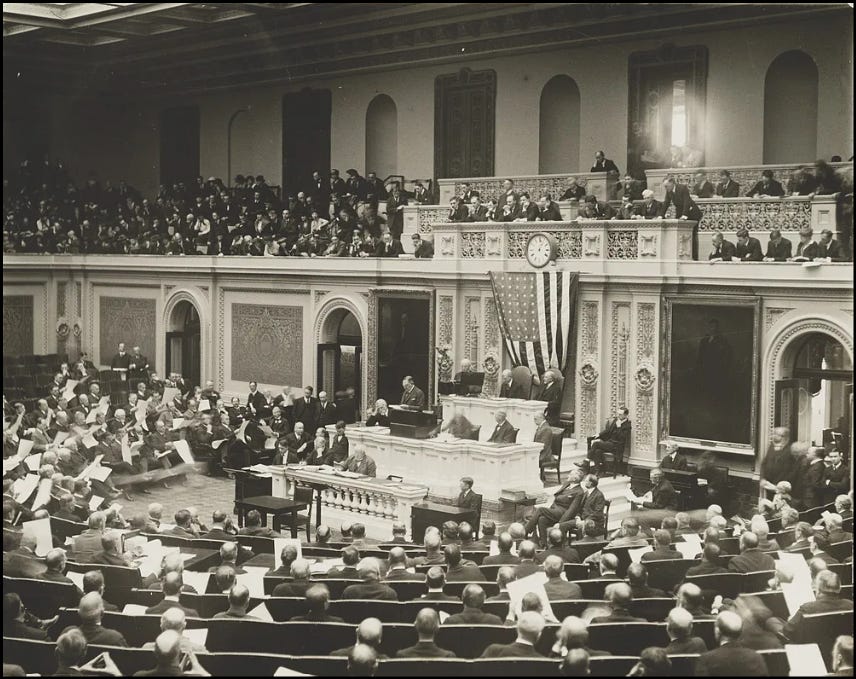
Over the next 50 years, Congress enacted hundreds of legislative vetoes. And if presidents didn’t like them—and they definitely didn’t—it didn’t stop them from signing the laws. They wanted the delegated authority, and the legislative veto was the cost of getting it. Congress also got creative with the legislative veto, passing laws allowing a single-chamber to cancel an executive action via resolution, or in some cases even allowing a single committee to do so.
When Congress enacted IEEPA in 1977, it contained a legislative veto. The way IEEPA works is that the president cannot unlock its significant delegated authorities until he declares an emergency under the National Emergency Act (NEA). And the NEA provided for a legislative veto, via which Congress could end any declared national emergency by passing a two-chamber concurrent resolution to that effect. It also included fast-track procedures for consideration of the veto, meaning it would not be subject to a filibuster in the Senate.
This essentially retained majoritarian congressional control over presidential uses of IEEPA. If Congress didn’t like an action the president took using his IEEPA authority—be it a sanction, asset freeze, or (gasp!) tariff—they would have the authority to overturn it, by majority vote, without the cooperation of the president.
But wait, you say, didn’t the House and Senate already both vote to overturn some of the the IEEPA tariffs put in place by Trump by declaring an end to the NEA emergency that triggered the authority? Yes, they did. Three times in the Senate (here, here, and here) and once in the House.3
But those were largely symbolic political votes, because the Supreme Court destroyed the legislative veto 40 years ago.
Chadha: a debatable decision, a dumb one, and a truly dumb one
In 1983, the Supreme Court decided INS v. Chadha. Jagdish Rai Chadha had been subject to deportation for overstaying his visa, but applied for a suspension of the deportation, which was allowed under delegated discretionary authority Congress had given to the Attorney General in the Immigration and Nationality Act (INA), conditioned with a one-chamber legislative veto over use of the authority.
After successfully receiving a suspension of his deportation, the House of Representatives disapproved of the suspension via resolution, and Chadha was ordered deported. He sued, arguing the legislative veto was unconstitutional. Ultimately, the Supreme Court agreed. The legislative veto was dead.4
INS v. Chadha is not a crazy decision on the basic merits. There’s a reasonable argument to be made that the exercise of the legislative veto is functionally an act of legislating, and by not involving the president or the Senate, the specific veto in Chadha violates both the bicameralism requirement and the presentment clause of the Constitution. And, indeed, that is what the majority opinion argues.
But there are reasons to be skeptical, both as a formal constitutional matter and a functional separation-of-powers one. The dissent notes that before Congress delegated the suspension authority to the Attorney General, Chadha would have needed a private bill in Congress to remain in the country, which would have needed the approval of House, Senate, and executive to be enacted. Under the legislative veto at issue, all three of those actors also needed to consent: the AG to approve the suspension, and the House and Senate not to overturn it.
Perhaps more importantly, the dissent also observed how well the legislative veto fit into the modern structure of the administrative state. Congress had chosen to build a large and powerful executive branch, and the legislative veto gave them an excellent tool to be confident they could maintain control over it. Take away the legislative veto, and you put Congress to a difficult choice: decline to build much-needed executive governance capacity, or go forward with much less control of it.
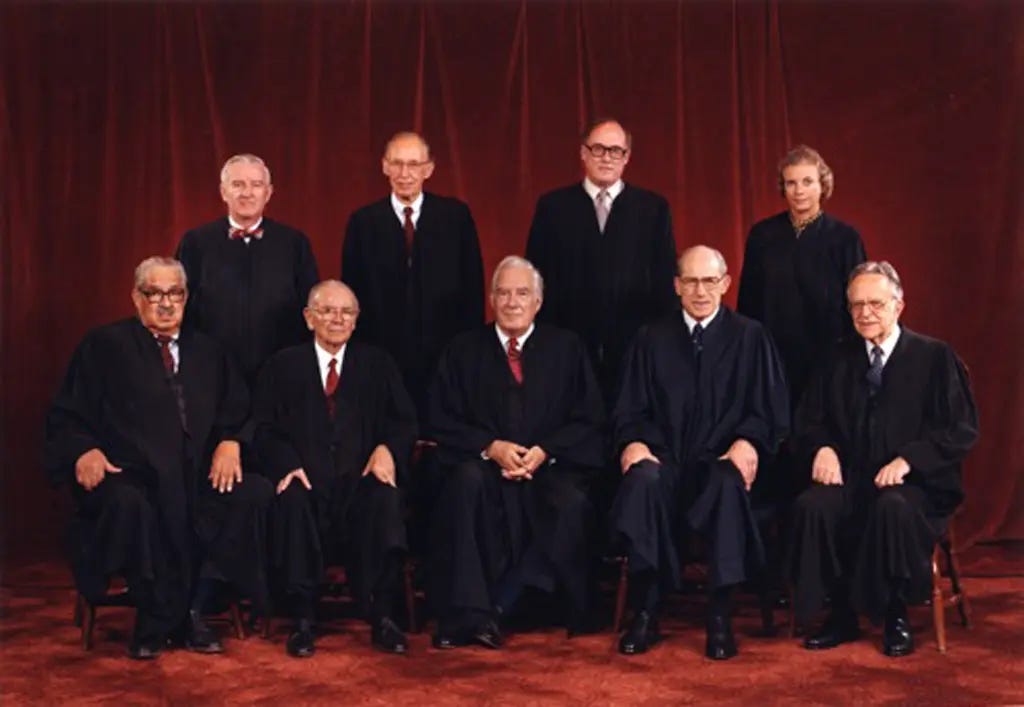
In my view, the legislative veto in Chadha should have been left in place (we’ll return to this later). But it’s certainly debatable. The real sins of Chadha are its scope. Rather than just strike down just the perhaps egregious form of the legislative veto at hand—a single-chamber override of an administrative action about a single person—the majority struck down every legislative veto in existence. It’s the single-biggest nullification of congressional law in the history of the Court, striking down hundreds of provisions. Including two-chamber legislative vetoes of regulatory authority (such as IEEPA/NEA) that seemed at least somewhat less problematic than the INA authority at hand.
But even worse than that, the Court chose to sever the legislative vetoes from the laws in which they were placed. That is, the Court removed the legislative vetoes but left in place the delegations of authority! This completely wrecks the intention of Congress with regard to these laws, because there is no way to assume that Congress would have delegated the authority without the veto, and every reason to believe exactly the opposite: that the delegations and vetoes were a carefully-chosen balance that reflected the obvious trade-offs Congress faced when delegating authority to the executive branch.5
Of course, Congress could just rewrite the laws with tighter restrictions on the delegated authority, or withdraw it all together. Oh wait, they can’t! Because the ratcheting-up problem means that the status-quo is now “delegated authority with no legislative veto.” If Congress wants to change that—and why wouldn’t they want to change that, after a key tool of control was removed from the laws—they would need either the consent of the president (good luck), or a supermajority vote in Congress to override his veto.
The results were all too predictable. In most cases, Congress faced presidential opposition when reshaping post-Chadha, and could neither withdraw the various executive authorities nor put comparable substitute restrictions on its use. On many major authorities that formerly had legislative vetoes, the best Congress could do was put in wimpy joint resolutions of disapproval—essentially fast-track procedures for legislation objecting to executive actions, but which needed to be signed by the president. That essentially meant they would need a supermajority to overturn anything. It’s almost useless.
It’s all fun and games until Trump shows up
After Chadha, an interesting thing happened: Congress kept passing laws with legislative vetoes in them. Hundreds of them. And presidents kept signing them. So much so, that a fair number of scholars don’t think Chadha had much substantive effect. They point out that legislative vetoes of both the “report and wait” variety and “prior-approval” variety exist all over the appropriations process, and that executive agencies strongly adhere to them. They may be informal, but they still work as an oversight tool and a governance mechanism.
I think this is half right. These informal mechanisms, in my experience, work extremely well in the appropriations process. For reprogramming decisions especially, the prior-approval process—where agencies need to get sign-off from the committee leaders before moving money around within accounts—is fully entrenched and working really well, especially for Department of Defense money. But that’s in part because of the nature of the annual appropriations process; as discussed above, money naturally sunsets and you have to come back and beg for more, with inaction favoring the legislature. The repeated game guarantees Congress an easy and obvious way to punish disobedience; the delegated authority, when it’s in the form of money, always expires.
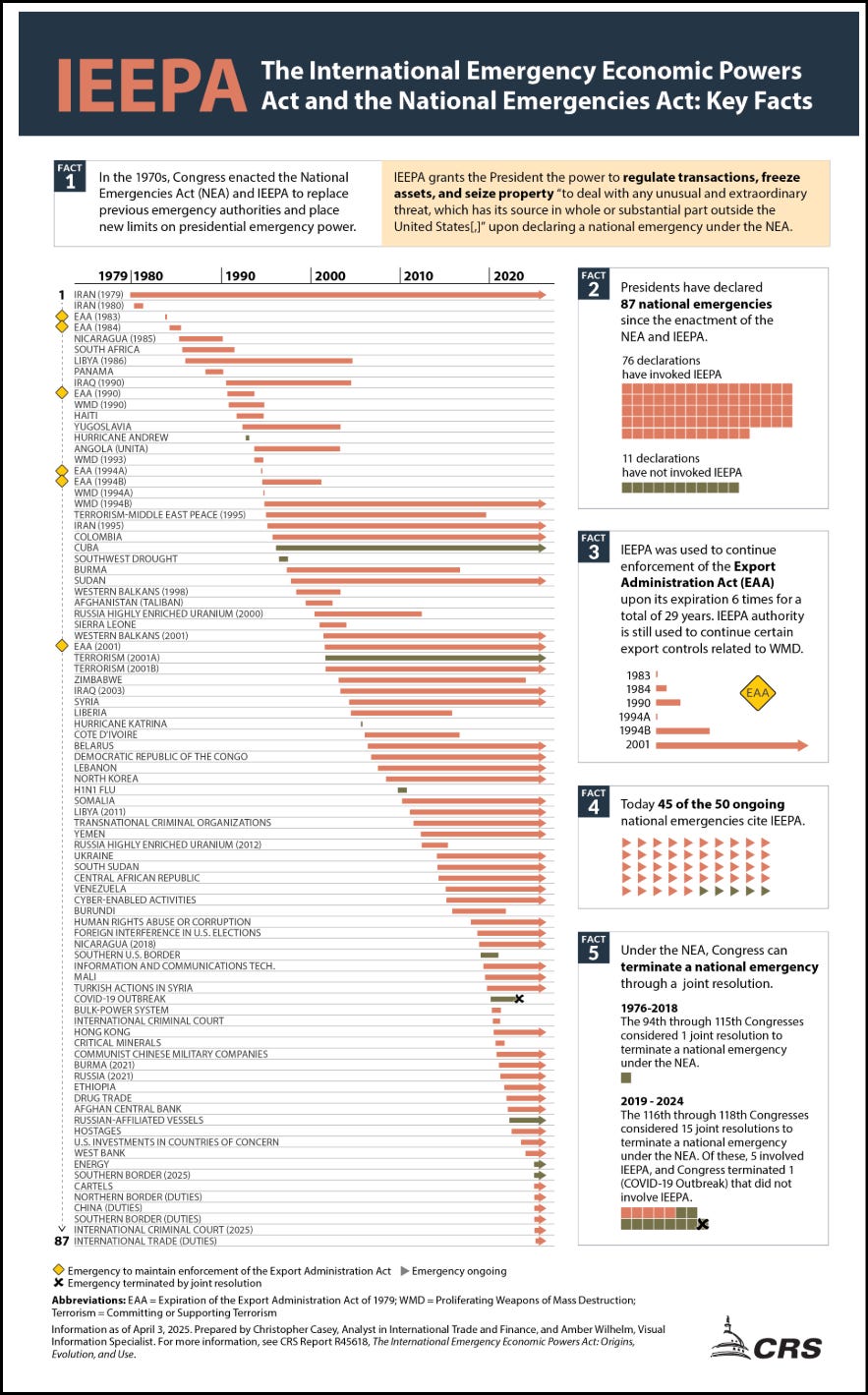
Much less impressive has been Congress’ ability to control use of the emergency powers delegated to the president via the NEA and IEEPA, as well as the post-Watergate constraints of Nixon-era presidential overreach, in the War Powers Resolution and the Impoundment Control Act. The substitution of joint resolutions of disapproval for legislative vetoes has tilted all of these laws toward the presidency, and made congressional attempts to curb executive actions under them mostly inert. And, indeed, declared emergencies have skyrocketed in the last several decades; there are currently 51 in effect, some of them dating back decades. A massive proportion of them are IEEPA emergencies; many people just accept IEEPA now as a regularized tool of presidential trade power.
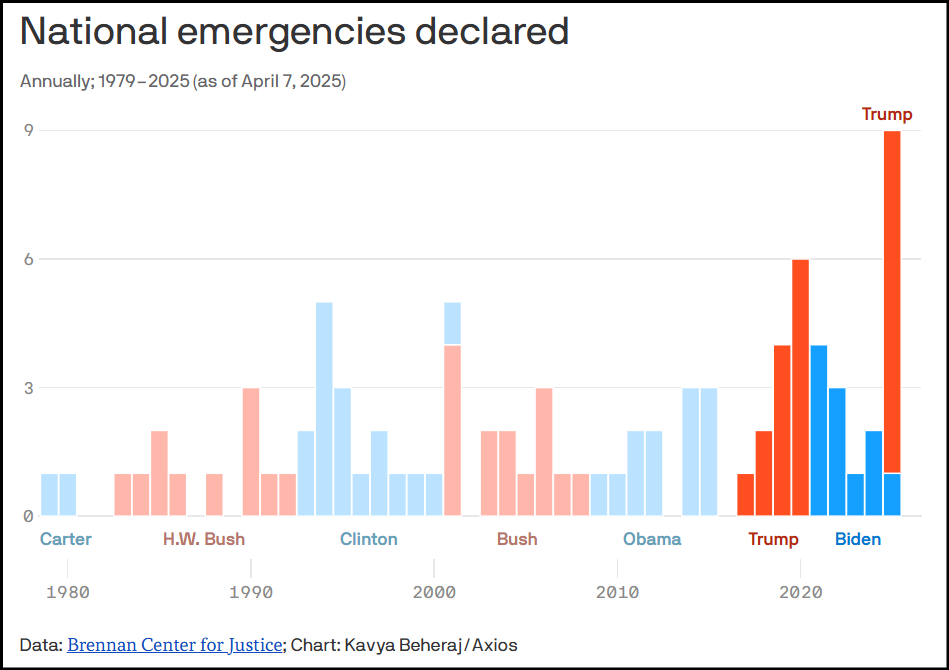
And yet, as Chafetz convincingly argues, Trump has really taken this to a new level. He declared over 20 emergencies across his terms in office, and both of his signature non-legislative policies—the wall on the southern border and the global tariff system—were accomplished via emergency authority. Even more to the point, both the wall and the tariffs were accomplished by emergency authority that both chambers of Congress later voted to overturn—and which would have been overturned under the legislative veto construction of those laws—but which fell short in the post-Chadha-age, because the joint resolutions of disapproval could be (and were) blocked by presidential veto.
The Court Takes Up the Tariffs But Forgets the Legislative Veto
Hopefully, all this makes clear why Learning Resources v. Trump is so frustrating. Nine justices spend 170 pages arguing about whether Congress has delegated tariff authority to the president in IEEPA, without ever bothering to mention at least four pieces of relevant history here. That Congress intended to have much more control over all uses of IEEPA. That they voted this year to end the tariffs in question in the case. That such a vote would have been successful at ending the tariffs had their version of IEEPA still been in force. And that version of IEEPA doesn’t exist because of previous decisions of the Court.
On a fifth relevant point, however—that Congress faces the ratcheting-up problem when trying to claw back delegated power—Justice Gorsuch does show up in defense of Congress:
When a private agent oversteps, a principal may fix that problem prospectively by withdrawing the agent’s authority. Under our Constitution, the remedy is not so simple. Once this Court reads a doubtful statute as granting the executive branch a given power, that power may prove almost impossible for Congress to retrieve. Any President keen on his own authority (and, again, what President isn’t?) will have a strong incentive to veto legislation aimed at returning the power to Congress. Perhaps Congress can use other tools, including its appropriation authority, to influence how the President exercises his new power. Maybe Congress can sometimes even leverage those tools to induce the President to withhold a veto. But retrieving a lost power is no easy business in our constitutional order.
From a legislative power point-of-view, this is simultaneously excellent and enraging. Excellent because judges rarely speak so plainly about the actual political context of separation of powers issues; much more often, they say things that amount to “Congress can change the laws if they don’t like them,” which is sometimes the right perspective but almost always sidesteps the ratcheting-up problem of delegated authority. That Gorsuch is so sympathetic here (and elsewhere) to the realities of legislative politics is heartening.

But it’s equally infuriating, because Gorsuch quite clearly sees that this reality means the Court must be the primary defender of Congress in the face of executive overreach in cases of vague delegation of congressional power. Rather than even muse about the return of the legislative veto—or offhandedly suggest that a belated-striking down of IEEPA itself by overturning the severability decisions might be worthwhile (that would never happen, to be clear)—Gorsuch simply places the Court front and center as The Decider.
Of course, as 170 pages prove, the Court is thoroughly divided as to how to actually decide these things. Instead of Congress policing its own delegations of IEEPA power via the legislative veto, the Court will now continually struggle to decide, case by case and tortured doctrine by tortured doctrine, how much power Congress delegated. Courts obviously have a role to play here—even with the legislative veto, a statutory construction ruling on the applicability of IEEPA to tariffs might be needed—but the wholesale substitution of court rulings for legislative vetoes is sub-optimal for any number of reasons.
First, it doesn’t allow Congress to ok some IEEPA tariffs but not others; that’s a flexibility you might like in a vague delegation of power. Second, it doesn’t allow the current Congress to set the standard, instead locking-in court rulings as forward-going precedent. Related, and third, it doesn’t allow the standard to fluctuate with day-to-day politics; changing circumstances for policy actions are the province of Congress, not the courts. Fourth, it forces Congress to write overly-narrow delegations of authority; the legislative veto gives Congress a permanent safety-valve to not worry about overly-broad delegations. Fifth, litigation takes a long time; Trump’s now-illegal tariffs have been in place for over a year. And finally, it unnecessarily draws the courts into these cases; all of this would be moot if the legislative veto existed.
Congress isn’t blameless here
The best case for overturning Chadha and restoring the legislative veto is a simple one: Congress can produce a virtually-identical statutory structure to the one-chamber legislative veto that would almost certainly be constitutional, by combining sunsets and joint resolutions of approval.
Imagine a delegation of authority to the executive branch that has the following restrictions: any use of the authority (say the declaring of an emergency) requires a 72-hour notification and waiting period after it is announced, before it can go into effect. At the end of that waiting period, the authority expires without going into effect, unless Congress passes—and the president signs—a joint resolution approving the use of the authority, which has fast-track authority in both chambers.
It’s not really possible to distinguish the substantive effects of this from a one-chamber legislative veto. In both cases, Congress delegates authority that either chamber can subsequently block with a simple majority if it disagrees with the use. In fact, the main way you can distinguish this is that it perhaps puts Congress too much in the driver’s seat, since, unlike the legislative veto, inaction blocks the use of the delegated authority. And maybe it creates a lot of work for Congress to affirmatively approve everything.
In any case, this isn’t a hypothetical. Various bills in Congress during the Trump era have proposed to reform existing delegated powers by converting them from joint resolutions of disapproval to sunsets-plus-approval mechanisms, particularly with regard to the NEA. The most common arrangement is to provide short sunsets (often 30 calendar days or 20 legislative days) absent congressional approval via a fast-track process. In 2024, the Senate Homeland Security and Government Affairs Committee held a hearing on the topic and reported out NEA reform legislation. To date, however, Congress has not enacted anything.
One question is why didn’t Congress take this up earlier in the wake of Chadha. The obvious answer is: they did. But the ratcheting-up problem stood in the way. The weak substitutions of joint resolutions of disapproval that replaced a number of the legislative vetoes were enacted under the post-Chadha conditions, in which the delegated authority had been severed but remained with the president. That made it nearly impossible to claw back the authority, and consequently impossible to use the delegation as carrots so the president would consent to stronger mechanisms of control like sunset-and-approval. The same problem remains today with any of these reforms.
But Congress also deserves some of the blame. Since Chadha, there’s been no excuse for using joint resolutions of disapproval rather than sunset-and-approval arrangements. But in several cases—most notably the Congressional Review Act, which passed with a veto-proof majority as part of other legislation—Congress used disapproval mechanisms. Not surprisingly, the Congressional Review Act has been mostly useless, except when administrations change hands; presidents simply aren’t going to sign legislation overturning their own administration’s regulations. Other times, Congress has simply not acted.
Likewise, Congress often chooses to not sunset delegations of authority that, in my view, should never be given to the president on an open-ended basis. This is most notable with Authorizations for the Use of Military Force (AUMFs). Smart practice for Congress would be to sunset every AUMF at two years; not only would that prevent what happened with the 2001 and 2003 AUMFs for the global war on terror and Iraq—which were stretched and used as justification for things for decades—but it would also be more responsible for each Congress to be forced to take formal responsibility for ongoing wars.
The Court did lasting damage to the separation of powers in Chadha, and they are not turning back. Restoring the balance will be up to Congress.
P.L. 95-223; 91 Stat. 1626; 50 US.C. §§1701–1707.
Note how this is not true of mandatory spending, such as social security. With the entitlement programs placed in permanent law, inaction perpetuates them. The only way for Congress to adjust such spending involves the president (or the unlikely 2/3 supermajority).
It’s worth noting that the House and Senate never passed the same resolution to end the emergencies related to the tariffs, so even under the original provisions of IEEPA and the NEA, what they did would not have ended the emergency and the tariffs. But I have little doubt, however, that if these weren’t symbolic votes but instead had actual potential to end the tariffs, the two chambers ultimately would have passed the same resolutions.
Again, for an excellent account of Chadha, see Chafetz, The Chadha Presidency.
The majority opinion does address this, and makes a plausible argument that, in the specific Chadha veto, Congress had put a severability clause in the Immigration and Nationality Act. I don’t buy it, but it’s there.
Great piece! As someone who keeps a fairly close eye on politics I can’t believe I was totally ignorant of the history of the legislative veto!
Regarding justices not normally speaking to the realities of separation of powers in how difficult it is to get the President to agree to reduce his power. I think the simple answer is that they think that for legislating purposes, the President is part of Congress. It is not a bug but an intended feature of the system that Congress cannot deprive the President of delegated powers without his consent because there is a reason that legislative power was not just limited to the House and Senate. Basically it is not a principal agent problem, but rather part of Congress just wants to go further, then the entire institution. Just as when the House wants to take some power back from the President and the Senate rejects it. Similarly, it is an intended feature that the president be able to block any such change.
Describing this as a separation of powers problem is like describing the fact that the same party controls both Congress and the presidency as a separation of powers problem. Basically, the problem is not that Congress is being undermined. It’s that the institutional decision making mechanism doesn’t agree with you on decision-making. It’s telling that you yourself start complaining near the end that Congress has many options to deal with the inability to enact legislative veto but doesn’t care to do so, and gives the executive far more power than you wish it would. From the lens of your principal agent perspective, these complaints make no sense. Of course. If the principal wants to give the agent more freedom, the agent should receive more freedom. That’s not interfering with the execution of the will of the principal. Your problem is instead that you disagree with the principal on substantive policy regarding what the agent should not be capable of doing.
Indeed, often, Congress may not wish to decide an issue, even if it could do so in advance because it wants the executive or some other actor to take up the decision and take it out of Congress‘s hands. If you disapprove of this, it would make much more sense to call for a stronger non-delegation doctrine. Instead of complaining that Congress has been deprived of a tool to limit executive power. When you yourself admit that it has other such tools and the problem is that it doesn’t want to use them because it’s Happy giving the executive more power.