

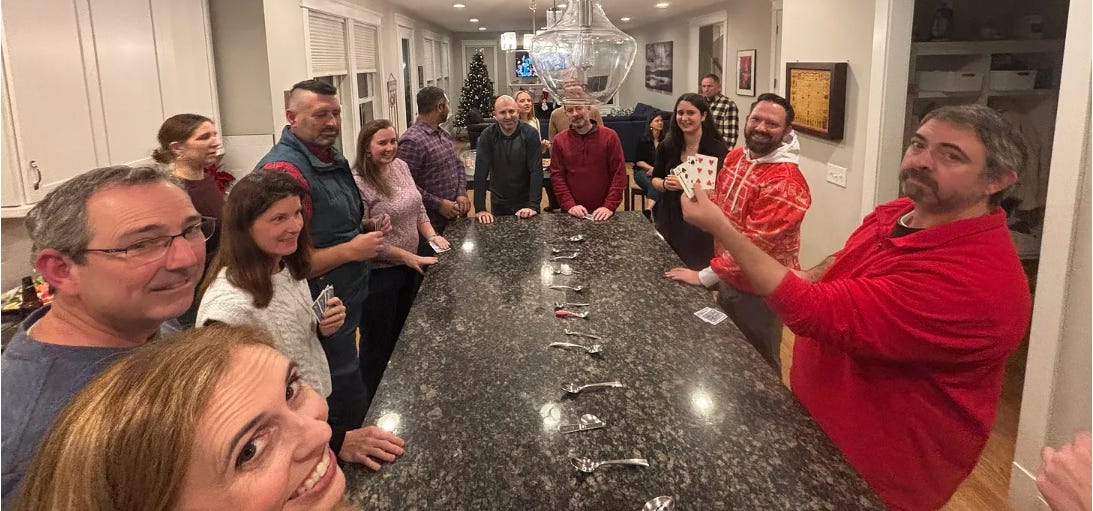
There comes a moment in every game of Talking Rule Spoons where the wheels completely come off and you have to just stop and marvel at what is going on in your kitchen.
At our New Year’s Eve party Wednesday night, it happened with three people left in the game. Geoffrey, Anna, and Tess. One adult and two teenage girls, standing around our island countertop, trying their best to figure out how the hell they were even going to get the game restarted, let alone finish it.
The problem was that twelve other people—those of us who had already been eliminated—were having the time of our lives making it difficult for them to proceed. Someone had turned the stereo up. Like, all the way up. Someone else was working the kitchen lights, flashing them on and off at roughly 5 flickers a second, creating a strobe effect throughout the room.
Four or five people were drumming their hands on the countertop as loud as they could. Separate people were loudly arguing various concerns in Geoffrey, Anna’s, and Tess’s ears. And Eugene—who had seemingly been eliminated in the previous round—was loudly protesting that he wasn’t actually out and strenuously demanding to be dealt in.
Geoffrey made eye contact with me and just started shaking his head. Anna and Tess had given up for the moment and were just staring around the room in wonder. All three of them looked like they might crack at any second and deliver a huge Shut the Fuck Up to one or all of us.1
But of course, that’s exactly what we wanted.
Because then they’d be out of the game too.
A Good Dumb Game, Made Great by a Brilliant Rule

Old-fashioned Spoons is a pretty good dumb game. Get n people, n-1 spoons, and a deck of cards with n ranks, the rest removed. Put the spoons in the middle of a table or island countertop and have everyone sit/stand around it. Deal out the cards so everyone has four. Then have a leader say “pass” about once every three seconds, everyone passing a card left each time.
If you make 4 of a kind, you can grab a spoon. The instant anyone grabs a spoon, everyone can grab a spoon. The person without a spoon gets a strike. Unless no one has 4 of a kind, then the first person who touched a spoon gets a strike. Set it all up again. Rotate everyone one spot around the table. Repeat. We play two strikes and you are out. If someone gets out, reduce spoons by one and cards by one rank. Continue until one person is left.
It’s so stupid but so much fun. And it’s impossible to play without constantly laughing. The intensity of the mad dash for the spoons often takes rookie players by surprise. And the ferocity of normally-calm people is both hilarious and revealing. People dive across the island. The spoons end up on the floor and you see people throw body checks. Minor injuries are not uncommon.
As I wrote last week, you really haven’t lived until you’ve seen your quiet, unassuming neighbor dive across your kitchen counter in her Christmas sweater to try to rip a spoon out of a child’s hand, all while everyone—including the neighbor and the child—is losing it laughing.
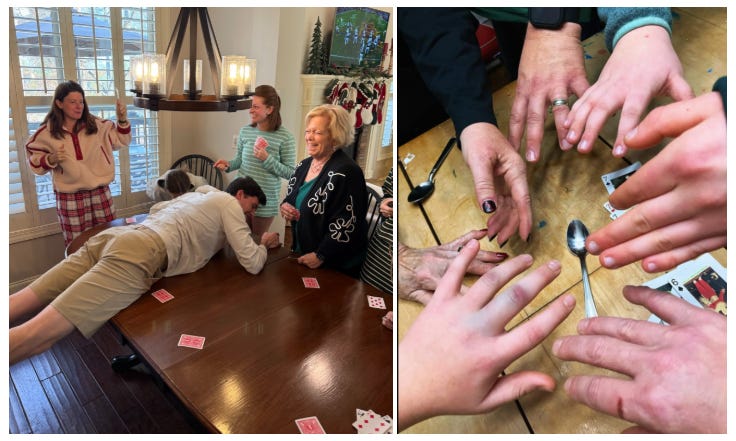
But, in the end, traditional Spoons is not a game you ever want to play. Because Talking Rule Spoons completely and utterly dominates it in all respects.2
Ok, the talking rule: once someone is out—and immediately upon them being out—if you communicate with them in any manner, you are also out.
This ups the mayhem dramatically. Because at the end of a round, players who are left are trying to deal the next round, not fully sure if a new person has gone out—was that their second strike?—and 4 or 5 people who are definitely out will be loudly demanding to be dealt in or asking random questions.
And if you even acknowledge any of it, you are out. And so your wife is impatiently asking over and over "what time are we going to get the desserts out?" as your kid is whining for your help while your sister is claiming you forgot to deal her in.
The obvious beauty of the talking rule is that it keeps everyone involved in the game, even after they are eliminated.
The more subtle beauty is that it destroys the very structural foundation of the game itself. Traditional Spoons takes a break between deals, and if there are any problems or disputes, you can easily work it out. Talking Rule Spoons destroys the very idea of between and deal and work it out.
Consequently, the game has two phases. Until the first person is eliminated, you are just playing traditional Spoons. The moment anyone is out, the game becomes the Talking Rule Spoons meta-game, a snake eating its own tail.
Rules, Meta-rules, and the Impossibility of Enforcement
Talking Rules Spoons requires a few meta-rules for people who are out. Ours are very simple. If you are out:
you may not touch the spoons;
you may not touch the cards;
you may not touch the players or throw things at them; and
you may not impede the basic mechanics of the game.
The last rule is usually explained with the examples that you cannot place your hands in front of the eyes of one of the players, nor may you stand at (or on) the island in a way that makes it more difficult for players to pass the cards.3
Anything else—and I mean anything else—is fair game. You can stay at the island. You can scream. You can bang on the table. You can ask people endless questions. You can dispute rulings. You can demand to be dealt in. You can loudly say “pass” out of sync with the game. You can fake grab at spoons. You can start tossing a football back and forth across the table with someone else who is out.
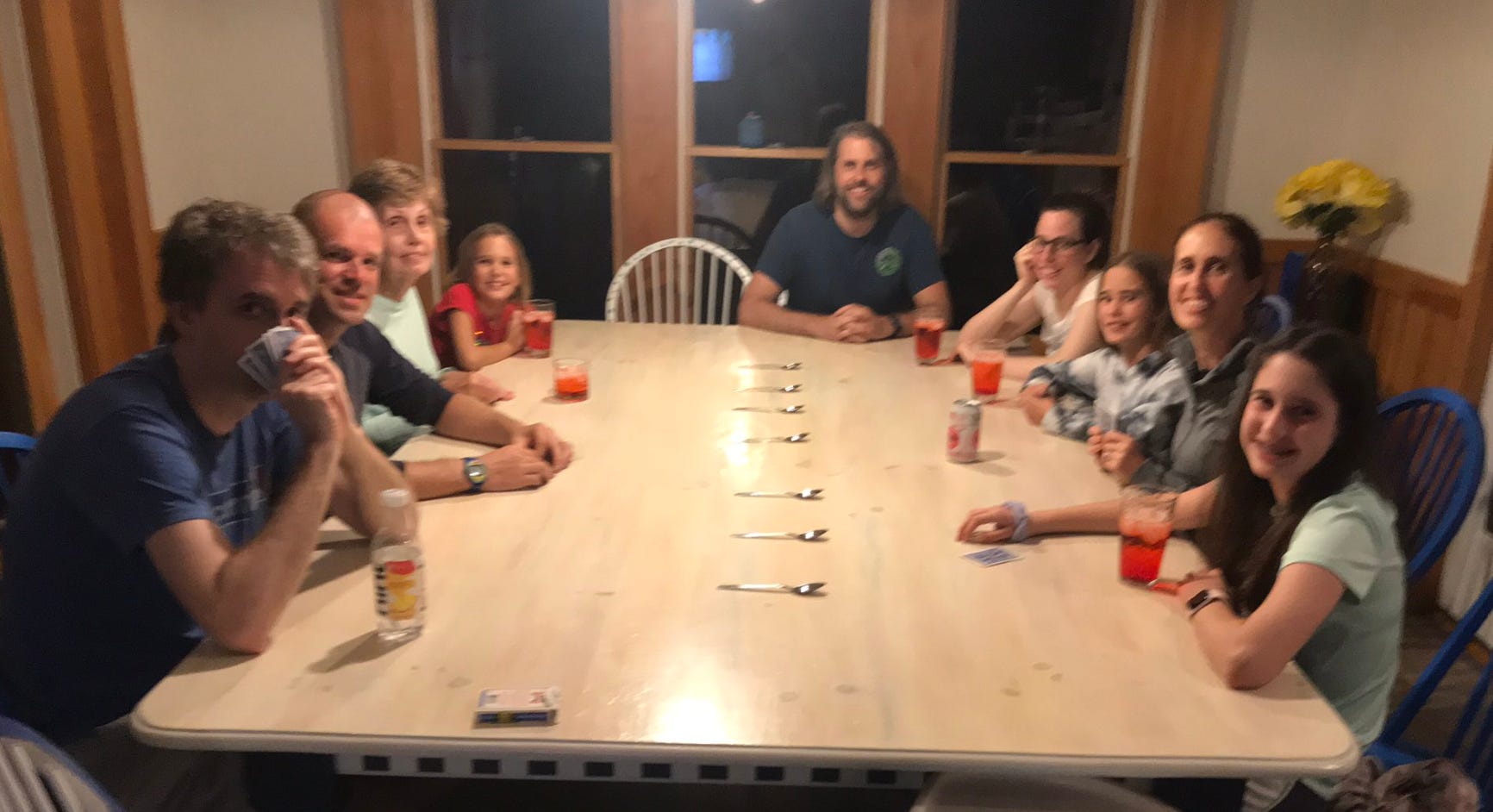
This all immediately creates wonderfully delicious problems. The first and most important one is that it becomes very difficult to figure out what happened at the end of a round. You enter a grey area where you cannot be sure what happened, but you need to figure out exactly what happened.
Someone will be not holding a spoon. That definitely gives that person a strike. But was it their second strike? Are they out? They will be saying they are not in either case. So you can’t trust them, which means you can’t talk to them. And if they are out, did anyone else accidentally talk to them? Is there anyone you can trust to talk to so you know how many spoons and cards need to be setup for the next round? Did I mention four people will be banging on the table and screaming things at your during all this?
The core problem is that reasonable dispute resolution requires (1) understanding the facts of the situation; and (2) applying the rules to the facts. But both of these things are really hard to accomplish if you can’t talk to people, and particularly if you can’t respond to arguments people are making, even if you know for sure the arguments are ridiculous.
One extremely common Great Moment in any Talking Rule Spoons game is when you are huddling across the island with two other people who you know aren’t out, saying things like “I’m only talking to Dan right now. My understanding is that Sarah just got her second strike, so she’s out, and I’m pretty sure Michael talked to her, so he’s out, so we need to get rid of two spoons and two ranks of cards.” And Dan just looks at you and says, “But I think Anna talked to Michael, was that before or after Michael talked to Sarah?” And you just break down laughing, because you barely heard what he said, because Sarah, Michael, and Anna are all loudly protesting various facts of the matter.
The other delicious moment is the one that opened this post—when the people who are out are flagrantly stretching the limits of the don’t impede the game rule. This puts the still-in players in a bind, because they don’t really have any recourse to enforce the meta-rules except to appeal to the better angles of the out-players nature, in the hopes that individual bad behavior will be shut down by other players who are out. Is it going to be Lord of the Flies or Hayek’s Spontaneous Order?
Talking Rule Strategies
One glorious aspect of Talking Rule Spoons is that a good elimination via the talking rule is almost as satisfying—and sometimes more satisfying—as winning the game. So people go hard trying to bust people once they are themselves eliminated.
The strategies used as an out-player are limited only by your imagination. I’ve been playing for 30 years, and I still see genuinely novel stuff all the time. But generally, there are four categories of plays you might make, depending on your goals:
First, if you are earnestly trying to get someone out, subtle techniques are the best. Walk away from the table for a few minutes, then pop back in and ask someone a normal question unrelated to the game in a calm voice. Stuff like “Where are the paper plates?” or “What time should we have dessert?” can work well.
I busted second earlier this month on a devastating “Mr. Matt, can I charge my phone here?” from a neighborhood teenager in a two-family game. I blurted out “of course,” and didn’t even realize I was cooked. Only one person was out and the game was still very sedate. Devastating.
Game-related incorrect queries can also draw emotionally-charged responses. “I thought you got out?” and “You have a strike, right?” sometimes trip people up before they can rationally collect themselves.
But the key subtle technique is playing it cool the moment you go out. More people bust on the talking rule at the end of a hand than any other time. The chaos and the uncertainty of what happened make it much easier to catch people.
If you don’t rant and rave like an idiot when you bust—easier said than done—you can often drag someone with you just by saying “who doesn’t have a spoon?” or “did you see Dave hit the floor there?” right after the mad dash. And even if you got out four rounds ago, the end of round chaos is a great spot to drop a disagreement about what just happened and see if you can get anyone to bite.
The second category of plays are annoyance gambits. The goal here isn’t necessarily to get people out immediately—though boiling someone over and getting them to lose their temper and scream at you is a truly fantastic badge of honor—but rather to bring up their anger level so you can soften them up for subtle plays later. General game disruptions are classic. Bang on the table. Get everyone who is out to call “Pass” loudly and randomly out of sync with the game. Turn the lights off. Turn the music up. Open the windows during the winter.
Personal annoyance gambits also work well. Stand right in someone’s ear and talk nonsense to them for a whole round. Or grab a whistle and blow it right behind them.
A third excellent set of plays are attacks on the game. First off, interject yourself into all discussions about what is going on. And dispute everything. Second, make lots of fake spoon grabs. It’s not uncommon late in a game to see multiple hands fake going for the spoons after every pass. And while getting someone to wrongly grab a spoon doesn’t always get them out—it might be only their first strike—it is very satisfying when you pull it off.
The last category of talking rule plays are the fourth-wall gambits. You see some stunning stuff here, especially from kids. The basic idea is to start doing things that are truly external to the game, daring someone who is still in to tell you to stop. Are you 17 years old and both of your parents still in the game? Just ask them if it’s ok if you have a beer, and when they don’t answer just go crack one open and start chugging it in front of them. My buddy’s 12 year-old went and found his credit card and started ordering Fortnite V-bucks. Grab your wife’s phone and start reading her texts out loud. Go find your sister’s diary.
Some of the best fourth-wall work are the fake emergencies. Earnest interrupt the game and claim the dog got loose, or some red wine spilled on the carpet, or that two kids broke the TV in the basement. The possibilities are endless.
When my middle daughter was about 11, she pretended to fall down the stairs during a game, after being the first one out. We were 98% sure it was a play—I mean, the Bayesian posterior probabilities here are absurd—but she was legitimately crying and screaming and all of us were standing around her at the bottom of the stairs and what the hell do you do when a tween is laying on the floor shrieking “Daddy, my ankle! Please, this is real!” for more than 3 minutes?
We broke down and talked to her. Because we are idiots.
The Game Theory of Spoons
There’s not that much to the actual game play in Spoons. You have four cards and you keep passing them. Then you try to grab a Spoon. And you try not to talk to people who are out. But there are a few tricks.
First off, remember that the goal of the game is not to make four of a kind, but to grab a spoon. Therefore, one strategy you might deploy—especially when you are on the end of the island and don’t have that many spoons within reach—is to give up on trying to make four of a kind. Don’t even look at your cards. Just pick up whatever is passed to you and send it to your left on the next pass. Keep your eyes on the table so you can get out of the blocks quickly when someone else makes four of a kind.
An alternative play that also works well is to help the person on your left. At a crowded island, it’s very easy to see the other players cards, and if you have a pair card for someone at the start of the hand, you should feed it to them as your first pass, before they pass its twin away. Once you know what they are collecting, you will know when they make four of a kind before they do. That’s quite useful.
A second strategy you see a lot is people who just refuse to talk to anyone. They try to go the whole game completely buttoned-up. It’s a solid move, if you can pull it off. Just commit yourself to not talking. At all. The problem is that it also makes you a target for annoyance plays. People who are out really come after people who seem to be trying too hard, and so if you are going to go this route, expect to have someone camped out on your ear pretty quickly.
Third, throw a lot of fake spoon grabs. That’s just fun. And you’ll be surprised how often you can catch someone with it. But it also softens some people up and slows them way down when a real spoon grab is initiated, which can occasionally be the difference between you getting a spoon and a strike. Here’s an early game fake-grab from New Year’s Eve that nailed someone for a strike:
Finally, take advantage of the chaos. Absolutely enforce the rotation rule after each round when you are on the end of the island and in a disadvantaged position. But if you are in the middle and no one else is pushing for a table rotation, let it go and reap the benefits. Rules only matter if someone is trying to enforce them.
And in Talking Rule Spoons, that’s a lot harder than you might think.
I am truly devastated I do not have a video of this sequence of mayhem. I had setup to video the game, but my phone died halfway through.
I had played traditional Spoons as far back as I can remember (early 80s), but I first learned the Talking Rule at my girlfriend’s (now wife’s) house in summer 1995, when I was 17. They played P-I-G (i.e. three strikes), and stuck their tongues out instead of grabbing spoons. But the Talking Rule was the real eureka of their game. And they had played it as far back as my wife can remember.
There are also some extra rules to the basic mechanics of the game that can make Talking Rule Spoons go more smoothly. One is the principle that you cannot be holding cards and a spoon at the same time. That is, you must drop your cards as you go for a spoon. This also helps you if you go out, because one of the few defenses someone has to you getting them on the talking rule is if you still have cards in your hand, you are breaking one of the meta-rules.
"Rules only matter if someone is trying to enforce them."
Also fairly pertinent to the United States Senate.
If you like spoons check out Jungle Speed. It's originally a French game I think, but has a similar mechanic of everyone grabbing for a totem from the middle! Similar chaos ensues!