

With the midterm congressional elections approaching, Republican Supreme Court-watchers are getting nervous.
They would very much like one or both of the older conservative Justices—Clarence Thomas (age 77) or Samuel Alito (age 76)— to retire this year, so that a replacement nominee of President Trump’s can be confirmed by the friendly GOP Senate majority.
If they don’t retire this year, the Democrats might flip control of the Senate in November, giving them leverage to bargain for a more moderate nominee or to outright defeat (or just ignore) any and all Trump nominees. Some Democrats are already promising to do just that.
Strangely, there’s an easy way around such a majority blockade, and it doesn’t require pressuring justices into strategic retirements. Just like an actual naval blockade, you can run a Senate majority nominations blockade by getting your cargo out to sea before the blockade gets set up.
That is, President Trump could nominate—and the current Senate could confirm—any judicial nominations they want, stockpiling them for potential future vacancies that occur next Congress, and removing the next Senate from any role in their consideration.
Think of it as floating storage, out to sea beyond the reach of the blockade.
One reason I’ve been hesitant to write about this is that I don’t think it would be a great development for the Senate if majorities started stockpiling confirmed court nominees for president to later deploy. And I’m decidedly unenthusiastic about giving Trump a good strategic legislative idea.
But given the partisan hardball trajectory we are on—a blockade is coming eventually, whether we like it or not—I think it’s worth laying out the procedural and politics dimensions of blockades and stockpiles.
Wait, is stockpiling really legal?
Yes, it appears to be legal. Every appointment made by the president to a Senate-confirmed position in the executive branch or the judiciary has three distinct components:
A nomination made by the president;
The consent of the Senate via confirmation; and
The actual appointment, via written presidential commission.
Traditionally, we think of all three of these things as happening after a vacancy arises in an executive or judicial office. And that’s usually the case.
But for the first two, it’s totally unnecessary. There’s no requirement that presidents wait for vacancies to arise in order to make nominations, or for the Senate to confirm those nominations.
In fact, this regularly happens in both executive branch and judicial nominations. It allows for continuity and smooth transitions in cabinet positions—we usually have the Secretary of Defense remain in his position until his successor is confirmed by the Senate—and Supreme Court retirements can be—and have been—conditioned on the successful confirmation of a successor. And there’s decades of case law to back this up.
More questionable is whether the president could actually appoint someone—that is, could they literally sign the commission—without there being an actual vacancy in the office or judgeship. The Biden administration believes the president can, but there’s less caselaw and this seems more in dispute.
But it doesn’t matter. For the purposes here—stockpiling confirmed nominees before the other party gets control of the Senate—all that needs to happen is nomination and confirmation. And there’s no dispute that both of those things can happen prior to a vacancy arising.
A second question is whether the president can delay signing a commission for a Senate-confirmed nominee. Again, the answer is yes. The president is under no obligation to ever actually appoint someone who they have nominated and the Senate has confirmed. Until the president signs your commission, you do not hold the office and the president retains full discretion to appoint or not.
But what about across different Congresses? Maybe the president can’t get a nominee confirmed in Congress A and wait to appoint them to the position after Congress B has commenced? There’s essentially no jurisprudence here, but past practice has been that presidents can and do sign commissions and make appointments for nominations that were confirmed in the previous Congress.1
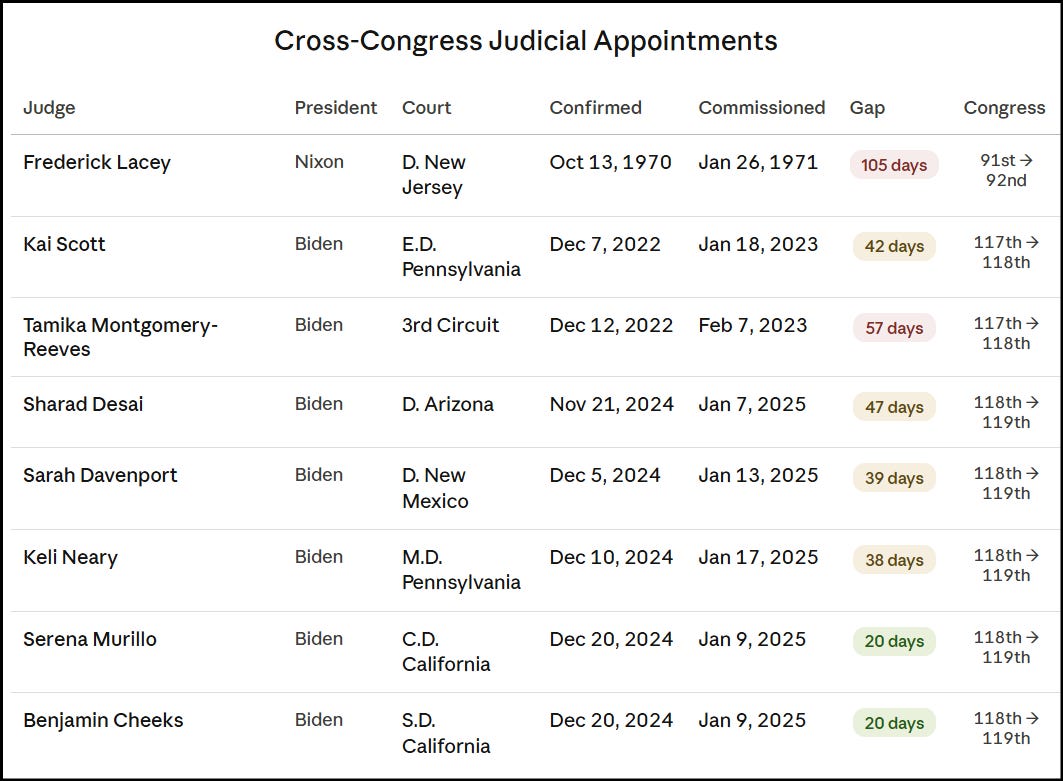
A search of the Federal Judicial Center biographical database reveals eight cases in which a judge confirmed in one Congress was commissioned by the president in the next Congress. This includes five contemporary judges nominated by President Biden, confirmed by the majority-Democratic 118th Senate, and commissioned during the early days of the Republican-controlled 119th Senate.2 I can’t find any evidence of Republicans objecting to these appointments.
A final question is whether the Senate can reconsider a nomination it has already acted upon. That is, can the Senate in Congress B choose to rescind its consent for a nomination already given by the Senate in Congress A. Under Senate rules, there’s a standard parliamentary motion to reconsider. But once that is disposed of—usually via unanimous consent immediately after the confirmation—the nomination is returned to the president, and the Senate loses control of it.3
How did we get here?
Public pressure from partisans to strategically retire from the Court is not new. Democrats mounted a campaign in 2022 to encourage Justice Breyer to retire before the midterms in case the Republicans took the Senate—which he ultimately did.
Justice Ginsburg, on the other hand, ignored similar public pressure to retire during Obama’s term. She eventually died in 2020 while still serving on the Court, allowing President Trump to nominate her replacement, and tarnishing her reputation among liberals.
This sort of public partisan pressure for Justices to retire has arguably increased in the past 20 years, because opposition parties in the Senate have more strongly opposed most nominees to the Court. Gone are the days of Justice Scalia 98-0 confirmation in 1986, or even Chief Justice Roberts 78-22 bipartisan confirmation in 2005.

The last five confirmations have been closer to straight party-line votes: Justices Kagan in 2010 (63-37, 4 Republican votes), Gorsuch in 2017 (54-45, 3 Democratic votes), Kavanaugh in 2018 (50-48, 1 Democratic vote), Barrett in 2020 (52-48, no Democratic votes), and Jackson in 2022 (53-47, 3 Republican votes).
Perhaps more importantly, the nomination of Merrick Garland by President Obama in March 2016 (after Justice Scalia passed away) was never even voted on in the Senate. Under the leadership of then-Majority Leader McConnell, the GOP Senate majority refused to even take up the nomination, setting up a complete majority blockade for the remainder of the 114th Congress.4 When Trump won the 2016 election, the Garland nomination withered, and Justice Gorsuch ultimately replaced Scalia on the Court.
The Garland precedent is exactly what Republicans now fear. If the Democrats win control of the Senate, might they actually set up a majority blockade on any Supreme Court vacancies for a full Congress, in hopes of winning the presidency in 2028 and filling the seats themselves? It’s entirely possible, maybe even likely. And that’s why so many Republicans are pushing for retirements now.
But, again, the retirements aren’t necessary. They could just nominate, confirm, and stockpile appointments right now.
Why hasn’t anyone tried this before?
If you can really stockpile confirmed nominees, why haven’t the parties been doing this all along?
Mostly because we are—and yes, I understand I am abusing the blockade analogy here—entering largely uncharted waters.
Prior to the mid 1980’s—and really prior to 2010—nominations just weren’t highly partisan issues. With a handful of exceptions, Senators mostly confirmed nominees on a non-partisan (or softly-partisan) basis, and opposition parties didn’t spend a lot of time or energy trying to limit the total number of successful confirmations.
The very idea of a blockade—and consequently the necessity of blockade-running strategies—wouldn’t have even occurred to Senators or the parties.
Beginning roughly with the failed Robert Bork nomination in 1986, a steadily growing partisanship entered into confirmation politics. But it was mostly mild—remember, Roberts gets 78 bipartisan votes as late as 2005.
By 2011, however, the intensity had grown considerably, and there was significant Republican obstruction on judicial nominations by President Obama in the 112th and 113th Congresses.
But it was minority obstruction by Republicans—the Democrats controlled the Senate—using the filibuster to block and/or slow down nominations. And a minority blockade in the Senate is easily dealt with by other means: you nuke it.
In November 2013, Democratic Majority Leader Harry Reid successfully invoked the so-called nuclear option, in order to end the filibuster on nominations to executive branch offices and judicial nominations to lower courts. (Four years later, Republican Majority Leader McConnell would do the same to eliminate the filibuster on Supreme Court nominations). The pace of confirmations increased after the nuclear option, as you might expect.
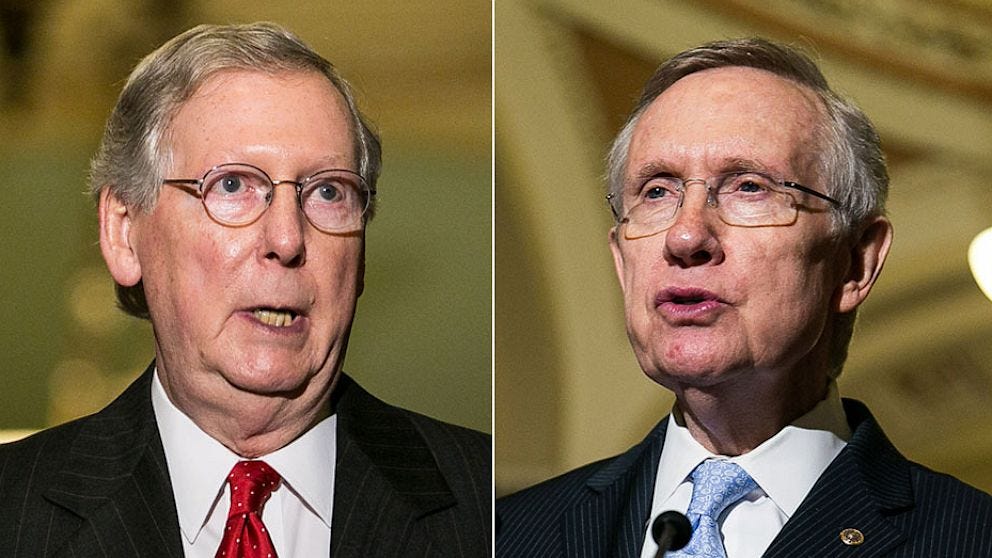
When the Republicans won control of the Senate in the 2014 elections, they did indeed setup a mild majority blockade in the 114th Congress—McConnell refused to bring the Garland nomination to the floor for almost all of 2016—and the pace of confirmations again slowed, though by no means came to a complete halt.
But since the 2016 election, the issue has been dormant. We have never had an opposition party control the Senate since the end of the 114th Congress. The GOP controlled the chamber during all of Trump I (115th and 116th), and the Democrats had the majority during both Biden Congresses (117th and 118th).5 In 2024, the GOP won it back concurrently with Trump winning the presidency.
If the Democrats win the Senate in the 2026 midterms, it will be the first time we have an opposition-majority in the Senate in the post-Supreme Court filibuster era.
And we simply don’t know how such a majority will behave. My hunch is an opposition majority will not have the political stomach (or public support) for a complete and total judicial blockade of all nominations to all courts. As much as that sort of hardball might appeal to some partisans, it doesn’t comport with modern practice, even in our highly polarized age; a significant number of judicial vacancies in the lower courts are still filled by voice vote or unanimous consent in the Senate.
But would an opposition majority blockade Supreme Court nominations for up to two years, in hopes of winning the presidency? I’m not sure, but I can imagine there would be a lot of pressure on Democrats to do so in 2027 and particularly 2028. It wouldn’t surprise me in the least if they did.
And remember: there’s no nuclear option when facing a majority blockade. You can’t just blast your way through it. Trump and the Republicans would have to either negotiate an end to the blockade, try to use public pressure to induce its political collapse, or both.
Or, as I’ve suggested here, they could get the nominations out to sea now.
Isn’t all this bad for the Senate?
Yup. A majority blockade of judicial nominations and a preemptive stockpiling response both seem bad for the Senate as an institution.
Stockpiling has the potential to be a huge waste of time. Taken to its logical extreme, you could imagine the party of the president confirming a nominee for literally all 870 federal judgeships, so that any vacancy that arose in the second Congress of a presidential term, under an opposition Senate, could be immediately filled.
This seems like it would be grossly sub-optimal for everyone involved. It’d require the Senate, the Senate Judiciary committee, and the White House Counsel’s Office, to vet, consider, and confirm tons of nominees who ultimately would never end up being appointed.
It’d be even worse for the nominees themselves—who the hell would want to suffer through the onerous vetting process with no real chance of actually getting the judgeship? And it probably also does the public a normative disservice to have appointees who weren’t vetted recently, or considered in light of contemporary political dynamics.
Stockpiling confirmed nominees would also be another escalation of partisan constitutional hardball, and that’s probably, on balance, bad.

Perhaps most importantly, it would also be an example of a Congress tying the hands of a future Congress. That’s generally something I’m against.
But it seems to be the direction we are headed. The current unified Republican majority is poised to try to enact appropriations for ICE and CBP via the reconciliation process, with the specific goal of locking in the funding for multiple years, precisely to avoid a future Democratic House in 2027 from having a say in the funding decisions.
If this is how unified governments intend to behave—locking in policies that prevent the second Congress of the presidential term from meaningfully appropriating or considering nominations—that will inevitably make Congress less responsive to the electorate, and the executive less responsive to Congress.
As a strategic partisan matter, stockpiling nominees barely looks different than multi-year annual appropriations. The only question is what the public politics will bear. That’s true for blockades and true for blockade-running via stockpiling.
I can imagine strong public resistance to blockades and preemptive stockpiles. I can also imagine it mostly blowing over politically, just as the nuclear option did in 2013/2017, and the McConnell blockade did in 2016.
There’s also an order-of-operations issue here. We may not see stockpiling become politically viable until after we encounter and endure another serious majority blockade. The politics of a preemptive stockpile would be easier at that point.
One way or another, the era of treating Supreme Court vacancies as they arise—and assuming the Senate will be there to process them—may be coming to a close.
Note the distinction here from a nomination that is pending in the Senate at the end of a Congress. Under Senate rule XXXI, clause 6, any nominations pending in the Senate at the end of a session are automatically returned to the president, unless the Senate agrees to suspend the rule and retain the nomination.
Ten other potential cases exist. Nine where the judge is commissioned on either January 3 or (under the old congressional calendar) March 4. Those cases are ambiguous, because if the commission was signed before noon, it would have occurred in the same Congress as the confirmation. The 10th case is Albert Reeves, a judge nominated by Harding and confirmed by the 67th Senate. The FJC database shows his commission being signed 151 days later, in the 68th Congress. But other sources indicate his commission was signed the same day as his confirmation. He is excluded for this reason.
I can’t find any historical evidence of the Senate attempting to rescind a nomination after consenting to it, disposing of the motion to reconsider, and returning it to the president. There is U.S. vs Smith, with deals with a motion to reconsider made after the nomination was returned to the president. It’s not implausible that the Senate could construct rules and argue that they have the power to undo their consent prior to the signing of a commission and appointment by the president, but the current Senate rules do not contemplate this at all, and it’s unclear how the Senate would even go about formally trying to do it.
Garland was never going to end up on the Court. If McConnell had brought the nomination to the floor for an up-down vote, it would almost certainly have been rejected. Voting down nominees is, of course, also a majority blockade. But McConnell’s refusal to take the vote was not what killed the nomination, and the decision to bury the nomination rather than vote it down was probably borne out of a desire to protect vulnerable GOP Senate candidate from a tough vote.
This isn’t technically true, since the terms of Congress do not align with the terms of the president. From January 3rd to January 20th in 2021 and 2025, we briefly had opposition majorities in the Senate.
If you want to establish the political groundwork for a future expanded/packed Supreme Court, playing with these kind of tricks is how you get there.
There are many arguments a future Democratic administration could use to justify expanding the court. The argument for preserving the current Court size and conservative majority comes down to comity and “this is how it’s been done for decades, the current majority was arrived at fair and square, so let’s not change it even if we’d like to”. Get too experimental in how you maintain that majority, you’re handing over the moral argument.
Full disclosure: I am very much *in favor* of the Democrats expanding the court in a future administration, and the main challenge there is convincing my fellow Democrats. These tactics will make that argument wildly easier.
Quibbling about the terminology, I recall back during the 2013 drama, that some experts were arguing that the term "nuclear option" was being misapplied. That it referred not to ending the filibuster for types of nominees, but rather the response to it. The idea being that if the majority ended the filibuster, that the minority would invoke what they called the nuclear option, which was to object to every single instance of requesting unanimous consent henceforth, grinding the entire business of the Senate to a halt, until the majority restored the filibuster.
Am I totally misremembering this? I can't seem to find discussion of this online, but I swear it was a thing. I realize that the current use of the term seems settled, but I really thought there was disagreement at one time.