

We are arguably in the midst of the most important changes to the congressional spending power in decades. The 119th Congress feels like a major inflection point.
If I had written that sentence last year, it would undoubtedly have been taken as a reference to aggrandizements of the Trump administration, and a fight over the separation of powers. As much as our previous presidents have stretched the boundaries of executive spending authority, what Trump has advocated for in his second term has really taken it to 11.
The administration has dragged its feet on spending lawful appropriations and defended the practice of impoundment, turning congressional prohibitions on such practices on their head. They have illegally transferred funds to use for purposes Congress did not appropriate them, and illegally used donations to bypass appropriations. The president muses about using tariff revenue for spending Congress hasn’t approved, and about controlling revenue produced by war spoils. They leveraged the government shutdown with a laundry list of dubious spending decisions.1
Despite all this, the most important changes to the appropriations process and its politics are arguably happening in Congress. The traditional bipartisan appropriations process—a wobbly but still-standing relic of a different age—is under serious strain, and its collapse is arguably on the horizon.
Wither Washington’s Third Party?
There’s an endlessly-repeated cliché on Capitol Hill that there are three political parties in Washington: Democrats, Republicans, and Appropriators.
And, you know what, it’s basically true. Appropriators don’t think like partisans. They are compromisers and pragmatists. They prefer moderate deals over partisan gridlock, and want policies enacted more than unresolved issues to take into elections. They care more about actual programs than top-line budget numbers. They don’t like ideological fights intruding on their turf, and they really dislike kicking the can down the road with continuing resolutions.
As partisanship has continued to accelerate in recent years, the appropriators have been a notable source of resistance. They have continually rejected the huge budget cuts contained in the Trump administration’s budget requests, including this year. They countered many of the Trump spending aggrandizements with limitation provisions. They rose up to reject Jim Jordan’s bid for Speaker in October 2023. And they continue to be led by Members who are moderate by temperament, even when they are ideologically not centrists.
Despite the fall shutdown, there’s an argument that the FY2026 appropriations process ultimately proved pretty normal, at least by recent standards. On its face, it doesn’t look like the appropriations process is about to buckle.
But under the hood, the procedural scaffolding and political norms that reinforce the pragmatic moderation of the process are beginning to crack. Under the traditional process, Congress has no choice but to enact bipartisan appropriations. Appropriations bills are subject to a filibuster in the Senate, and no bill is going to gather the 60 votes necessary for cloture absent a bipartisan compromise. This both creates the bipartisan culture at the appropriations committees, and also enforces it.
In the 119th Congress, however, we’ve seen discretionary appropriations both enacted and cancelled by party-line votes. And partisans are clamoring to expand these processes going forward. To the degree they are successful, what we are witnessing is the beginning of the end for the power of the Appropriator Party.
Partisan rescissions: the end of credible commitment
Last summer, Congress rescinded—that is, they cancelled—over $9 billion in funding for foreign aid and public broadcasting. This was not, in and of itself, remarkable. Congress rescinds money all the time in appropriations bills, and $9 billion isn’t even that much money. And it was politically overshadowed by the absurd pocket rescission used by the Trump administration to rescind another $4.9 billion.
What was unusual was the process by which Congress produced its rescission. Instead of appearing in the back of an annual appropriations act, it was done via the rescission process included in the Impoundment Control Act (ICA). Under the ICA process, the president can submit requests to rescind funding the administration no longer believes it needs. If Congress approves the request, the money is rescinded. If it does not, the administration needs to spend the money.
This process is rarely used; presidents have only made formal proposals a handful of times since the 70s. And that’s because (a) Congress typically likes the spending choices it made less than a year ago; and (b) when Congress and/or the president want to rescind funds, they often just build those rescissions into the negotiated annual appropriations bills. Tons of rescissions—proposed by Congress or by the administrations—occur every year. It’s a normal part of budget execution.
There’s a loophole in the ICA, however. The law provides for expedited consideration of any formal presidential rescission request, which means it only needs 50 votes to pass in the Senate. Which, in turn, means that deals struck in the annual appropriations bills—which require 60 votes and are always bipartisan products—can be undone unilaterally on a party-line basis.
The ICA rescission didn’t sit well with anyone. Appropriators in both parties view it as an impediment to forward going negotiations for FY2026 and beyond. It wasn’t much money, but its use creates a commitment problem. As minority leader Schumer put it at the time, how can you cut bipartisan deals if one party can turn around and undo them immediately afterwards? And it shifts the rescission decisions away from the appropriations committee and toward the Senate floor.
From a separation of powers point of view, the use of an ICA rescission can be seen as a good thing; rather than trying to impound funds or otherwise subvert the spending power, the president engages with the process as designed by Congress for rescinding funds he believes aren’t necessary. That’s exactly what Congress wants. But the expedited procedures turn it into a potential sword for partisans to upend compromise deals and, more importantly, make it impossible to cut deals in the first place.
This is more a crack than a flood right now. It’s tough to cut spending, even on a party-line basis; the original request sent over by Trump was itself altered on the Hill, and a 2018 Trump attempt at an ICA rescission was rejected by the Senate. But partisans now have a model for how to upend the deals, and that is going to make the Senate minority rightfully wary of cutting those deals.
Reconciliation: the triumph of party-line appropriating
Of greater concern is the rise of party-line appropriating via the reconciliation process. This week, Republicans have indicated they are going to move funding for ICE and CBP via the reconciliation process in order to end the DHS shutdown, essentially giving up on negotiations with the Democrats. Other Republicans want to throw in military funding.
As I wrote last week, the reconciliation process is set up under the Budget Act as a mechanism for the House and Senate to quickly adopt legislation to, well, reconcile the budget. Like raise taxes or cut mandatory spending programs. It works because it provides time limits on debate on the Senate, which means it’s not possible to filibuster a reconciliation bill, which means you can easily get to a final passage majority vote.
Of course, for quite some time now, parties have found clever ways to use the reconciliation process not to cut spending or raise taxes, but to pass party-line legislation, even in ways that explodes the budget rather than reconciles it. Many of the most important laws of the 21st century were reconciliation bills: the 2009 stimulus; Obamacare; the Tax Cuts and Jobs Act (Trump I tax cuts); the American Rescue Plan (ARPA); the Inflation Reduction Act (IRA); and the One Big Beautiful Bill (OBBBA).
Two general limits have existed on reconciliation up until recently. First, the Byrd Rule, which prohibits legislation in reconciliation bills that isn’t substantially budget-related. Second, reconciliation bills have traditionally not contained discretionary annual appropriations.
But we have seen extensive use of reconciliation for discretionary appropriations in the past few Congresses. ARPA, IRA, and OBBBA all contained significant amounts of discretionary appropriations—over $1.6 trillion in total. The OBBBA contains the DHS money that is funding CBP and ICE right now, as well as the money the president is claiming he can use to pay TSA and other DHS employees during the current shutdown.
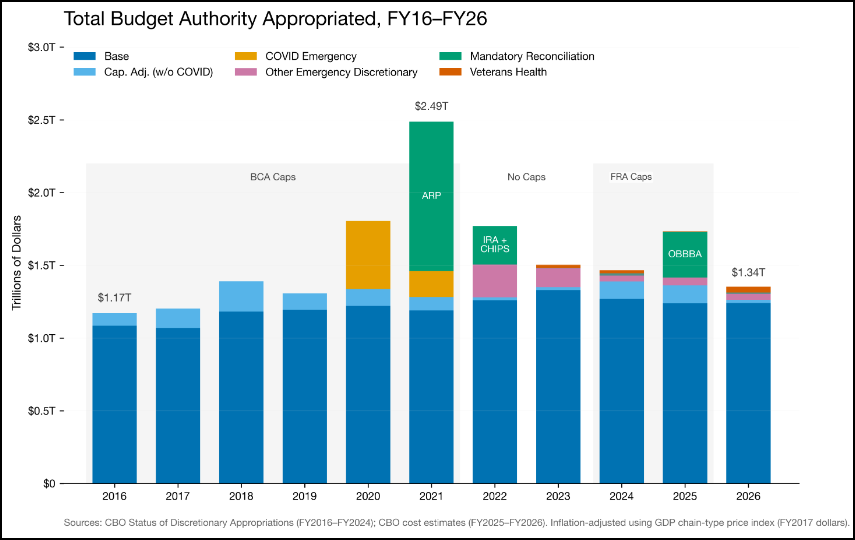
Unlike the Byrd Rule, there’s no legal or procedural impediment to using reconciliation to enact discretionary appropriations; it was always norms and the power of the appropriators preventing it from happening. And while appropriators on both sides of the aisle in both chambers are angry about what is happening this week, it doesn’t seem like they are going to be able to stop it.2
Laid bare, the logic of using reconciliation for discretionary appropriations is the destruction of the traditional bipartisan process. While party-line rescissions upend the ability to credibly commit to deals, reconciliation renders the deals themselves unnecessary.
Winners and Losers
A shift toward increased use of reconciliation (and, to a lesser degree, rescission) for annual appropriations is going to create political winners and losers. Here’s a survey of some of the political impacts.
Loser: partisan minorities. This should be obvious, but there are subtle things going on here. Partisan majorities that appropriate via the reconciliation process are unlikely to settle for one-year appropriations. In fact, the GOP play right now with the reconciliation bill can be read as an attempt to lock in ICE and CBP funding for multiple years—perhaps as many as ten according to Senator Graham—to prevent themselves from having to fully negotiate spending levels at those agencies during the divided government everyone expects to be coming next January.3
Winner: the president. Presidents hate filibusters. That’s easy enough to understand—presidents are never in the minority, they have their tool of counter-majority policymaking for when they oppose congressional majorities, and party-line legislating—if available—will usually be driven by, or at least responsive to, the White House. The discretionary appropriations process will become much more responsive to the president’s budget request if it becomes a party-line process. Parties don’t always listen to their president, but they listen a hell of a lot more than the opposition party does.
Loser: oversight. This follows directly from the idea of multi-year partisan money and increased presidential influence. Locking in years of ICE funding gives the agency much less reason to be responsive to congressional oversight and investigation. After all, they will already have their money. Perhaps more importantly, partisan appropriating is unlikely to come with the limitation riders that constrain agency behavior that are so common in the bipartisan process. Annual appropriations aren’t just bargains over spending levels; they are also deals about agency policy.
We’ve already seen DHS exploit the lack of limitation provisions in their OBBBA money to wiggle out of oversight requirements included in their annual appropriations bill. Democrats have insisted that any deal to end the shutdown include provisions that apply those limitations to the OBBBA funds. Now that the shutdown may end via reconciliation, it’s anyone’s guess whether that will materialize.
Loser: the appropriators. At first glance, it might seem like majority-party appropriators will gain influence under a party-line system. I think that’s a fantasy. What’s going to happen is that the moat around the committee is going to dry up, and the decision-making over discretionary appropriations is going to be raided by every other power base under the sun: the leadership, the White House, the authorizing committees reporting reconciliation instructions. The appropriators will still be players, but they will be operating in a much more crowded arena. And on the oversight side, they won’t have a pseudo-monopoly over the phone calls to/from the agency budget shops.
Winner: congressional leaders. Another obvious one. Maybe the biggest winner is actually the Speaker of the House, who will no longer have to figure out a way to make his party eat a bipartisan Senate deal without losing his job.
Loser: the Senate. Speaking of which, any flattening of the filibuster tends to hurt the Senate. People are so used to the Senate rolling the House that they forget how much the filibuster drives that reality. The majority party in the Senate is often less extreme than the majority in the House. Right now, that Senate party can (and often will) throw its hands up in the air and blame the necessity of bipartisan compromise for their inability to move off a bargaining position that shifts the bill toward the center and far away from the House position. Once the filibuster disappears and it’s just an internal-party dispute, some of that leverage is inevitably going to vanish.
Loser: shutdown opportunists. As Gabe Fleisher points out, putting discretionary appropriations in reconciliation bills is going to give unified governments a potentially easy way out of shutdowns, which in turn should make the prospect of trying to leverage a government shutdown less appealing. Good.
The Slow Drip and the Inevitable Flood
An increase in appropriating using tools like the rescission and reconciliation process will not end the bipartisan annual appropriation process overnight. For one, it’s still going to be necessary under divided government, or at least under divided Congress. Even beyond that, this sort of change tends to happen slowly in Congress, and leave all sort of odd incongruities in its wake. The appropriators are not going to go quietly and surrender their massive base of power just because some of their co-partisans have a few funding ideas.
But in the long run, we are clearly headed toward a majoritarian Senate. The current 60-votes-for-everything Senate has only really been around for 15 years and it’s not a stable equilibrium. And the cracks are getting deeper. Nominations have become a fully majoritarian process. On the mandatory spending side, the reconciliation process has long ceased to have anything to do with reconciling the budget, and now exists exclusively to allow party-line legislating. It is very hard for me to believe that the appropriations process was going to survive another 20 years completely insulated from the majoritarian wave. And now it has not.
But the Senate can remain irrational—and self-contradictory—perhaps longer than you can stay sane. A world of three appropriations processes—one for divided government, a second for bipartisan agencies under unified government, and a third for partisan agencies under unified government—seems not only plausible, but much in line with how Congress adapts and changes: slowly, and with new procedures, tactics, and norms coming into play before the old ones are fully swept away. The result is a layered system that looks utterly incoherent, even judged solely on its internal logic.
Questions still remain—how far will partisan majorities take this? Will new majorities (perhaps Dems 2029) aggressively wield rescissions, either via the ICA or reconciliation? And how much will the weakened appropriators resist all of this? But I think we are at the point where we can say that the reconciliation process is a major component of discretionary appropriations politics. The barn door is just highly unlikely to be shut on that.
Both President Trump and OMB Director Vought have justified much of this under a theory of executive power that brings to mind Charles I and pre-settlement Stuart England. Trump seems to have no understand and little care for the basic longstanding terms of Anglo-American legislative supremacy over taxation and spending.
These developments are actually make it hard to talk about discretionary and mandatory money. Technically, from a scorekeeping perspective, the categories are procedural—“discretionary” appropriations are simply appropriations in annual acts from the appropriations committee, while “mandatory” refers to all spending controlled outside of the annual appropriations process and dealt with by committees other than House and Senate Appropriations.
But in practice, the distinction was also functional. Discretionary appropriations were viewed as operating funds for federal agencies, while mandatory spending was entitlements—such as Social Security, Medicare, and unemployment benefits—which were not specified amounts but formulaic guarantees of benefits set into permanent law. ICE funding in reconciliation bills is technically mandatory spending from a scorekeeping perspective, but functionally still discretionary appropriations as a functional matter. The lines are getting blurry.
Note that there’s one significant limit to this; appropriations for the army cannot extend beyond two years. Here’s an article making the case that this restriction should be viewed much more widely than just for uniformed troops, and perhaps should include DHS funding.
I'm so old I remember when it was a big deal when appropriations bills stopped having open rules... At some point I'd hope individual members would fight for their own prerogatives against the ongoing empowerment of leadership but not today, apparently.
This is a good thing - first past the post is mathematically incompatible with a super majority legislative system and arguably the 60 vote threshold is the origin of a lot of sclerosis in the system.