


In the Morning (7 action items)
1. Do not—under any circumstances—turn on a TV prior to 6pm EST.
This isn’t specific to the morning, but it has to be first, because it’s absolutely crucial. The only thing worse than the election night coverage on the cable news networks is the election day coverage on the cable news networks. And trailing right behind those two things is the douchebag in your office who watched the Today show on election morning and is now repeating the same drivel to you over the watercooler or over Zoom. Don’t be that guy.
In case you are tempted at any point in the day, I’ll save you the time by summing up the coverage for you here:
worthless anecdotes about turnout; anecdotal profiles about who the independents are voting for; analysis of rainy weather forecasts that supposedly affect turnout but actually do not; interviews with senior citizens who voted at 11am in the Midwest; explanations of the “science” of exit-polling and election prediction; questions about why aren’t there more moderates;
Meta-narratives about the parties probable reactions to a 25-seat swing in the House vs. a 35-seat swing; debates over whether this is 2010, 2018, or neither; editorials on whether this is a “change” election, a “wave” election, or a “turnout” election;
exposés on campaign financing, voter turnout, and enthusiasm; debates over divided government and gridlock; evidence-free polemics on Trump’s mental state and post-election plans;
stories about the parties angling with teams of lawyers to oversee recounts; worries on the right and left about voter fraud and voter suppression; some Blair-witch style Youtube videos showing something allegedly wrong.
Add to this 35 other things that could be studied with a rigorous methodology but instead will be delivered in the absence (or face) of data, and an equal number of things that should never be studied, period.
Did I mention this will all be delivered to you at a 4th grade comprehension level?
Don’t fall for it. Trust me.
2. Learn the Senate landscape cold.
Right now, there are 53 Republican and 47 Democratic (or Democratic-aligned) Senators. In North Carolina, the Republicans are all but guaranteed to lose a seat, as Senator Tillis is retiring, and popular former Democratic governor Roy Cooper is a near-lock to replace him. Of the other 34 races for Senate seats this year, there are 11 races that are remotely close enough to be at all in doubt. Three seats currently held by Democrats:
(States link to Kalshi prediction market, candidates to wikis; rating via Cook)
New Hampshire (OPEN, Pappas (D) vs. Sununu (R)) LEAN D
and eight seats currently held by Republicans:
South Carolina (Graham, challenged by Andrews) LEAN R
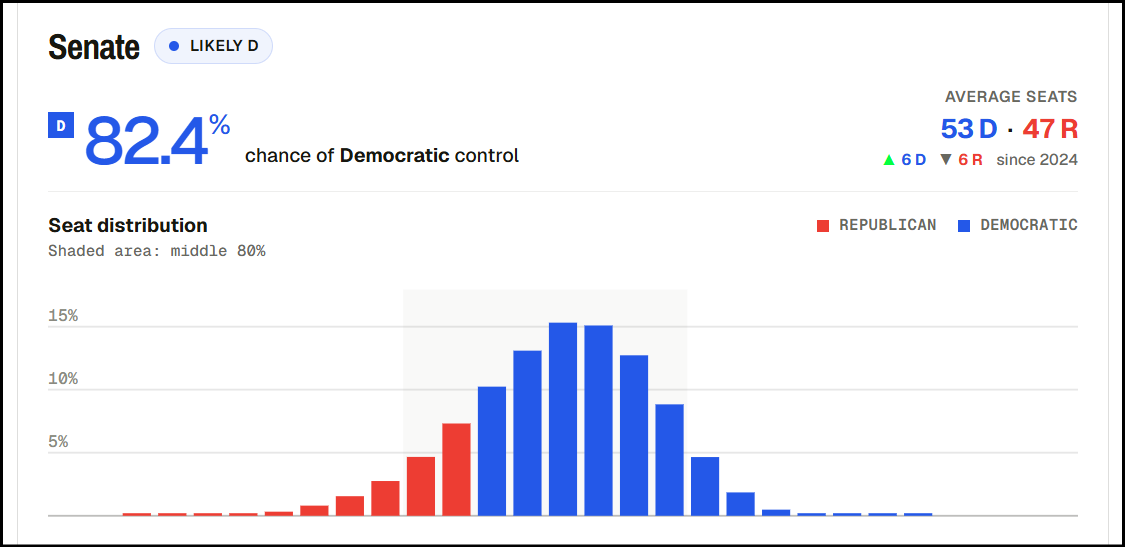
Look over the candidates and the stakes in each of these. Forget all the rest of the races. Review some recent polls, and check out some of the online forecasts to think about different situations. (Here’s Nate Silver’s forecast).
4. Figure out some House bellwethers.
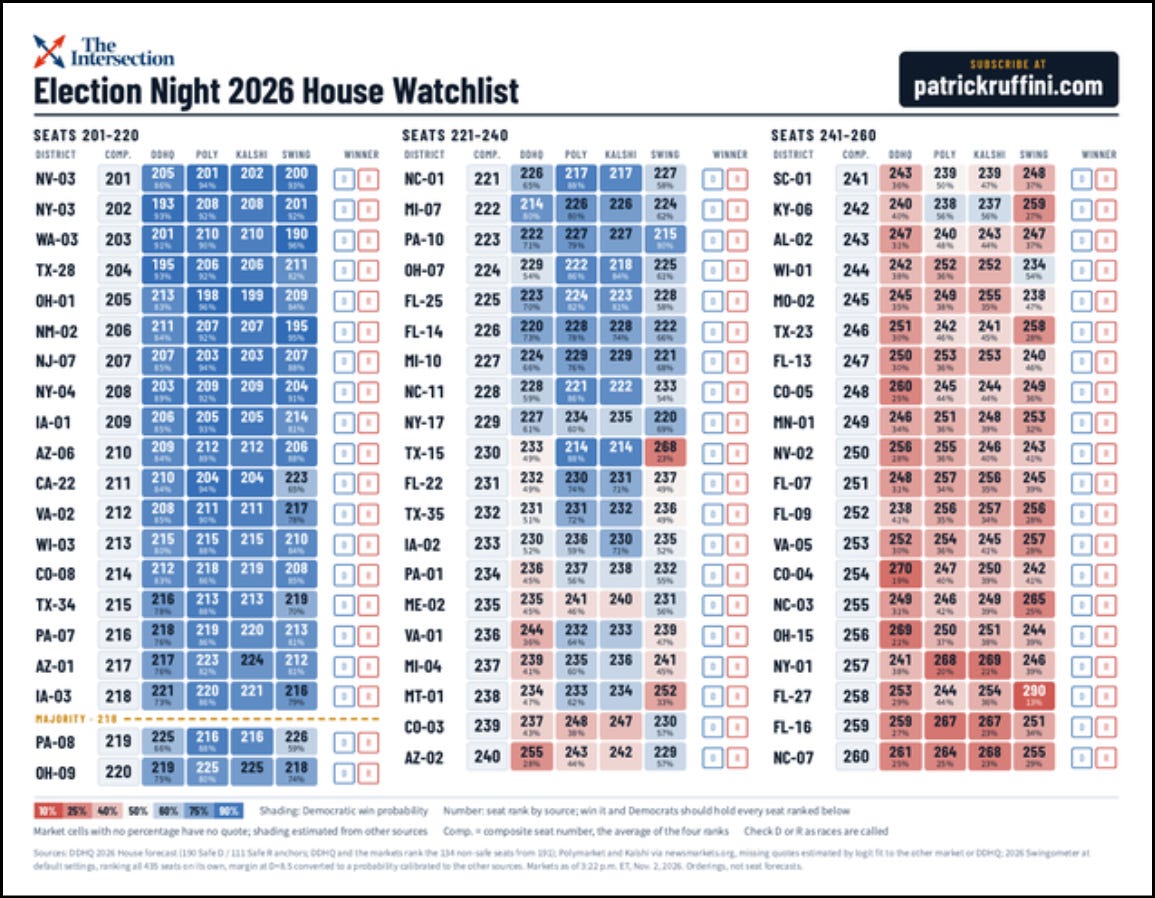
Unless you spend your days dealing with the House of Representatives (ahem), it’s hard to be up on all the competitive house races. But it’s a lot more fun to watch returns if you can assess the importance of a given House race result—both for who can control the House and what it says about the presidential race—without having to trust Chuck Todd. Throughout the night, there will be a flood of House returns, and if you know that Virginia’s 2nd District and Colorado’s 5th district are a lot more important in judging the national result than New York’s 10th and California’s 18th, you’ll be ahead of the game.
In the past, this has been a doable-but-arduous task. These days, there are now a lot of interactives and breakdowns that make your job easier. Start by checking out one or more of these websites to get the full lay of the land.
Then grab an excellent cheat sheet like this one to guide you through the night:
5. Make a prediction of some sort — and maybe a bet — but don’t be the “prediction-guy.”
Make your prediction public by emailing it to someone (Or heck, tweet it to me @MattGlassman312). Here’s mine: Democrats picks up a net 34 House seats and control the chamber 239-196, and gain Senate control, 53-47. The Dems finally beat Collins in ME and get over the hump in Texas, but Marshall holds on in Kansas. I also guarantee that either David Gergen or some pundit governor-type (Ed Rendell? Haley Barbour?) will get on my nerves at some point. And yeah, I’ll bet you a drink that I’m closer than you on that House total.
The trap to avoid here is turning the whole night into a test of your prediction ability. Don’t be that guy who’s only interested in the NCAA tournament because he’s got seven brackets going and $1000 on the line, but doesn’t really give a shit about college basketball. So keep the predictions light and modest. Guess some House and Senate totals, and call half a dozen races.
But don’t go crazy. Face it: you didn’t build (you didn’t build!) your predictions from some proprietary model and a whole bunch of insider information, so your success or failure basically reflects zero on your ability as a forecaster. But your behavior tonight can reflect grandly on your status as a douchebag. So let Nate Silver and the British gambling houses sweat it out; your job isn’t on the line here.
If you do want to throw some money down on Kalshi, here’s a quick tips for making +EV bets, based on a lifetime in the Saratoga picnic area:
Unless you can articulate your edge, you don’t have one.
If you don’t have an edge, the favorite is a better bet. Favorite-longshot bias is real, in horse racing and political markets, and laying 9-1 will systematically be a better bet than taking a 9-1 longshot.
On the other hand, if you would like to try some systematic forecasting, here’s an excel sheet that lets you run 50,000 election simulations to your basic specifications for both the House and Senate. Each time you alter any of the state win probabilities, the file re-runs a simulation of 50,000 elections, based on the individual state/district probabilities, and reports the following relevant national results: average Dem seats, probability Dems take the Senate/House, and the most common number of Senate/House seats. Excel will instantly re-run the simulation (it takes about 2 seconds on my crappy computer) any time you change any of the win probabilities.
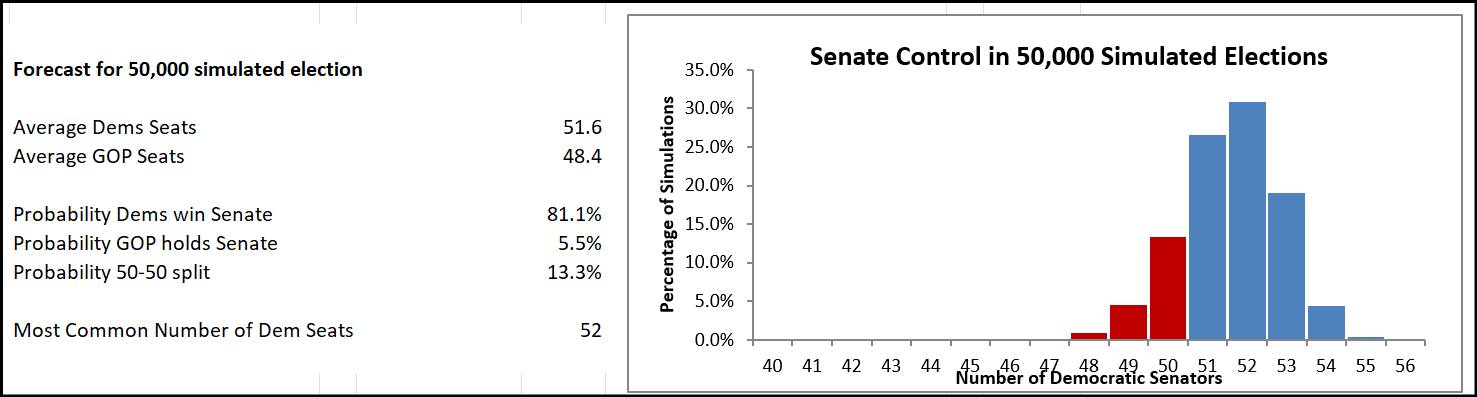
Now, let me be crystal clear about one thing: this is not a model of the election. The Monte Carlo simulation is the final step in translating your model into a forecast. Your actual model is the data and analytical process that generates the individual swin probabilities. When you waste a fun hour plugging in various different state probabilities, your implicit model is “my best guess.” In effect, you are just doing somewhat-systematic punditry. If you want to actually model the sprobabilities, you need at a minimum some sort of data (if you just want to forecast) or some data and a theory (if you want to forecast and explain the Way Things Work). Here’s my old blog post that explains in more detail.
6. “Watercooler” the election.
In the last 20 years, I spent a lot of time trying to avoid political discussions—and that was when I worked on the Hill! So I understand your general impulse to avoid your wackier colleagues and Crazy Neighbors on Election Day. But it might be the one day of the year when talking politics at the office or with your neighbors can generate some positive returns. Especially if you go beyond contemporary politics and talk to people about democracy.
Obviously, you have to weed out the cynics who want to lecture you on why they didn’t vote and the angry partisans who can’t imagine who would vote for that idiot and the monologuers who won’t shut up about why Denmark is such a better democracy than ours, but if you can weather those storms, you might strike gold.
You’re not looking for anybody specific here, but I recommend finding two people in particular if you can. First: a veteran. Ask him if he ever voted from a combat zone. Then listen. Second, someone who’s run for local office in the past. Ask them what it was like on election day when they ran and how it changed their view of democracy. Then listen.
7. Vote if you haven’t yet done so. Volunteer if you are so inclined (you should be).
Or don’t vote. It’s utterly not consequential to the election. But you’ll feel better about yourself if you do. If you need some inspiration, read my voting story from a few years back.
Or go past just voting and get involved! As political scientist Eitan Hersh says, “politics is for power.” Too many people know all about the election and watch endless news coverage, but don’t have the foggiest idea as to how you actually influence politics, and little inclination to start trying. They are essentially hobbyists, rather than participants. You should actually participate in politics.
It’s really easy to participate! Even as late as today, you can volunteer to phone bank for Democrats or Republicans You can always walk your neighborhood and offer to take people to the polls. Or just go to the polls alone and stand at one of the party tables and talk to voters.
In the afternoon (6 action items).
8. Again, resist any and all temptation to turn the television on.
For full explanation, see #1. But remember, they’ll be doing things like using a panel of “experts” to interview David Axelrod for three minutes about who he thinks is going to win the swing states. You’ve been warned.
Instead read this old Phil Klinkner article on the occasional high importance of mid-term elections, or this Matt Yglesias historical piece on the most important mid-terms of all-time.
9. Figure out who you are going to watch the returns with.
In a typical year, people go all sorts of ways with this. I totally respect the people who have to watch alone, in the dark, just them and the TV, like they’re die-hard baseball fans watching game 7 of the world series. Others prefer the election-night-headquarters style parties with you and 200 of your closest friends at a barroom. Other people (like me) prefer a small home get together with a few friends.
And I think that’s important. American politics is ferociously partisan these days, and very stressful to a great many people. Consuming this sort of information can be a lot less stressful if you are with some friends.
I think a home get-together is best, preferably with at least one person who roughly shares your politics and one who at least mildly doesn’t. I don’t recommend getting a ton of people together; think more “friends coming over” than “party” — you want six, not thirty. Usually, I remind people that this isn’t a presidential election and that midterms call for a more refined, thoughtful arrangement. But the intensity and enthusiasm in American politics right now has sort of throw that out the window. Brace yourself for a presidential-election crowd, and then welcome it.
A few tips. Brining a lot of huge partisans into the mix is a double-edged sword; I’m not a huge partisan myself, and I try to avoid both the echo-chamber style get-together as well as the Hatfield/McCoy scenario. But I do like having some strong ideologues around—from diverse viewpoints— who aren’t too attached to party labels.
One key: avoid cynics and Euro-philes at all costs. Face it, democracy is the least-worst alternative, and politics in the parliamentary systems on the European continent is just as much of a mess as it is here. Yeah, the Senate is anti-democratic, but so is the veto. Get over it. I don’t want to hear it tonight. And neither do your guests.
10. Get your snack setup straight.
This is tricky. It’s not a college football tailgate. It’s sure as hell not a dinner party. It’s not a BBQ. It’s not having people over for The Game. My suggestion is to go simple and traditional. That means, of course, pizza and beer. Fill in with pretzels or chips. The thing to stay away from is really messy food, since you’re going to want access to your laptop or Ipad (see below) regularly. So probably stay away from salsa, or guacamole. And as much as it pains my upstate heart, wings are a big no-no.
You also want a wonkcave configuration that’s amenable to eating and using a computer. You don’t have to go full-blown dork with TV trays and all that jazz, but figure something out ahead of time, so you aren’t sitting on a really deep couch, balancing a plate of pizza on your knees while you smear blue cheese all over your Ipad screen.
11. Learn about a few ballot initiatives.
Here’s a comprehensive cheat sheet that includes statewide questions voters will face Tuesday. Personally, I’m focused on the following: the Virginia constitutional amendments on gay marriage, abortion, and felon voting rights; California’s billionaire wealth tax proposal; and the proposals in multiple states to ban transgender participation in public school girls sports.
12. Forget the governors’ races.
Once you’ve studied the Senate races and found your House bellwethers, you might be tempted to start looking into some governor’s races.
Unless your state happens to have a competitive race, it’s not worth it. Maybe pick one that’s really interesting, but don’t bother trying to master them. Invariably, they won’t affect your life and you won’t think about them again until they start announcing for President in a few years. Put your energy into learning more about the Senate races. It makes for much better viewing.
13. Ponder our republic.
The last ten years of American politics have featured a tremendous amount of vitriol, norm-breaking, and outright hostility between parties, candidates, elected officials, and citizens. While we have one of the strongest and longest-standing republics in the world, it is not immune to decay, rot, or even collapse.
Many political scientists, journalists, and other observes have serious concerns that these developments are not just an extreme version of ordinary election name-calling, but canaries in the coal mine for serious cracks in our democracy.
Even if you aren’t worried about the republic itself, things have gotten somewhat depressing in American politics. The candidates aren’t popular; it’s almost impossible to explain to someone who can’t remember that the losing candidate in 2008 had an approval rating in the mid 50s. Congress can feel hopelessly gridlocked. President Trump has successfully made banana-republic style politics a lot of the public discourse, but he has also accelerated the rearrangement of the ideological coalitions in American politics (see chart). And there’s a media fragmentation that’s both disorienting and disconcerting; is anyone even listening to the same information?

There’s an absolutely foreboding atmosphere among some people I talk to and among many people all over the country. On the other hand, there’s no real proof this is “the most important election of your lifetime,” especially since people declare that before every election. I still love this David Mayhew editorial from 2012 on what makes an election important (at least in retrospect).
14. Vote if you haven’t yet done so.
Or don’t. It’s utterly not consequential to the election. But yo u’ll feel better about yourself if you do. If you need some further patriotic inspiration, go read my old State of the Union post. Or check out these old excellent Jennifer Victor and Jonathan Bernstein articles on why voting and elections are important, even if the fairy-tale vision of democracy was never true. Or my old article on the same topic.
Early eve, before polls close (6pm EST) (5 action items)
15. Again, resist any and all temptation to turn the television on.
For full explanation, see #1. But remember, they’ll be doing things like making predictions about national turnout levels based on anecdotal interviews at 2 precincts in the Midwest. You’ve been warned.
16. Get your laptop setup with the proper tabs open.
My setup is going to look like this: a main live-blog sitting open on the desktop from Nate Silver and friends, an assortment of other blogs available for quick consult (Strength in Numbers, Truth and Consequences), the tally-maps from a major network or paper (probably New York Times Upshot), the Kalshi prediction markets page for the election, and the Virginia official returns site. Anything more than that, and it becomes unwieldy. But find your own, there’s no shortage of good election-night bloggers are work. And, of course, come find me on Twitter if you want to hear my thoughts.
You also will probably want one of the great hour-by-hour guides to what is important available. None of them have been published yet, but there will be plenty up and running tonight (the NYT Upshot one will be my go-to).
Also, if you want to be a real pro, go find a county by county watchlist like this f’ing thing from two years ago, and get it loaded up on a tab. That one was made by @alexanderao, but other people might throw them up. This is how most of the hardcore election analysts work in real-time; they examine county level results in key locations to see if candidates are hitting their targets, and draw conclusions from that. Now you can do it too.

17. Arm yourself with the proper printouts.
Some things are just better to have in hard copy. A copy of Cook’s House Race Ratings is the classic thing to just have sitting on the table. I also usually recommend getting some scrap paper ready to use as your own tally-sheet for House and Senate pickups.
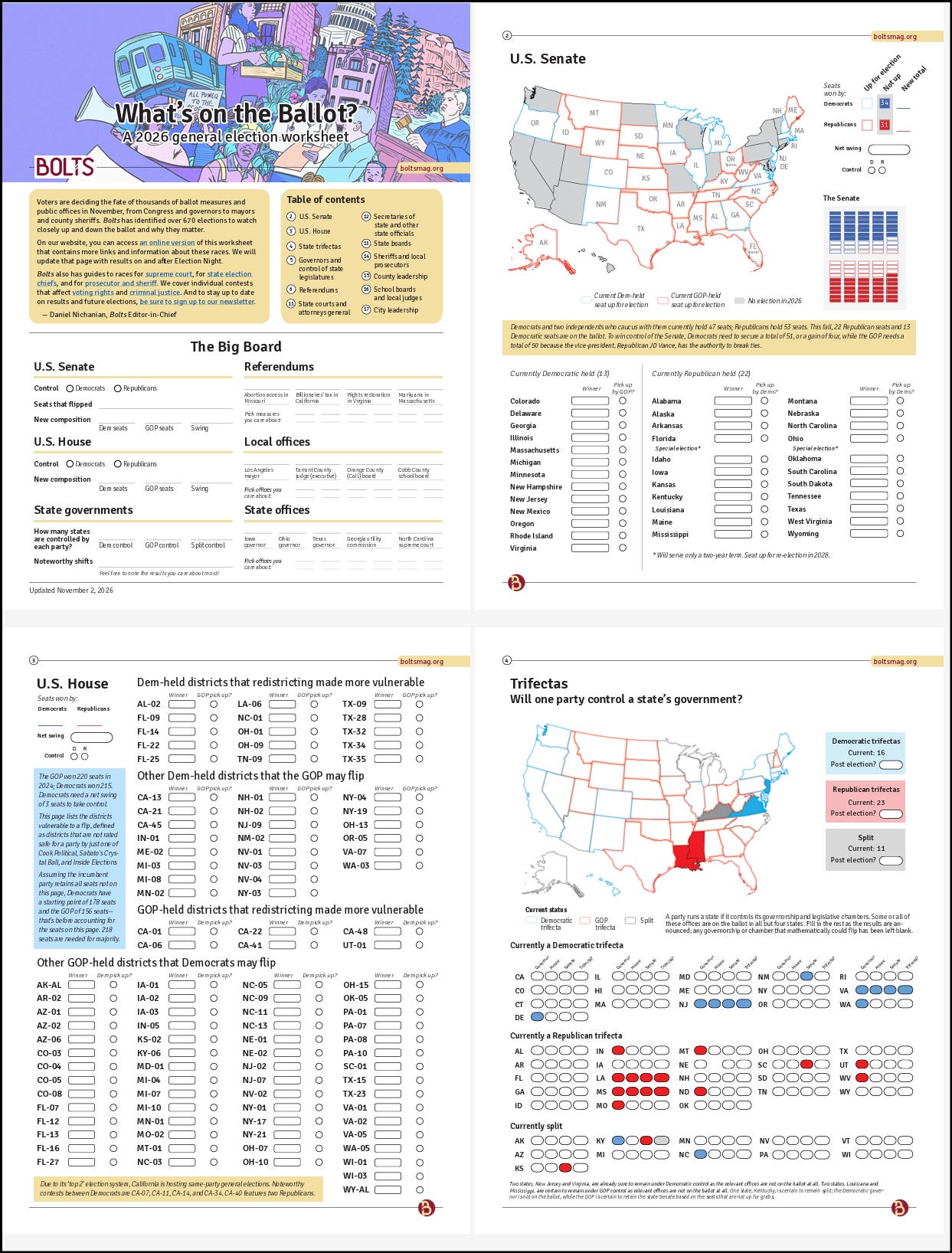
But there’s a new sheriff in town: get a load of this freaking thing (pdf version here) that Daniel Nichanian put together, it might be the perfect hand-tally election tracker. Just get it, print it out, and it and have it sitting by your side. I’m not kidding. It has dozens of referendums to track and goes in-depth on some local elections. All in an easy to read format.
The other thing you want is an hour-by-hour cheat sheet for the House bellwethers. I recommend this one:
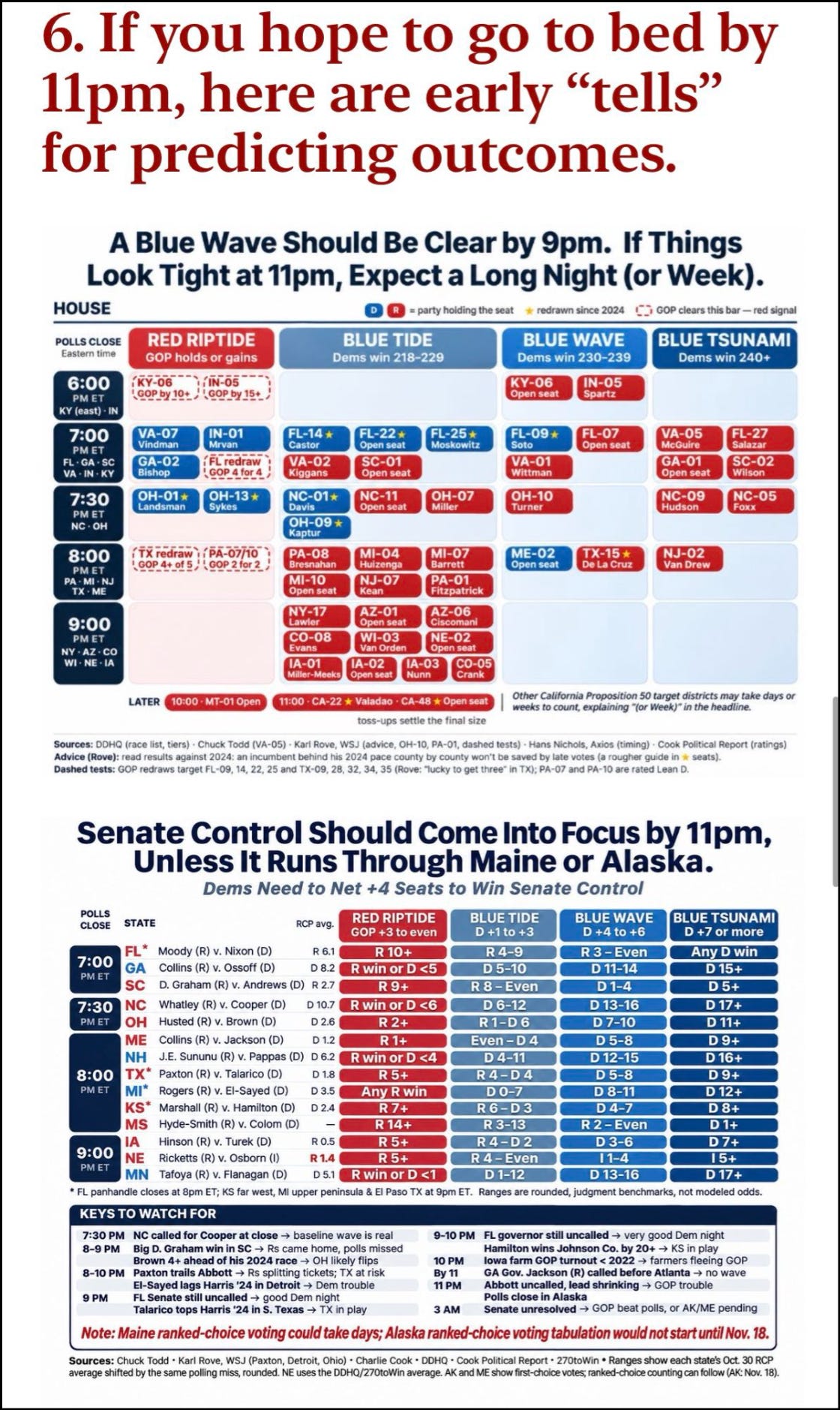
18. Get yourself setup on social media.
Nothing has made following political events more fun in the last 15 years than Twitter. It brings just the right mix of seriousness and humor that democratic electoral politics deserves. As recently as two years ago, it was a no-brainer to be plugged into it on election night.
I still think it’s worth it, but the place has definitely become a lot less fun. In the wake of Elon Musk acquiring it, the social dynamics of it have changed. A lot of great follows, especially on the liberal side, left. The new algorithm pushes a lot more junk (and a lot more potentially offensive stuff) and a lot less wonky election content at you. And the overall vibe is no longer the freewheeling public square atmosphere that made the 2008 through 2020 elections so much darn fun.
The problem is that nothing has really replaced it. The Twitter clone sites like BlueSky just don’t have the critical mass, and stuff like Facebook isn’t quite right for the job. So you are sorta stuck. But I still think Less-Than-Perfect-Twitter is still worth it on Election Night. I’ll still be there and I recommend you be there too.
Follow some straightforward news sites (@AP, @CNN, etc.), and the big name forecast-types (@redistrict, @natesilver, @nathangonzalez, @kkondik, @nate_cohn, @ForecasterEnten, @GElliottmorris). But here are a bunch of non-obvious tweeps I recommend following (for all-around reasons of smarts, humor, and likely volume of tweets tomorrow): @speechboy71, @LPDonovan @daveweigel, @costareports, @MEPFuller, and @wakeup2politics. Also, follow at least one of the complete partisan clowns, my favorite has always been Bill Mitchell.
And, of course, @MattGlassman312. There are hundreds of other good ones too, so find your own!
After the polls begin to close (5 action items).
19. Ease into things.
If you plant yourself on the couch at 6pm, you will be brain-dead by 10:30. This is not college football; it is best enjoyed with an active mind. So turn on the TV, get your prep-work out, but don’t sit down. If you absolutely must be plugged in from the get-go, I recommend cleaning or exercising in the TV room. And for goodness sakes don’t eat a full sit-down dinner in front of the television. You’ll regret it. Have a light snack and order the pizza for 7:30. Make the returns background noise and a passive activity early on; by 7:30 or 8, you’ll be ready to hunker-down.
20. Pick a cable news network and stick with it.
And I recommend making your choice based solely on comedy. Who has the stupidest display board, with the most useless bells and whistles? Who has the most commentators lined up in a bleacher-like tier? Which network is doing live-remotes from the most ridiculous places? Who has the funniest name for their “war room”? The bottom line is that the cable networks have ceased to be journalistic endeavors, and are now only good for getting raw data or being entertained. Everything else — from play by play to commentary to meta-analysis — is better on the Internets. Like fifty times better.


21. Don’t be afraid to get emotional.
For whatever reason, America spent the 20th century trying to remove political intensity from the practice of actually casting and counting the votes. As recently as 100 years ago, polling places were raucous scenes, complete with bands, rallies, and liquor. Now they are like graveyards. And that carries over a lot of the time to how people adsorb returns. Don’t let it get to you. You’re emotionally invested in either politics or policy; you wouldn’t be reading this otherwise. Don’t pretend we’re counting the votes in a vacuum. Go ahead and cheer.

22. Around 9:00pm EST, call someone who’s only mildly into politics, and talk to them about the elections.
Or more precisely, listen to them. Mom is always good option if she fits the mold. Ask her who they voted for and why, and what she thinks of the emerging results. Don’t offer any opinions, analysis, or commentary. Too many junkies live exclusively in the world of the strategic meta-narrative; it’s both insightful and refreshing to hear people on election night who approach things at face-value.
23. Find out who won local office in your town.
Contrary to the indications derived from media coverage, your town and school board elections routinely have a bigger effect on you and your family than anything going on in Washington. It’s bad enough that you don’t know who your state rep is, but it’s unconscionable that you don’t know who’s setting the policies for your kids’ school. Take the time and find out who won these races, and promise yourself that you’ll have a better knowledge of them next time around. Or that you’ll get involved. That way, you’ll at least feel guilty two years from now when you say, “Is he the Democrat or Republican?”
Late Night (3 action items)
24. Turn it off by 1:00am EST, after the initial California returns have come in and been digested.
Unless you’re prepared to stay up all night, the marginal value of waiting each additional half-hour at that point is really low. If they can’t call the west coast races by 1:00am EST, it will probably be sometime—perhaps weeks—until they can. The marginal value of staying up past that probably isn’t worth it, even if Alaska will determine control of the Senate. And by the way, no state ever certifies its results on election night, and many routinely take up to a week to tabulate final results.
That said, I didn’t go to bed until 6am in 2020. I was still live-tweeting sweet betting opportunities after Wisconsin came in at 4:30am. So YMMV.
25. Watch an unexpected victory speech, and an unexpected concession.
Obviously, if there’s a pretty big surprise upset (like Graham losing in SC), find those speeches and watch them live. Otherwise, look for the tight Senate races in MI, TX, etc. And if you can find an internet feed of a political amateur winning a House seat, those are solid gold moments.
26. Light up a joint if pot wins in Massachusetts.
Just kidding! Federal law will still make marijuana possession, sale, and cultivation illegal in the United States, and Gonzalez v. Raich will continue to guarantee for the time being that those federal laws are constitutional, regardless of how much money we throw away in the War On Drugs and how many non-violent drug offenders we put in federal prison in the coming years. Think that’s dumb? Me too. But I tend to support candidates who are ready to end the drug war. Next time, will you?
Enjoy the elections, everyone!
I respect all of this, yet I’m taking the exact opposite approach: completely ignoring everything until tomorrow morning when I look at the news. Nothing is gained (for me) from stressing over returns on election night over just waiting to see where things stand in the morning. I’m going to pour myself a stiff drink, put on some movie as apolitical as I can find, and trust that I can assess the state of American democracy tomorrow. My mental health is REALLY going to thank me for it.
I can't believe what an excellent column this is. I almsot deleted before reading because I am clearing out my inbox of ads and election solicitations. Easily the best election resource I have EVER reads (and I've been vorting for 53 years).