

The World Cup just started, so I feel compelled to offer my longstanding soccer hot take: soccer is an absolutely amazing spectator sport, but the game itself is just ok. As a sport, soccer is amazing in spite of itself.
Soccer is indisputably the greatest spectator sport in the world, primarily because everyone believes it’s the greatest sport in the world. I don’t think any sport even comes close to the level of aggregate emotional investment that soccer produces in its billions of fans. Throw in the nationalism and the pageantry and you get an intensity that is off the charts. It’s a spectacle that cannot be matched. And it creates incredible social and community bonds. And that makes it great.
I’ve been to exactly one international soccer match—U.S. vs. Honduras in 2009—and I was blown away by the atmosphere and the experience. The singing. The chanting. The flags being worn as capes. The rhythmic jumping up and down. The nonstop intensity. I had so much fun. And that match was completely pathetic in terms of spectacle and attendance, at least compared to soccer in other parts of the world. I sat (stood) next to a Honduras fan who blew a horn the entire game while jumping up and down. He never took a break. Not once. I’ve never seen anything like that, and I’ve been to a lot of hockey games in Montreal.
This is all totally legitimate. The whole world deeply loves soccer, and that in and of itself makes soccer incredible. And it’s not some sort of illusion; the intensity of the fans and the spectacle of the crowds literally make it really fun to watch soccer, even on TV and, especially, in a group of people.
Related, soccer’s intense popularity creates, better than any other sport, the social connections and community that are a big part of why sports are so wonderful. Sometimes there are mass cultural delusions that don’t generate any positive return—like how everyone pretends they love corn on the cob, an objectively terrible food—but that’s not soccer. Soccer is fucking awesome as a spectacle, that creates joy and community for billions of people, and that’s good. The World Cup is undoubtedly the best sporting competition on the planet.
But once you strip away the spectacle, soccer is objectively not that great of a game. It’s fine, I guess. But it’s far from an amazing spectator experience.
The problem with soccer the game is that, frankly, it’s boring. The underlying issue is that the correct strategy is really passive and risk-averse, which makes long stretches of the game pretty dull. And the ball goes out of bounds a ton, which is also dull.
And there’s almost certainly no tactical fix for this. I have no doubt that soccer has been strategically studied and analyzed more than any other team sport, and that high-level soccer strategy is optimized to win, given the incentives of the rules. It’s just highly unlikely there’s a not-yet-discovered winning strategy that is super exciting. Absent major rules changes that aren’t going to happen, this is soccer.
The more general issue with soccer, to me, is that it’s structurally a continuous sport but often functionally operates like the discrete sports. It’s sort of caught in the middle, and in my view ends up with the worst of both worlds. The core continuous team sports—like hockey, basketball, and rugby—are entertaining because the exciting action is so non-stop you barely have time to think. The discrete team sports—like baseball and American football—are objectively boring 95% of the literal time you are watching, but build their tension and excitement on the contemplative expectation of the next action.
Soccer doesn’t give you the non-stop mind-numbing excitement of the continuous sports, but it also doesn’t give you the fixed and known on-off rhythm of the discrete sports. I continually find myself groaning when I watch soccer, because it looks like the team with the ball might attack, but then they passively retreat all the way back to their half of the field. That can go on for minutes at a time. And then it gets kicked out of bounds. The crescendo of tension that you get waiting for the next pitch or snap just doesn’t build. The best moments of soccer are undoubtedly the corner kicks and the close-in direct kicks. The discrete anticipation is great. But they are few and far between.
This is why every hockey fan intuitively has the Jarvis critique. From the point of view of hockey, what soccer needs is actual continuity and incentives for aggressive strategy.1
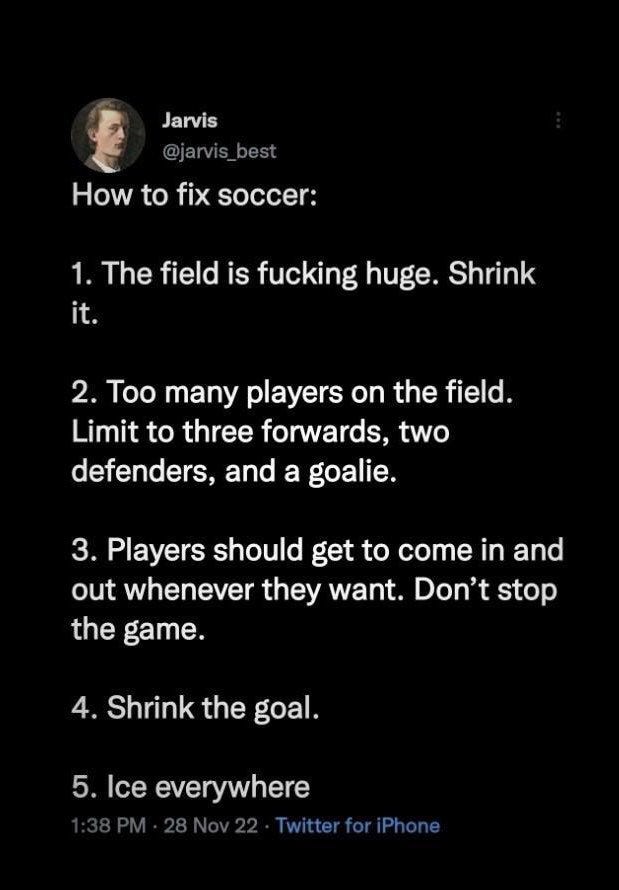
He forgot “put boards up so the ball doesn’t go out of bounds.” This is also why youth and amateur soccer, as a game, can be more fun to watch than pro soccer. The comparative lack of skill and relative inability to control the ball create a situation where it’s strategically less rewarding to be passive, and the continual turnovers create opportunities for profitable aggressive actions. You lose the world-class athletes doing world-class athlete things. But the trade-off is it’s just more continuously exciting.2
The true proof of this—that the spectacle and communal fandom makes soccer great, despite the game—is how quickly soccer can get tedious to watch alone on TV. I put the Mexico-South Africa game on yesterday afternoon, and it was fun to see the crowd and I’m a total sucker for the pageantry and nationalism. But by the middle of the second half, I was mostly looking at my Ipad. Nothing was happening in the game, Mexico mostly just listlessly passing the ball around waiting for the clock to run out. Put me in that stadium or give me three buddies to watch with and I probably stay interested. But otherwise? Forget it. And this was in a 1-0 game.
And look, that’s true of all sports to some degree. They are usually better in-person, always better with a big crowd, and way more fun at home if you have other people to watch with. The crowd atmosphere is a big part of NHL games, and NBA Finals games at MSG are so incredible even through a TV that you can’t help but be constantly reminded how boring regular-season NBA games often are. But soccer takes this to an extreme. It becomes unwatchable significantly faster than other sports when you are alone and the stands are empty on the TV screen.
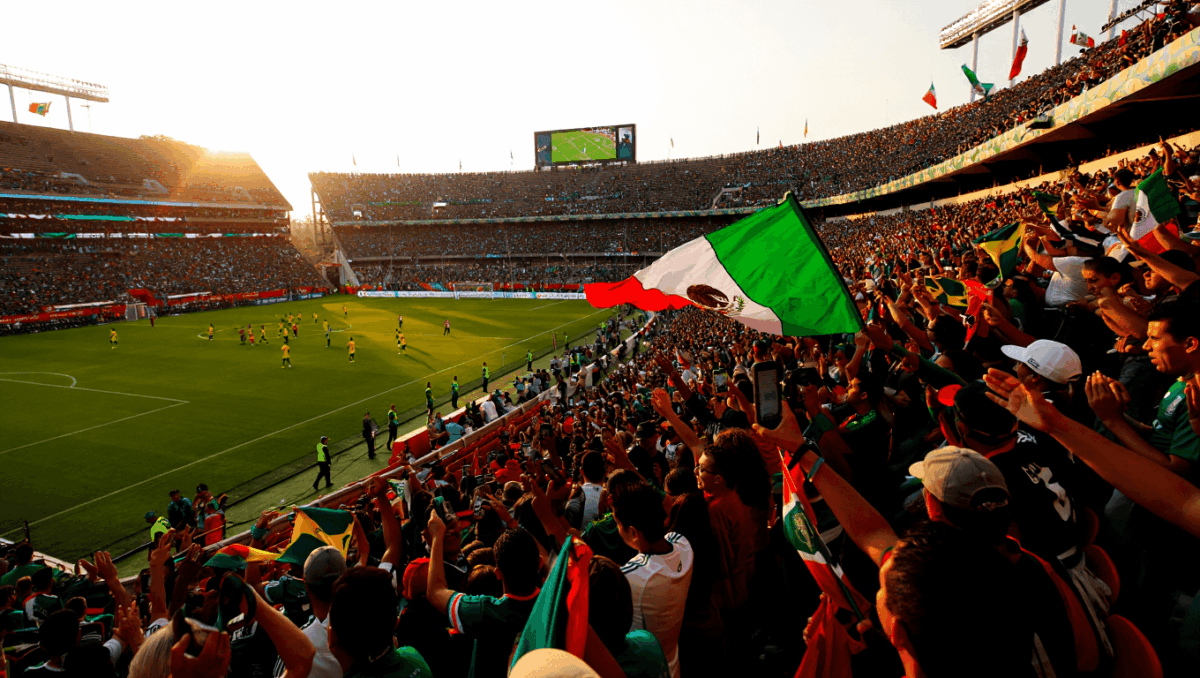
Mexico - South Africa World Cup game. Also the proper perspective on what’s great about soccer. It’s also silly to pretend soccer’s a great game because it’s the most popular. A lot of people argue this—bruh, if it wasn’t the best game why is it so popular?!?!?!—but that’s a logical fallacy. Soccer’s popularity is driven, in large part, by how inexpensive it is. It requires virtually no equipment or infrastructure. The poorest kids in the world can play, and the poorest communities in the world can sustain recreational leagues. And that’s awesome. It’s one more thing to love about soccer. It’s truly the peoples’ game.
And the participatory aspect of soccer also can’t be discounted. It’s a pretty darn fun game to play. It can be meaningfully played by younger kids than almost any other sport. And you don’t have to be a total genetic freak to become a top player; unlike football and basketball and rugby, a lot of high-level soccer players are passably-normal humans, incredible athletes but not 4 standard deviations out on physical size. Anyone can, in theory, become great. Which is another thing to love about soccer.
But none of this means we have to pretend soccer the game is itself a great spectator sport. It just isn’t.
I’m sure I will get skewered by many for writing this up. I’m definitely going to be told I don’t understand soccer or I can’t appreciate it’s beauty or I haven’t watched enough Premier League games or I’m too American or I call it soccer and not football. But things can become popular for reasons other than how internally great they are, and that popularity can itself make them truly great. That this is the case with soccer doesn’t diminish the spectacle in any way, but it is the reality.
But you better believe I’m looking forward to the U.S. game tonight. It’s going to be awesome.
I highly doubt soccer is ever going to get a major rules change that transforms the game, but you can imagine them. Get rid of traditional offsides and put in hockey-style fixed blue lines. That would instantly make soccer higher-scoring and reward a more aggressive strategy. It would also, of course, utterly upend the game, which is why it would never happen (and perhaps why it should never happen).
I personally also find this true with football. The NFL is amazing because you get to watch the best freak-athletes in the world do amazing physical things. But the kickers are so good that a lot of the most exciting parts of high-school football—most notably going for it on 4th and 7 from the opponents 22—just aren’t part of the pro game.
Re. soccer: very perceptive, totally valid, no arguments.
Re. corn on the cob: WTF???? Grilled corn on the cob may be a mess to eat and have no nutritional value, but it's DELICIOUS. If you're going to claim it's "objectively terrible" and everyone just pretends to like it (I'm not posing! I get no social clout from eating it!) at least show the receipts in a footnote or something. Jesus.
Its a personal opinion.
IMO, sport in and of itself is kind of boring to watch. All sports. Like I can admire the skill of players, particularly in sports I have played. But a great performance that 100 people or even 30,000 disinterested people watch isn't that interesting or exciting. What makes it fun is the stakes and investment people have in the outcomes, the soap opera. That is why soccer is the best, because this soap opera is the best.
I think that the lack of scoring is actually one of the things that makes the sport great and exciting. Getting a goal is so meaningful, because it can win you a game on its own.
Another thing is that at least outside of a few places (USA and Mexico), all leagues have promotion and relegation, which means there are large stakes for most teams all season. Not relevant for the international game, which imo is worse to watch for a variety of reasons. In the US, a large portion of the season is spent playing meaningless games. In the EPL, every game is hard and almost every game matters for something. The financial penalty for relegation is really, really big.