

Dear Friends,
It has been quite a week in Congress. Some notes, grouped by legislative item.
The SAVE Act and the Talking Filibuster
The SAVE Act has been on the floor most of the last two weeks in the Senate, in what purports to be a so-called talking filibuster but so far doesn’t actually appear to be an attempt to end debate via attrition. For background, here are things I’ve written on the talking filibuster:
A blog post primer and corresponding video primer;
Straightening out why “talking filibuster” is such a confusing name for it;
A discussion of the 1964 Civil Rights Act filibuster;
A discussion of the 1893 Silver Purchase repeal filibuster;
My recap/analysis of the SAVE Act coming to the floor;
My explanation of attrition strategies;
My FAI podcast appearance with James Wallner discussing all this.
I continue to have a somewhat nuanced view of all this. Strategically, I’m quite sure an attrition strategy to end debate on the SAVE Act will not be successful, and it certainly will not get the GOP a majority vote on the legislation as it currently exists. That’s a fever-dream of the overly-online crowd.
That said, I’m all for them trying, because a talking filibuster is nothing more than getting the Senate on a bill and staying on the bill to deliberate it. And that’s good for the Senate. Part of the dysfunction of the modern Senate is that they’ve completely given-up on floor deliberation. And one path forward in politics is to use the legislative process to demonstrate your intensity of preference.
One thing hard-core opponents of using talking filibusters as strategy get wrong is that attrition strategies can work even if you don't literally use them to get to the end of debate. And that’s because there are multiple types of attrition: physical, procedural, and political.
You could make someone with the floor pass out—that’s physical attrition, it can work if you have a single Senator filibustering you. You could run them out of speeches under Rule XIX—that’s procedural attrition, and it’s the one that has almost never worked.
But you can also try to turn the politics against them. This is the most potent attrition strategy, precisely because it doesn't rely on the rules. You break the opposition by making the politics of continuing the filibuster not worth it for them. That could be because the public turns against them, because they want the Senate to do other things, because they want to go home, etc. So they cut a deal and end the filibuster.
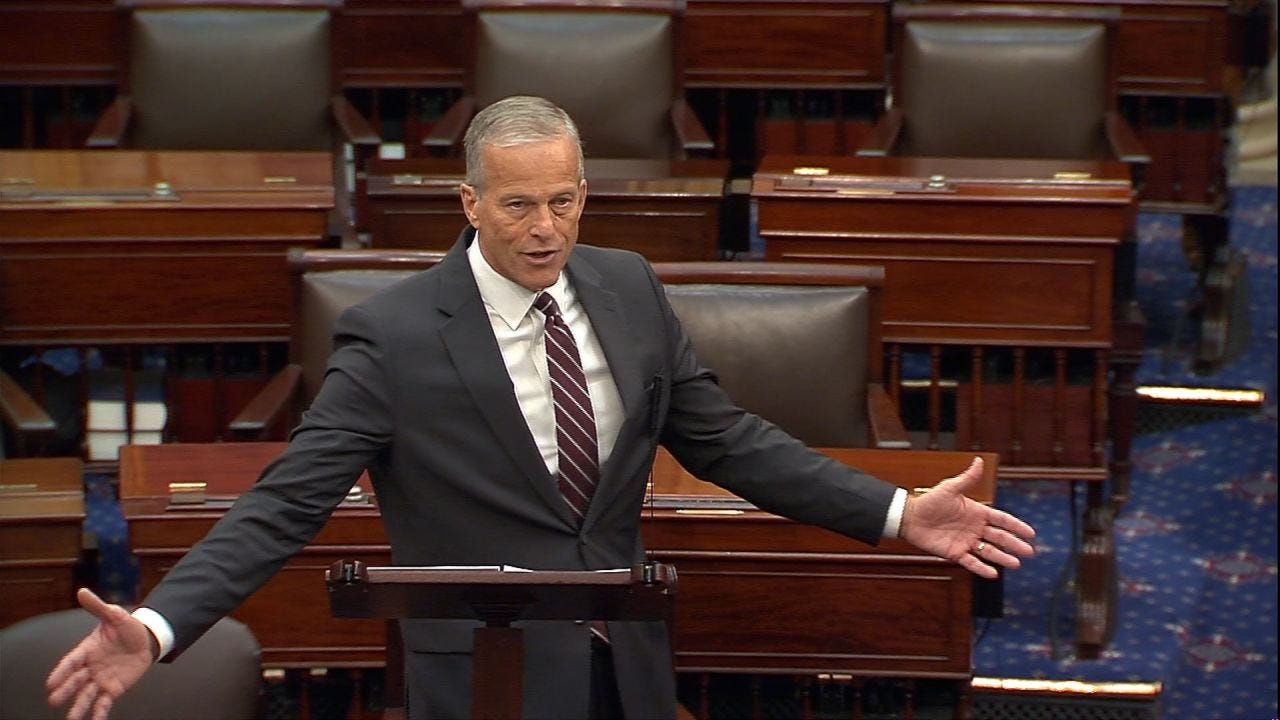
In theory, one really good way to do this is to create a spectacle on the floor via forcing a 24/7 talking filibuster, where you demonstrate your resolve, see if the other side is willing to counterbalance it, and hope to move the public politics your direction.
I think this is the only realistic hope for the SAVE Act talking filibuster proponents. That, of course, will fall short of anyone who thinks they are actually going to procedurally break the filibuster and get to a majority vote on the exact SAVE Act they have proposed.
Now, the current GOP strategy will not create the political attrition. What they are doing on the floor right now doesn’t look anything like an actual talking filibuster. They aren’t forcing Democrats to hold the floor; they aren’t keeping the Senate open for long hours or on the weekends; and they aren’t staying exclusively on the SAVE Act at the expense of other legislation. It looks more like the same-old 60-vote Senate than it does an attrition strategy.
I also think that the lack of appetite for demonstrating intensity among the GOP is partially because most GOP Senators don’t actually want a compromise here, or even a law. I think they want the issue in the Fall midterms. They know a law won’t actually do much if anything for voting security, and the issue might play well electorally with their base both before and after the election.
On the other hand, opponents of the SAVE Act have been ridiculing a get-on-the-bill-and-stay-on-it strategy, and that really annoys me. There’s a very procedure-oriented viewpoint out there that says “the talking filibuster can never succeed procedurally, so therefore it’s a bad idea politically” and I just don’t think that’s right.
It does a disservice to the Senate (and to legislative politics in general) when we take this attitude (I’m guilty of it at times). It undersells the public role of legislative politics, the price discovery aspect of the floor, and the role that effort, deliberation, and time play in forging compromises.
So, again, I don't think the SAVE Act is going anywhere via a talking filibuster strategy. But I bristle at the idea that proponents shouldn't try, and really bristle at the disdain people have for the idea of trying.
A few procedural notes:
This doesn’t look like a historical talking filibuster, in part, because Majority Leader Thune isn’t treating it as one. They have adjourned day to day, which resets the count of Rule XIX speeches each Senators can make. They have ended at relatively routine time each evening. He has filled the amendment tree on the bill, which has the effect of prohibiting Democratic amendments but also means the underlying bill can never be reach via attrition; the immediately pending question is a second-degree amendment on a motion to refer. They also have left the bill several times to consider other legislation—including several nominations. That’s fine—executive business doesn’t displace the SAVE Act, and even legislation that does isn’t a major problem—but it doesn’t keep any pressure on the SAVE Act.
Thune has also filed one cloture motion in relation to the bill—on a stripped-down voter-ID amendment. This was a political move to attack Democrats (including Minority Leader Schumer) who claimed to favor voter-ID. Interestingly, Thune had to take down most of the filled tree in order to get the voter-ID amendment attached. This took longer than you might think, for very-detailed procedural reasons. He had to get rid of the motion to refer before he could offer a second-degree amendment, but he had to table the motion to refer (instead of just withdraw it) because the yeas and nays had already been ordered on, because you can’t offer a second-degree amendment (to the motion to refer) until they have been ordered. Having fun yet?
The DHS Shutdown
Both the House and Senate approved legislation on Friday ending the DHS shutdown, which is now the longest shutdown in history. Unfortunately, they weren’t the same pieces of legislation.
At approximately 2:20am on Friday morning, the Senate passed by unanimous consent an amended version of H.R.7147, which contained a bipartisan compromise to provide appropriations for all DHS agencies except ICE and CBP, which can continue to operate on funds provided in the One Big Beautiful Bill.
This was transparently an attempt to jam the House; moments after passing the bill, the Senate adjourned by unanimous consent until April 13, with just four pro forma sessions between now and then. By passing the bill and leaving town, the Senate handed the House an up-down decision: accept our compromise, or leave DHS shut for another two weeks.
Senate leadership probably figured the House would capitulate, because (1) the lines at TSA at the airport are obviously giving Members serious political earfulls from constituents; (b) there was almost certainly a huge bipartisan majority in the House to pass the compromise; and (c) jamming the House is standard operating procedure in the Senate.
The House did not capitulate. Instead of putting the Senate compromise on the floor, Speaker Johnson and the GOP leadership put a two-month continuing resolution for all of DHS on the floor, which passed 213-203. Afterwards, the House adjourned under Speaker authority until April 13th, with only pro forma sessions until then.
Why did Speaker Johnson refuse to put the Senate compromise on the floor? Mostly because he was getting an earful from a sizeable percentage of his House GOP conference, many of whom were furious about the Senate deal.
This is a common problem for Speakers—being caught between a Senate deal that has the support of a majority (or even supermajority) of the House but significant opposition (or even majority opposition) within the majority party. It has seriously frustrated every GOP Speaker since 2010—Boehner, Ryan, McCarthy, and Johnson—and is arguably what brough each of the firs three down. Speakers need to maintain the backing of their conference, and it takes a lot of political capital to pass bills with the majority of your conference voting against them.
One question you might ask is why didn’t the supermajority in the House that favored the Senate compromise take action? They could have voted down the Speaker’s preferred legislation and made a play to substitute in the Senate deal.
One answer is that this is the essence of House politics. In the modern House, the Speaker almost always has a partisan majority that gives him this deferential backing to create a procedural coalition. That is, backbench members vote in lockstep on procedural matters such as what bills to consider and what rules to consider them under, even if they are opposed to the actual legislation.
They do this because the benefits they receive from the party, such as committee assignments, electoral support, and the help of other party members on bills they do like, outweigh the small costs of occasionally having bills on the floor they oppose. Bucking the party on procedural votes is a serious transgression.
Quite obviously, the House had the votes for either the Senate deal or for the Johnson House GOP alternative. But so long as his procedural coalition remained intact, Johnson had the choice of which one to put on the floor. His only concern was weighing the politics of the two options—substitute the two-month CR and leave DHS closed, or go with the Senate compromise and face the wrath of his caucus. He evidently saw the latter as the least-worst option. Anyone who says these are easy calls has never been in this sort of legislative box.
The DHS saga also brought back into the open the depth at which the House and Senate dislike each other at times. The vitriol being directed at the Senate by GOP House members during the day on Friday was not pretty. It wasn’t hard to identify the cause, either: a combination of substantive anger over the compromise mixed with the resentment of being jammed. From the point of view of a House Republican, all the Senate had done was shift the blame for the shutdown onto them, unless they adopted a plan they didn’t like. And they weren’t wrong.
A few procedural notes:
The House considered their DHS substitute as a self-executing rule. That is, the rule they passed did not structure a floor debate and deliberation over the DHS substitute amendment; instead, it literally directed that the amendment be adopted upon passage of the rule. This further protected Johnson from chicanery, since the only vote would be the procedural vote, where the norm of party unity under the procedural coalition is stronger.
The House had to overcome a clear procedural problem on Friday: in most cases, a rule reported from the Rules Committee needs to layover for a day before it can be considered on the House floor. Luckily, it has to layover for a legislative day, which is defined in the House as the period between adjournments. So the House simply adjourned for an hour, and when they came back into session, voila!, a new legislative day and the ability to take up the rule. They did, of course, have to actually start a new legislative day, and that meant saying he prayer, approving the journal, and saying the pledge of allegiance for a second time.
The Senate probably didn’t do themselves any favors by passing their compromise bill by unanimous consent. It left them open to the plausible (but wrong) charge by House opponents of the deal that the compromise didn’t actually have majority support in the Senate, but instead was pushed across the floor when Senators weren’t looking. And indeed, only five Senators were on the floor when the deal was passed by unanimous consent. But the plan had been hotlined—each Senate office was notified in case they wanted to object—and no one noticed their intention to object. But still, holding a roll call vote at 2:30am—or waiting until later Friday morning—that resulted in a 73-21 passage (or whatever) might have tipped the politics in the House.
The Senate adjourned for two weeks under a unanimous-consent agreement that prohibits any business from being conducted during the four pro forma sessions. But they have at least three ways they can break that agreement and get back into business-conducting session. First, by unanimous consent: any Senator can make a request at the pro forma sessions to modify the agreement, even the presiding officer. If no one objects, business can be conducted. Second, by agreement of the majority and minority leader. Under a standing order adopted in 2004, the leaders can jointly modify any adjournment order if necessary. Finally, the president can, in theory, call them back into session under the Constitution—even though they haven’t adjourned sine die.
One thing lurking behind all of this is the president’s announcement that he is going to pay TSA workers with DHS money from the One Big Beautiful Bill. This is an important piece of the politics here, but I’m going to wait until later in the week and fully discuss it on its own.
A common thread: the disembodied Senate
One thing that the politics of the SAVE Act and the DHS appropriations together is what I call the disembodied Senate. This is the phenomenon in which Senators observe what is going on in the Senate, marvel at or lament what is going on in the Senate, but seem completely unaware that they have any agency whatsoever to affect what is going on in the Senate.
This was on full display today with Senator Lee (R-UT):


What Senator Lee would like is for someone to go down to the Senate floor during one of the pro forma sessions this week, get recognized by the presiding officer, and make a unanimous consent request to either (a) modify the unanimous consent order governing the two-week adjournment so the Senate can return and consider the House DHS bill; or (b) simply pass the House DHS bill by unanimous consent.
It’s a hell of a thing to observe but not do, given that any Senator can unilaterally attempt to do it. But we see this all the time in the Senate. I don’t mean to pick on Lee here—this is a problem in the entire Senate, and he’s far from the worst offender—but the same problem is afflicting him on the SAVE Act. He spent weeks demanding Thune do something—try to bring the SAVE Act to the floor—than any Senator can unilaterally try to do. Just go down there and make a motion to proceed!
Underlying this problem is both a rational and irrational feature of Senate game theory. The rational feature is that there are benefits to being a team-player and precious little that you can do if everyone else hates you and refuses to work with you. And so rocking the boat by objecting the UCs that everyone else wants and making rogue motions to proceed to legislation that will probably fail can get you a bad reputation and create real costs. By complaining on social media and not actually being a pain in the ass, you can get some political points without fully pissing everyone off.
But it’s also true that if you just do things in Congress, they have to deal with you. Yes, you have to be judicious in your exercise of power, but at some point you have to try to exercise that power, if you care about the outcomes. So many Senators are locked into the team play theory of the Senate that they’ve created a self-fulfilling prophecy. Nothing happens in the Senate until the majority and minority leader forge a compromise, because no one tries to do anything until the majority and minority leader forge a compromise.
All Roads Lead to Reconciliation
Of course, the other thing that unites the SAVE Act and the DHS approps are the increasing number of Members who are looking toward the reconciliation process as a mechanism to pass them into law.
The reconciliation process is setup under the Budget Act as a mechanism for the House and Senate to quickly adopt legislation to, well, reconcile the budget. Like raise taxes or cut mandatory spending programs. It works because it provides time limits on debate on the Senate, which means it’s not possible to filibuster a reconciliation bill, which means you can easily get to a final passage majority vote.
Of course, for quite some time now, parties have found clever ways to use the reconciliation process not the cut spending or raise taxes, but to pass party-line legislation, even in ways that explodes the budget rather than reconciles it. Many of the most important laws of the 21st century were reconciliation bills: the 2009 stimulus; Obamacare; the Tax Cuts and Jobs Act (Trump I tax cuts); the American Rescue Plan; the Inflation Reduction Act; and the One Big Beautiful Bill.
Two general limits have existed on reconciliation up until recently. First, the Byrd Rule, which prohibits legislation in reconciliation bills that isn’t substantially budget-related. Second, reconciliation bills have traditionally not contained discretionary annual appropriations. But we have seen extensive use of reconciliation for discretionary appropriations in both the Inflation Reduction Act and the One Big Beautiful Bill—which contains the DHS money that is funding CBP and ICE right now, as well as the money the president is claiming he can use to pay TSA starting this week. And the Byrd rule is ever under attack in the Senate by those looking to stretch it to accommodate their ideas.
This week, we’ve seen both the SAVE Act and DHS appropriations come up as potentially included in a second-reconciliation bill this year. I’m with James Wallner that the SAVE Act could only be shoehorned into the Byrd rule by essentially destroying the Byrd rule and opening the floodgates on what can go in reconciliation bills. That will probably keep people from succeeding if they try. On the discretionary appropriations, I don’t see much hope in stopping the trend, and I think we are entering a period where the annual appropriations ride on a dual-track during unified governments—bipartisan compromises in the regular process, and majority-party plus-ups for partisan-coded agencies in the reconciliation bills.