Dear Friends,
Here are some things I found worth reading and pondering this week, with quick comments by me on each.
1.Gabe Fleisher, DOGE’s Final Failure.
As always, it’s a lot easier to say you are going to budget-cut than it is to get Congress to actually cut spending. Not only did DOGE not cut its goal of $2 trillion (that was always laughable), but government spending increased in 2025. And rather than enacting Trump’s proposed budget cuts, Congress ignored them and increased total discretionary spending in FY26. One big-picture takeaway here is that both Trump and his adversaries have strong incentives to overstate the effect he is having on policy. Trump wants you to believe he is massively reshaping the federal government…and the Democrats want you to believe the same thing. See also Yuval Levin here.
Another takeaway is, as always, if you want any durability for your policies, you have to get them into law. Unilateral executive action looks ferocious, but it’s mostly a weak substitute for getting what you want from Congress. Note that the only durable DOGE cuts were to USAID and public broadcasting, and those were done via statutory recission, in Congress, which the administration has now ruled out trying again. Everything else is mostly a sandcastle waiting to collapse. At least on spending. Trump has been more successful in reshaping the federal workforce. What a leaner, somewhat-less-professionalized civil service means absent cuts to resources, however, it’s quite clear. Matt Grossman muses here.
2.Matt Yglesias, AI Progress Is Giving Me Writer’s Block.
I must confess, I have felt this viscerally teaching undergraduate public policy. In some basic sense, no medium or long-term policy matters until we either navigate the transition to artificial general intelligence (AGI) or realize it’s not actually going to happen on the 3-6 year time horizon so many futurists and Silicon Valley types are now expecting. And to the degree AGI is its own existential-level crisis—economic or literal—its perceived proximity means it should/will be prioritized. And so existential issues with time-horizons one order of magnitude longer—like climate change—seem relatively unimportant to focus on.
Of course, maybe this is all overblown, and AI is either not coming any time soon, or will be less disruptive than people think. Watching and experiencing the transformation from LLMs to AI agents has made me bullish on rapid progress and associated economic dislocations, but it’s super easy to over-index on stuff like this as soon as you start investigating it. But I don’t really buy friction arguments that AGI will take time (years?) to filter through society; adoption of AI is fast, not slow. And the political opposition built on economic dislocation may be countered by medical breakthroughs that make breakneck advancement more popular (and rational) than currently predicted.
3.Nate Silver, Will AI Terminate Democracy?
I must confess that I find this entire genre of political theory hard to wrap my head around, there’s just so many angles from which to consider it. And I spend a lot of time thinking about democracy. One strategy prior to prediction is to just try to organize the various strands to build a general taxonomy of how AI might impact politics:
Altering political conflict. This is everything from new problems (AGI-induced unemployment, privacy concerns, rights and liability of agents) and new classes of policy (AGI taxation, universal basic income) to new coalitions/parties (anti/pro tech divides, physical/ knowledge labor classes) to natural questions about the public/private nature of AGI in society (public utility? state-owned? privatized?). In essence, AGI as a policy issue and an object of politics.
Altering power dynamics. This includes traditional corporate concerns—would this new technology concentrate wealth among a new economic elite, or expand the economic inequality gap in American society—but also libertarian concerns about the surveillance state and futurist concerns about AGI as an independent political actor itself. AGI as a disruptor of the underlying scaffolding of civil society in a liberal democracy.
Altering the democratic process. This would include everything from the explosion of information that could inform voters and policymakers or mislead them, the impact of AI systems actually making government decisions, and the integrity of elections in a world of AI manipulation tools. Essentially, AGI as a transformer of politics that raises questions of democratic resilience.
Altering the state/citizen relationship. What happens in a world of runaway abundance not produced by human labor? Authoritarian regimes might find it easier than ever to survive, untethered from the need for humans to fuel economic productivity or warmaking capacity, and more capable than ever of population control. Democratic regimes responding to popular opinion might become hopelessly inefficient in comparison, and tend toward authoritarian policies. This is the true sci-fi shit.
Related: Noah Smith You Are No Longer The Smartest Type Of Thing on Earth and this episode of the Dwarkesh podcast with Anthropic CEO Dario Amodei.
4.Andrew Barber, On Leaving Professional Poker.
Should be of general interest. Poker is both a more normal job than most people think, and still a very weird one. One of the weird aspects that Andrew neglects here is that there is literally no friction to entry, or exit. No capital investment, no regulatory hurdles. No hiring process. As the famous saying goes, “a professional poker player is anyone who says they are a professional poker player.” You can be truly self-employed, unencumbered by any interpersonal relationships. At least in theory. This makes it easier to do all sorts of things that don’t really work in other industries, like sorta-quitting a dozen times and coming back to it a dozen more, without much if any career penalty.
See also: Brad Owen getting disillusioned with the ever-maturing poker industry.
5.Kevin Kosar, What’s Wrong With Congress? and Helping Students See Congress is Not Gridlocked.
Count me on team Congress-Is-Taking-Too-Much-Shit-Right-Now. I’m certainly a believer that Congress has given away too much power to the executive and should reclaim some of it (see next few items below) but the idea that Congress is impotent or doing nothing is cartoon-caricature silly. When it’s not busy completely ignoring the administration and setting federal spending levels, the secret congress is busy passing all sorts of important legislation. Some of the disconnect is partisan incentives to food fight for the public, some of it is partisan incentives to hype executive dominance, and some of it is lazy elite and populist punditry in the long tradition of hating Congress when it’s actually losing that people hate.
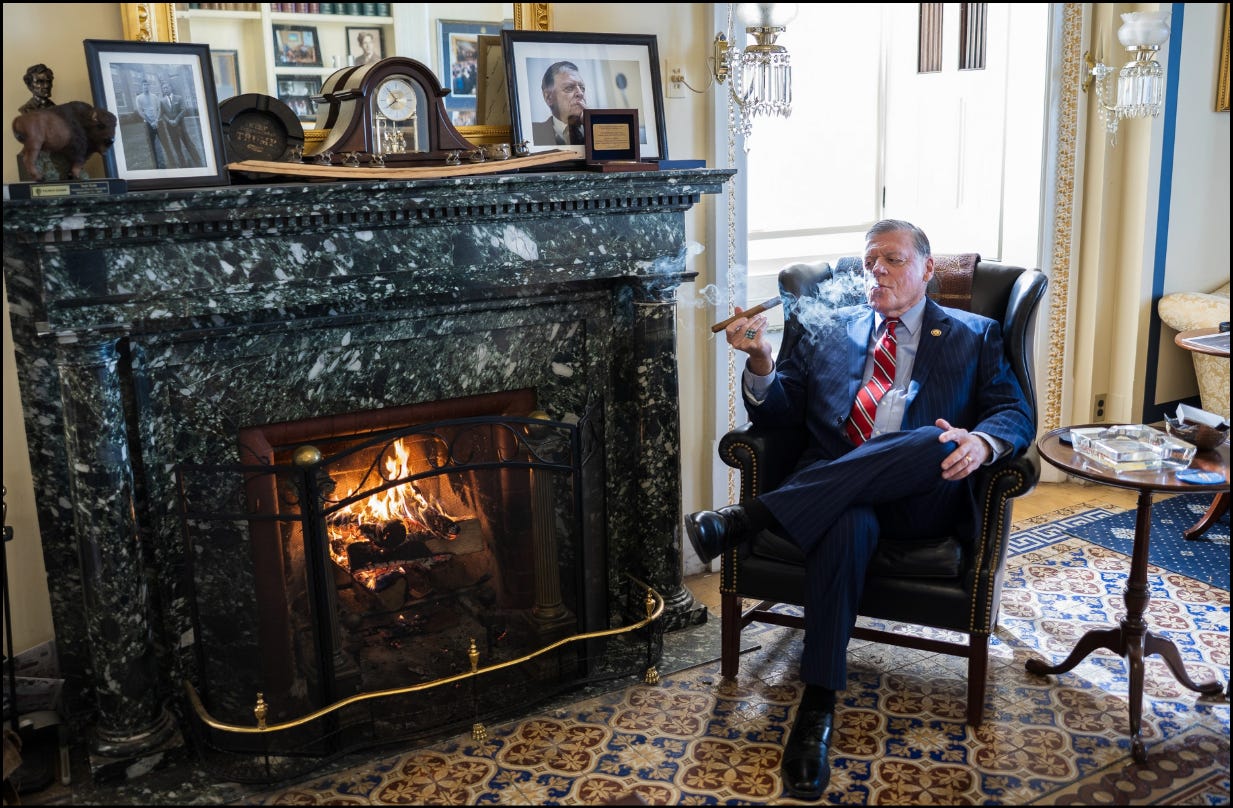
See also: a profile of Tom Cole. There was a normal appropriations process! Things sometimes work.
6.The Economist, The Crummiest Job in Washington.
One thing that is definitely wrong with Congress is that the job sucks. Especially in the House, and especially if you actually want to make policy. I was talking to a retiring 4-term Member I ran into on the Hill after the ‘24 election and he straight-up said to me, “Coming here was the worst decision of my life.” It’s not hard to understand why: you have almost no power, you spend all your time raising money, there are more death threats than ever, and everyone hates you. And so policy-types are quickly being replaced by party soldiers who don’t mind any of that.
I honestly have no idea why someone looking to make a policy impact would want to be in the House of Representatives at this point. Endless mind-numbing electoral politics that never stops, just to get 1/435 of the legislative power in one half of the legislature. Just go run for school board or mayor. Such a better ratio of good you can do to bullshit you have to put up with. And there’s evidence all of this is scaring people off from Congress.
See also: How a Congressional Office Actually Works.
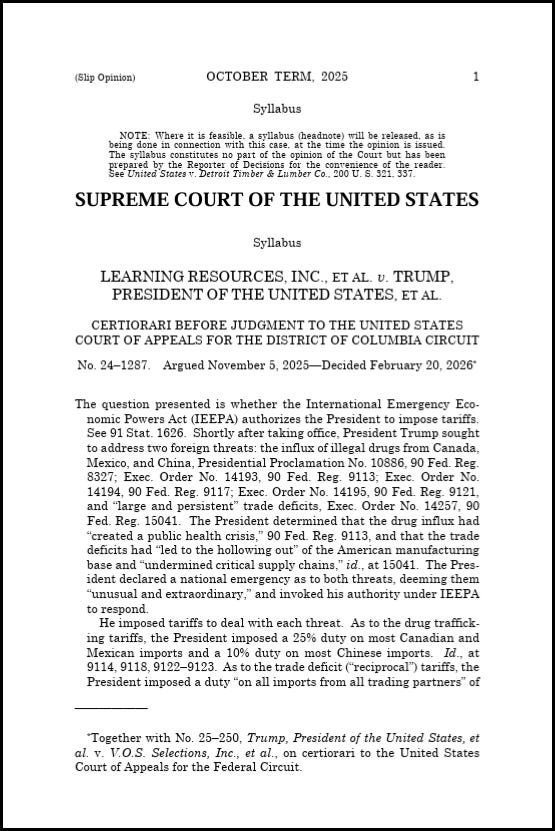
7.The Supreme Court decision on Trump’s tariffs.
I very much enjoyed Jack Goldsmith’s immediate reaction to, and analysis of the decision, and I agree that what we are seeing here is the Roberts’ Court solidifying the dual philosophical idea of a unitary executive that is very tightly vertically integrated in terms of presidential control of the executive branch, but well out over-its-skis in terms of creative use of statutory power granted by Congress. That’s probably good news for Democrats who figured the Court was just a front for GOP politics, but bad news for those same Democrats interested in governance via creative executive branch problem solving.
The most interesting concurrence—and the one everyone is talking about—is the Gorsuch one. To me, the most significant feature of it is that Justice Gorsuch is actually grappling with the so-called ratcheting-up problem, in which Congress can give the executive a power by bare majority, but can only undo it with a supermajority (because the president will veto the repeal). The Court has usually just left the legislative process as a given and said stuff like “Congress can always repeal this stuff if they don’t like it,” but here Justice Gorsuch is acknowledging both that such repeals are unrealistic on their own terms and that the imbalance of the ratcheting-up problem is an actual constitutional feature worth accounting for.
Some of this problem is of the Court’s own making. For generations, Congress had a perfectly good solution to the ratcheting-up problem: the legislative veto, which let Congress grant the president authority but retain the right to veto any individual use of that authority with a bare majority vote in Congress. The Court ruled that it was unconstitutional in 1983. One way to think about the contemporary drive toward a major-questions doctrine for the legislative branch is the Court grappling with the mess they made in the wake of the demise of the legislative veto. Indeed, the IEEPA power Trump used to impose the tariffs contained a legislative veto. And this is the real rub of the ratcheting-up problem: we are talking about a presidential authority contained in a statute Congress never passed in its current form; it’s essentially a product of a Court’s decisions. But I’m going to write much more about this later this week.
See also: Illya Somin on the decision.
8.Related: Trump’s press conference and wild policy reaction to the Supreme Court decision.
The obvious political victory for Trump in this spot is to just give up on the tariffs while going full-populist by blasting the Court as a bunch of elites standing in the way of good policy. Then he gets rid of a bad policy in practice, while retaining the benefit of it as a political weapon. He’s certainly railing against the Court, but he seems unable to let go of the tariffs, and now he’s looking around for ever-more-tenuous ways to continue them. As Liam Donovan likes to say, Trump’s superpower is his ability to claim victory in any circumstance—see, for example, the ICE withdrawal from Minnesota—even when he has been completely defeated. That seems to be failing him here, because there’s no clean way to claim actual victory.
One thing I know is a dead-end is Congress. There’s a majority in both chambers against at least some of the tariffs. A ton of GOP Members are happy the Court struck them down, and wish Trump would just let it go. And the prospect of getting the GOP to raise taxes by law in an election year is just pure folly.
9.Related: Ross Douthat advice to the administration.
This is obviously a smart list, but also totally at odds with Trump's instincts, brand, political style, and substantive politics. For better or worse, he's built on governance as spectacle and politics as zero-sum warfare. Mostly worse, but in any case not going to change.
In addition, the administration seems to be totally done with its legislative agenda. They’ve more or less ruled out a second reconciliation bill, and the White House doesn’t even seem to have any policy proposals. Some of this is normal sixth-year-of-a-presidency stuff, where the juice is just gone; most presidents turn to foreign policy at this point in their second term. But one would excuse Republicans for thinking a unified government might do more durable policy change.
10.This snowfall chart.
Three takeaways. First, the DC metro area is in an absolutely horrible spot for competent policy on dealing with snow. Far enough north that there will be a major storm not infrequently, but too far south for it to make sense to commit the resources necessary to adequately deal with major storms in any way other than a complete shitshow. The end result is frustration and misery.
Second, I grew up in Upstate NY but never really internalized just how unusual the situation is up there. It’s essentially the only place in the country where major cities are located in the three worst snowfall zones. Indeed, Syracuse, Rochester, and Buffalo are the three snowiest major urban centers in the country, and the cities in Michigan and Wisconsin benefit from being on the west side of the Great Lakes and aren’t hit hard by the lake-effect storms.
Third, I had no idea it ever really snowed in Arizona or New Mexico.

11.The Boys of ‘80 documentary about the Miracle on Ice hockey team.
Highly recommended. They do a great job of balancing contemporary interviews with these now-70-something men and footage of them as 20-something roughly-college-age boys. It didn’t help that my kids pointed out they would be in their 60s if we went that long again without winning the Olympic tournament.
Watching the gold-medal game yesterday, I was reminded of one reason I always particularly loved college/Olympic hockey: the one-and-done nature of the tournaments creates both the possibility of a Miracle on Ice—there’s simply no way we beat the Soviets in an NHL-style 7-game series—and makes every game maximally critical.
That’s both obvious and underappreciated. Hockey is a high-variance sport, and both the U.S. and Canada were arguably lucky to have made it to the gold-medal game, each surviving prior near-losses in the knockout round. As much as the NHL playoffs are the greatest sporting event in the world, Olympic hockey is arguably even more terrifying to watch.
Everything produced about the 1980 team always centers it around the malaise of late 70’s American economic and Cold War troubles. It’s weird to imagine the future documentaries produced about the 2026 team being set against the backdrop of partisan and political discontent of our age, and it makes me rethink a lot of the received wisdom about the role the ‘80 team played in reviving national pride.
12.Related: Capital One Arena getting a truly awful makeover.
The general trend in converting stadiums into high-end corporate experiences at the expense of raucous fan zones continues, and it’s not good for people who actually enjoy live sports. And this plan for Capital One Arena in DC is egregious even conditional on the general trajectory of things. As soon as someone says “vertical transportation” to describe an escalator and “curated culinary experience” to describe eating at a hockey game, you know for sure they’ve completely lost the plot. There are going to be seven different types of luxury seating in the new “Halo” level of premium seats, and I don’t think I can name seven different ways to sit at a hockey game. I honestly wonder if one of them is going to be a faux-authentic set of wood bleachers like we used to sit on at college games at Union, presumably for 25x the price.
.jpg)
The sad thing is that I’ve already noticed a downgrade in the game-day hockey fan experience at the arena. The crowd is quieter. There are strangely empty seats in the most high-valued locations. You see more people barely paying attention. My biggest worry, however, is that Ted Leonsis has misjudged the market. DC is a very dangerous place for an overpriced hockey product that isn’t winning. The Caps have been unusually good in the Ovechkin era, but that’s coming to an end. Miss the playoffs for a few years, and that arena is going to resemble an empty warehouse on game-night. This isn’t Michigan; there’s a fair-weather fandom here and a bottom to the supply of hockey goodwill. Doubly-so if your arena feels like a cruise-ship, and has prices that correspond.

13.Ezra Klein interviews White House reporters Ashly Parker and Michael Scherer.
Interesting throughout, and not pretty. The main takeaway remains that the White House still has no traditional information flow or policy process of any sort. As a governing entity, it just becomes chaos, with all the resulting policy mess in the executive departments and agencies: airspace is closed and then abruptly reopened, TSA shuts off Precheck and then turns it back on, tariffs are adjusted daily, hospital ships are weirdly sent to Greenland, DHS seems to be one big power struggle between incompetent factions. There just doesn’t seem to be an interagency process, or much coordination at all.
Unlike Trump’s first term, there also don’t seem to be any adults in the room. Instead, it’s a bunch of placating the president’s tornado style, and tolerating the resulting chaos. But that leaves open large questions of how much the president is actually delegating and how much individual operators are just freelancing behind his back. The Klein interview posits Trump as sort of just making decisions while he watches TV; you don’t need a policy process when the boss makes all his decisions instantly by gut instinct. It also saves a lot of meeting time.
14.Related: maybe competence matters?
In my view, partisans underrate competence, and even more generally underate governing. In the partisan mind, the policy is either good or bad, and that’s mostly a function of it as an abstract idea, not as an implemented policy. Removing all of the nuance of implementation conveniently helps transform policy into ideology, and makes electoral and legislative determination a higher virtue than flexibility and pragmatic problem-solving. This is also why some partisans prefer to talk about Congress. Legislation is more abstract than implementation.
The issue is that most folks aren’t partisan enough to care about ideology over outcomes, and outcomes—rather than ideology—are the realm of both governing competency and a sizable fraction of public approval. Partisans can certainly work to change this; one good way to square the circle is to create more hardcore partisans. But it’s not nearly enough. No one cares if you have a great election slogan or pass your bill. In the end, all you can do to please voters is change the material conditions of the country. If you can’t govern your way to that, you’re left just hoping the economy does it for you.
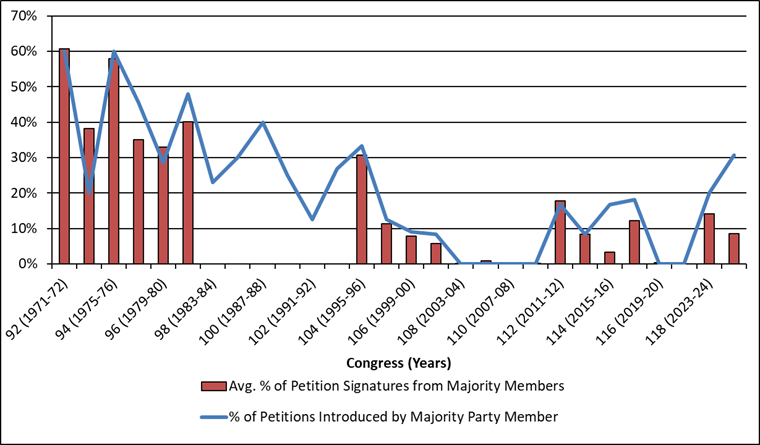
15.Matt Green on the rise of the discharge petition in the House.
We had gone decades in Congress at one point without a discharge petition—the formal mechanism where a rogue majority in the House can set the agenda without the support of the partisan majority leadership—successfully being used to move legislation. Leaders hated them and threatened to punish majority party Members who signed them. They were essentially signaling tools of the minority and maybe some renegade mavericks. Now they are back in force, being used left and right to move bills.
Some of this is the lack of a procedural majority in the House, and the resulting chaos. Neither Speaker Johnson or former Speaker McCarthy have been able to secure the deference from their party necessary to dictate the agenda. Everyone is contesting it—from the House Freedom Caucus on the right to the moderates in the middle. Combine that with a narrow majority and an ideologically stretched conference and weak leader, and there’s a lot of people deciding they are going to block the agenda. And that’s given rise to a culture of dissidence, especially as the Speaker has given up on trying to punish people and has accepted his plight. Once you normalize blocking the leadership agenda, it’s not a huge leap to trying to substitute your own agenda. The Freedom Caucus may be content with not doing things, but the GOP moderates have substantive policy demands.
One question you might ask here is why the discharge petition has become the preferred vehicle of malcontent expression in the House. At first glance, it doesn’t make a lot of sense. It’s slow. You have to gather the support for it publicly, forcing Members to take a stand against leadership before they know they are going to get any payoff. Why not just plan in secret and hijack the floor by voting down the previous question on a rule? Then you can set whatever agenda you want, instantly. My guess is that the slow, public nature of the discharge petition is actually a virtue. It’s essentially a commitment device. Once you get people to sign it, they’ve already publicly bucked the leadership. The hard political lift is done. So you don’t have to worry about cold feet and people bailing on your secret plan to hijack the agenda via defeat of the previous question.
16.The talking filibuster continues to be, well, talked about.
This coincides with the SAVE America Act now having 50 cosponsors in the Senate, meaning a filibuster (rather than a lack of votes) is plausibly now the thing holding back its passage. Impressively, Representative Roy put out a memo that gets the procedures correct. None of this changes the reality that breaking a filibuster by making the minority talk is an extremely difficult prospect. It’s not clear it has ever been successfully accomplished.
Forcing a talking filibuster has generally been used for spectacle purposes, to signal intensity (on both sides) and perhaps shift the public politics of an issue. That’s why it might still happen here. I don’t think Majority Leader Thune or the other Senate Republicans are under any illusion they could actually break the Democrats over this, but many Republicans—especially those that won’t have to answer quorum calls at 2 a.m.—probably think the PR value of such an exercise might yield electoral or public opinion fruit.
But starting a talking filibuster—much like starting a shutdown—raises the more-difficult question of how you end it. There aren’t a lot of obvious face-saving ways for the majority to just give up on the Senate floor and, sunk-cost fallacy aside, the logic of throwing in the towel might look worse to Trump and others as time goes on, given how much the appearance of looking weak weighs on their political calculations. I suspect this is one thing holding a lot of Senate Republicans back. Unless you do some cringe-worthy stunt like announcing ahead of time how long you are going to force the minority to talk before you give up, the open-ended nature of the exercise raises the stakes on your eventual inevitable capitulation.
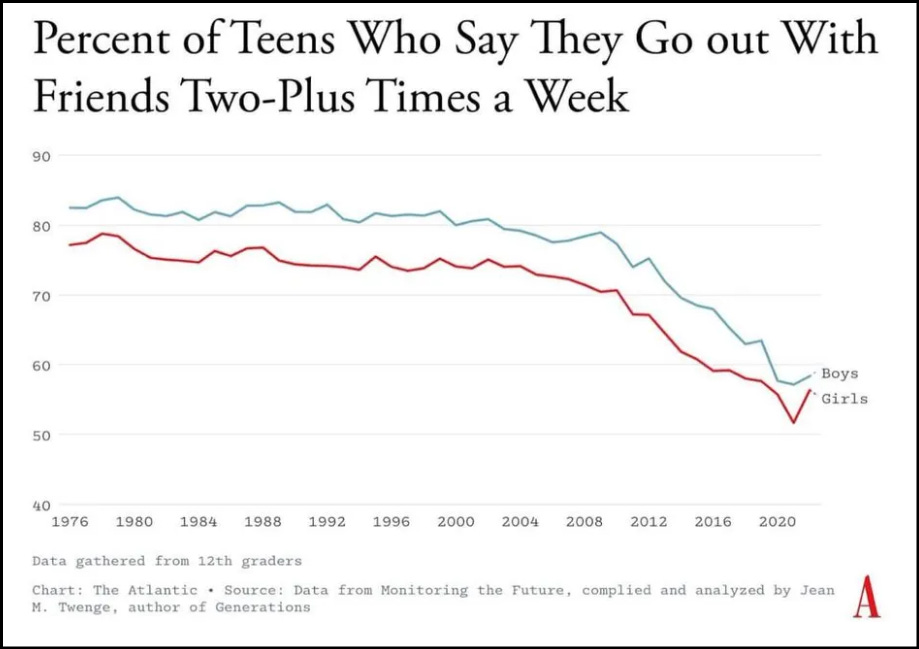
17.Teens stopped going out.
The decline in hanging-out in-person in groups has been well-documented, and is actually a pretty longstanding trend in America that was well-documented at least back to Bowling Alone, which captured at a minimum the amazing civic and social community built by the World War II generation and its subsequent decline among Baby Boomers and GenX.
But the wholesale substitution of online coordination and interaction in the 21st century seems qualitatively different, or at least feels scarier as an adult observing teenagers. And it’s not just hanging out. Teens stopped dating. And drinking. I’m hard-pressed to even understand the social world of the modern teenagers, and I live with three of them.
Whatever you make of that, my niche view is that people—all people, not just teenagers—don’t host enough, which I think of as fundamentally different from going somewhere with people. I know a lot of people who are uptight about having people over to their home, but I really can’t think of anything that is easier and makes people happier than being with people they know in a private setting.
Some of the problem is people make too much of it. You don’t have to clean your house, you don’t have to serve fancy food. You don’t have to plan it three weeks ahead of time. Just invite people over. Maybe for a card game. Maybe to watch a sports event. Maybe literally to just hang out. My guess is you’ll be shocked at how receptive people are.